The Working Poor

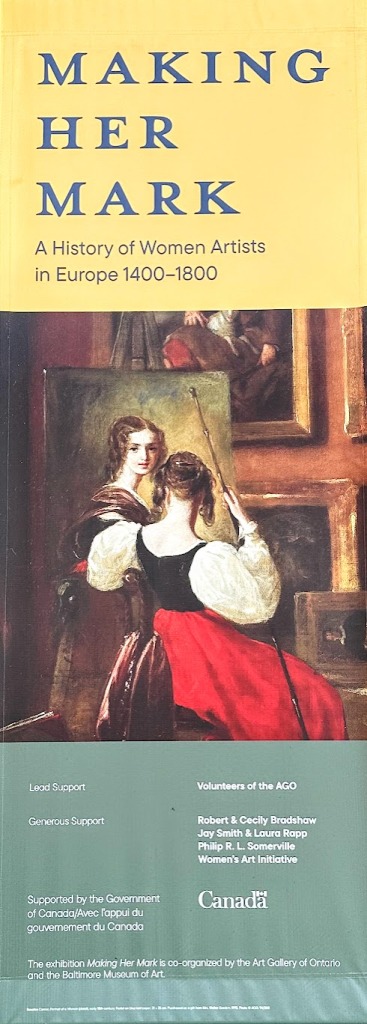
Welcome back to another instalment of Making Her Mark! I’m joined by Rebecca Budd, curator of Chasing Art to discuss how the poor were documented, by female artists.

Resa Welcome back, Rebecca! As you point out in your introduction, times were changing. Do you have a main take away from your research?

Rebecca – Thank you for the opportunity to participate in this amazing look back into art history, Resa. One key takeaway from my research is how Geertruydt Roghman, Catherine Brandinn, and Maria Louisa Catherine Cecilia Cosway used their artwork to honour the ordinary moments of life. I was inspired by how these artists challenged societal norms and created space for the voices of the underrepresented.

Resa We’ve had many amazing sisters. Well, let’s have a look at these 3, with art as our window.

16th Century

In the sixteenth century, change was in the air. Northern Europe witnessed a significant cultural shift as the Protestant movement emerged, challenging the established norms of the Catholic Church. This movement advocated for a personal connection with God, eliminating the need for church intercession.

Art responded. Religious imagery became less prominent, as the focus shifted away from traditional depictions of saints and biblical scenes. This transference in artistic focus not only reflects the broader societal changes brought about by the Protestant Reformation but also underscores the importance of recognizing the value of everyday experiences in art.

17th and 18th Century

During the 17th and 18th centuries, the art world was dominated by the portrayal of aristocracy and religious themes, leaving little room for the representation of ordinary people. The prevailing social hierarchy and the patronage system dictated that artists primarily catered to wealthy patrons who commissioned works that glorified their status and achievements. This resulted in a paucity of artworks focusing on the lives and experiences of the common populace, who were often relegated to the background of grand historical or mythological scenes.

Geertruydt Roghman

Dutch – 1625 – 1657

Geetruydt Roghman was born in Amsterdam into a family steeped in artistic tradition. Her upbringing in a creative household, with a father who was an engraver and a great uncle who was a celebrated painter, likely influenced her perspective on art.

A Pioneering Figure

Artists began to explore new themes that reflected the everyday lives of individuals, leading to a rich tapestry of subjects that resonated with the public. Geetruydt Roghman dedicated her work to depicting ordinary women engaged in their daily tasks. Her series not only showcased the realities of their lives but also contributed to a broader understanding of women’s roles in society during the seventeenth century.

Despite her limited output, Geetruydt Roghman’s work offers a glimpse into the lives of women, challenging the norms of her time and highlighting the importance of their stories. This marks her as a pioneering figure in a time when few artists chose to highlight the experiences of women. .

Celebrating Geetruydt Roghman’s Art

Exploring Geetruydt Roghman’s engravings on paper allows us to connect with the essence of humanity, as they capture the nuances of everyday life and the stories of real people who lived before us. These sketches serve as a mirror reflecting our shared experiences, emotions, and struggles, reminding us of the beauty found in simplicity.
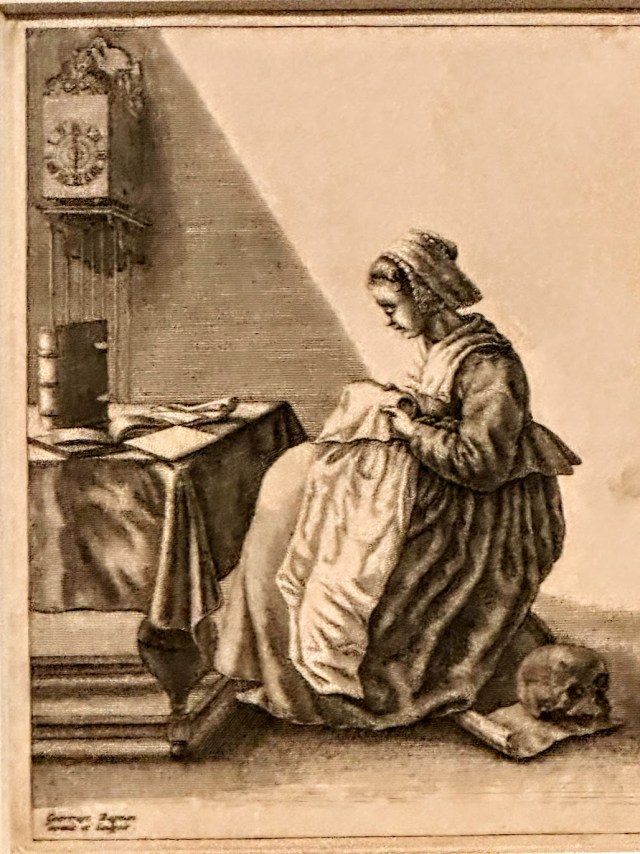
By exploring Geetruydt Roghman’s work, we gain understanding into diverse cultures and perspectives, fostering empathy and understanding in a world that often overlooks the significance of the ordinary. Such examination not only celebrates the artist’s talent but also encourages us to appreciate the richness of human existence in all its forms.

I believe that Geetruydt Roghman invites us to appreciate the beauty and significance of the ordinary, enriching the narrative of art history.

“Making Her Mark” exhibition encourages a reevaluation of her work, which advocates for the recognition of everyday life as a worthy subject of artistic exploration.

Note how small these engravings on paper are. They are in 8 x 10 frames.

Counter clockwise from the top: Young Girl Sewing – The Dressmakers – Woman Spinning

1640 – 1647

Resa Amazing art history, Rebecca. Now, on to Catherine Brandinn! You had some difficulty gathering information about her. For a while it looked like all we were going to have to remember her by was her art. Then you discovered Johann Christian Brand‘s name appears alongside herswhich seems to muddy the waters. Do you think this is another case of the disenfranchisement of women in the arts?

Rebecca – I was fascinated by the connection between Catherine Brandinn and Johann Christian Brand, which highlights the complex interplay of gender and recognition in the art world. Without question, Catherine Brandinn’s artistic legacy has often been overshadowed by the presence of Johann Christian Brand, whose name frequently appears alongside hers.

This phenomenon raises important questions about the historical disenfranchisement of women in the arts. The association of Johann with Catherine could suggest a similar pattern, where her identity and artistic achievements are overshadowed by his prominence.

However, I believe that there may be another explanation. Consider that Johann Christian Brand’s recognition may have been a means of validating Catherine’s work. In a time when female artists struggled for acknowledgment, the inclusion of a well-known male figure could lend credibility to her art. Consequently, while Johann’s association with Catherine may complicate her legacy, it could also provide a platform for her art to gain the recognition it deserves.

Resa You make a good point how difficult it was for women to be recognized in the arts. We may never know of Johann Christian Brand’s intent. However, her art is remembering her, not him.

Catherine Brandinn

Austrian? 18th century

The history of painting has predominantly celebrated the lives of the elite and significant events, often neglecting the stories of ordinary people. This selective representation raises questions about the value placed on different experiences and the narratives that have shaped our understanding of the past. The absence of everyday moments in art suggests a hierarchy of importance, where only the lives of the wealthy and powerful are deemed worthy of immortalization on canvas.

If painters had chosen to depict ordinary moments, our historical narrative would be richer and more inclusive. Imagine a world where scenes of daily life, community gatherings, and simple joys were captured alongside royal portraits and grand battles. Such representations would not only provide a more comprehensive view of society but also highlight the shared human experience, fostering a deeper connection to our collective history.

The transition in art from religious themes and the portrayal of affluent patrons to the representation of ordinary people began during the Renaissance and continued into the Baroque period. This shift marked a significant change in the subject matter of paintings, as artists started to explore the lives of the common man, and the beauty found in everyday activities. The rise of humanism encouraged artists to focus on individual experiences and emotions, leading to a more relatable and accessible form of art that resonated with a broader audience.

Catherine Brandinn portrayed ordinary people, capturing the essence of everyday life through her unique artistic lens. Her work often reflects a deep appreciation for the beauty found in the mundane, showcasing individuals engaged in daily activities. Her name is intricately linked to artist, Johann Christian Brand. This connection raises questions about her identity and the role this artist played in her life. When the artwork of Catherine Brandinn is viewed, Johann Christian’s name often appears alongside hers, suggesting that her narrative is largely defined through her relationship with this artist. This intertwining of identities hints at a deeper story waiting to be uncovered.

Catherine Brandinn’s painting, “Mädel mit Waldholz (Peasant Girl Carrying Wood),” created in 1775, captures a poignant moment in rural life. The artwork portrays a young peasant girl, her delicate frame burdened by a large bundle of wood, symbolizing the labour and resilience of women in agrarian societies. Catherine Brandinn’s use of soft colours in her engravings on paper evokes a sense of warmth and intimacy, inviting us to appreciate the girl’s strength and determination amidst her modest surroundings. The composition of the painting draws attention to the girl’s expression, which reflects a mixture of pride and fatigue.

“Mädel mit Waldholz” stands as a testament to the often-overlooked contributions of women in history. By focusing on the everyday tasks of a peasant girl, Catherine Brandinn elevates her subject to a figure of dignity and importance. This image encourages us to reflect on the narratives of those who have historically been marginalized in the art world and society at large.

ResaSo Rebecca, we move on to Maria Louisa Catherine Cecilia Cosway.  You mentioned that in researching Maria Louisa Cosway, you saw lots of her artwork, but not this one particular work Home Industrythat showed at “Making Her Mark”Do you think I’m crazy to think that we have something special here?

Rebecca – I don’t think you’re crazy at all, Resa. I am beyond thrilled that you were able to capture Home Industry in a photo. You have an amazing ability to find art treasures wherever you go!! Home Industry” is a gem!!

Maria Louisa Catherine Cecilia Cosway

English – 1760 – 1838

Maria Louisa Catherine Cecilia Cosway, an accomplished artist of the late 18th and early 19th centuries, was known for her diverse portfolio that included both prominent figures and ordinary individuals. Born in 1760 in Florence, Italy, she moved to England where she became a prominent portrait painter. Her ability to portray significant historical figures speaks to her talent and the esteem in which she was held in artistic circles.

A Progressive Artist

Maria Cosway’s artistry extended beyond the elite, as she sought to represent the lives of everyday people in her work. This inclination towards inclusivity allowed her to bridge the gap between different social classes, showcasing the beauty and dignity of ordinary life. Through her artwork, she celebrated the humanity of her subjects, making her art accessible and relatable to a broader audience. This commitment to portraying a diverse array of individuals marked her as a progressive artist for her time.

Home Industry tells a story of resilience and the quiet strength found within the home, serving as a reminder of the essential work that occurs beyond the public eye. Through her portrayal, she elevates the mundane to the extraordinary, encouraging us to recognize and honour the stories woven into the tapestry of domestic labour. It is a nostalgic reminder of a time when craftsmanship flourished within the domestic sphere, emphasizing the value of handmade goods and the skills passed down through generations.

Home Industry (1800) Pen and Ink Wash

We are invited to reflect on the importance of labour in a rapidly changing world and consider the implications of progress on the cultural fabric of society. During the late 18th and early 19th centuries, when Maria Cosway created this piece, the landscape of work was undergoing significant transformation due to the onset of industrialization.

Cottage industries, which had long been a staple of rural economies, faced increasing threats from mechanization and factory production.

This piece tells the story of a specific moment in time, evoking a narrative about the challenges faced by families during the industrial revolution. As industrialization encroached upon traditional ways of life, this artwork stands as a testament to the resilience of home-based labourers.
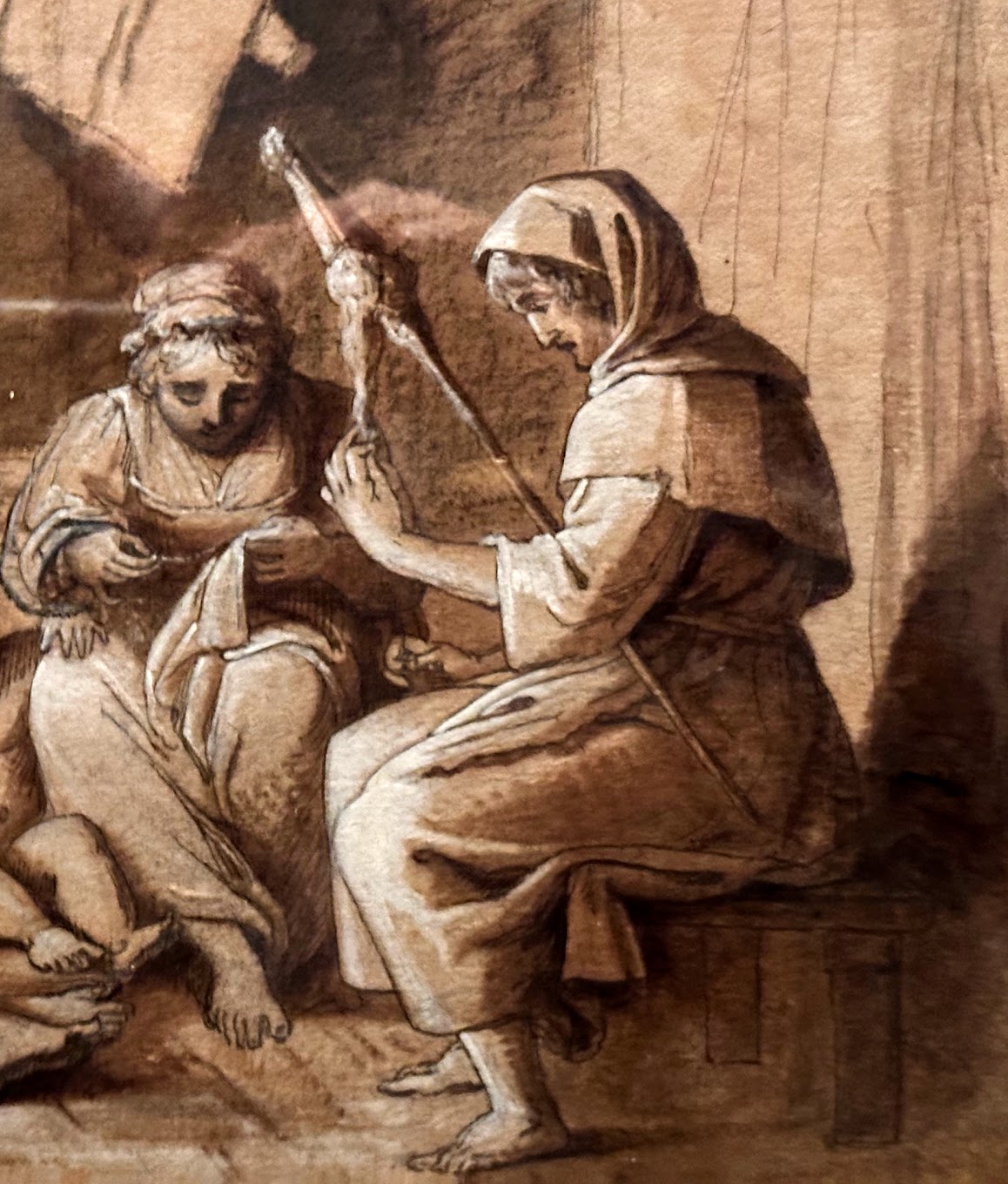
Home Industry also speaks to our time in history and is a relevant reflection on the balance between innovation and tradition.

Resa – Wow! Thank you Rebecca! Your co-hosting here on the “Making Her Mark” series has made it a much richer experience. Still, there’s lots to go. May I be allowed to try and tempt you to co-host another time, no rush, just sometime in the future? I have some juicy topics and artists I can present to you!

Rebecca– Hi Resa! Thank you so much for your kind words! I’ve truly enjoyed co-hosting the “Making Her Mark” series with you, and I would love to collaborate again in the future. Your topics and artist suggestions sound exciting, and I can’t wait to hear more about them. Let’s definitely keep the conversation going!

Resa – Yahoo! You know Rebecca, we might just be artoholics!

Click on above banner for source information!

Photos taken by & © Resa McConaghy – May 14, 2024

Art Gallery of Ontario, Toronto, Canada

Making Her Mark – Self Portraits VI

Welcome to the final instalment of Making Her Mark – Self Portraits. I’m here with Rebecca Budd, curator of Chasing Art. 

Resa – So, Rebecca, in this last Self Portraits post, we are headed to the Netherlands, 17th centuryto visit another artist that I had never heard of. Had you heard of Judith Leyster before this post?

Rebecca – Yes – just recently. I discovered her when I travelled virtually to the Rijksmuseum. Judith Leyster was featured in their Women of the Rijksmuseum exhibit two years ago. It was an eye-opening experience to discover her work.

ResaVery Cool, I’m excited to se what you’ve dug up!

Once Forgotten Dutch Master

Judith Leyster, the once-forgotten Dutch master, has experienced a resurgence in recognition. She was commemorated in a  Google Doodle, her artwork achieved higher- than-expected prices at auction, and she was featured in the most prestigious chamber of the Rijksmuseum.

Who Was Judith Leyster

A remarkable Dutch painter of the 17th century, Judith Leyster was born 1609, in Haarlem, Netherlands. The daughter of a brewer, she displayed a precocious talent for painting from a young age.

By the age of 24, Leyster had achieved the remarkable feat of becoming a member of the Haarlem painters’ guild, marking her official recognition as a masterful artist. She was one of the rare professional women painters of her time, being one of only two women accepted as a master in Haarlem’s painters’ guild during the entire 17th century Netherlands.

Leyster’s artistic talent quickly gained recognition, and she became known for her lively and expressive compositions, often depicting genre scenes, portraits, and still life paintings. Her work radiated a sense of spontaneity and skillful use of light and shadow, showcasing her technical prowess and innovative approach to painting.

Leyster’s artistic pursuits defied conventions, as she ventured beyond the typical subject matter embraced by Dutch painters of her time. Her work encompassed a diverse range, and she was among the pioneering artists who explored and popularized the domestic genre scene, portraying everyday life with a fresh perspective.

In the early 1630s, before her marriage to the lesser-known artist Jan Miense Moleanaer, Leyster produced some of her most significant works. However, despite her talent and dedication to her craft, her contributions to art history remained largely unrecognized until the late 19th century.

Judith Leyster Rediscovered

The rediscovery of Leyster’s significance in the art world came about during a lawsuit between an art dealer and his vendor.

It was revealed that many works attributed to her contemporary and rumoured rival, the great Dutch painter Frans Hals, were, in fact, Leyster’s creations that had been incorrectly credited. This significant discovery brought long-overdue attention to Leyster’s remarkable talent and her influential role in shaping the Dutch Golden Age of art.

It is remarkable how the true authorship of artworks can be uncovered through careful examination and historical investigation. The discovery of Leyster’s initials hidden beneath a faked signature of Frans Hals in “The Happy Couple” (aka The Carousing Couple) serves as a testament to her enduring impact on art history and the need for ongoing reassessment of attributions.

This revelation not only sheds light on Leyster’s artistic contribution but also prompts a re-evaluation of artworks attributed to her contemporaries. It further underscores the significance of ongoing research in uncovering the often overlooked achievements of pioneering artists.

Resa – When searching for other female artists from the past whose art has been misattributed, I found an intriguing article (July/2024) in  Daily Art Magazine. The article cites 5 female artists.

“This systematic misattribution essentially meant the erasure of women from the art historical canon, which eventually resulted in their erasure from history itself.”

Rebecca, do you think it’s possible that as art experts and historians uncover yet more misattributed art that we could see some famous paintings by famous artists, the Rembrandts, Da Vincis, et al being reattributed to women?

Rebecca – You have asked a very insightful question, Resa! It’s certainly possible. As more art is studied works that have been misattributed may be finally recognized as contributions of women artists. It would be a significant shift in how we view art history. I truly believe that we are now embarking on an extraordinary exploration of art history. It gives me great comfort that we are seeking to foster a richer and more equitable understanding of the artistic legacy we inherit. I am glad that you mentioned the Daily Art Magazine. It is one of my go-to places to learn about art.

Judith Leyster’s Self Portrait: A Glimpse into the Artist’s World

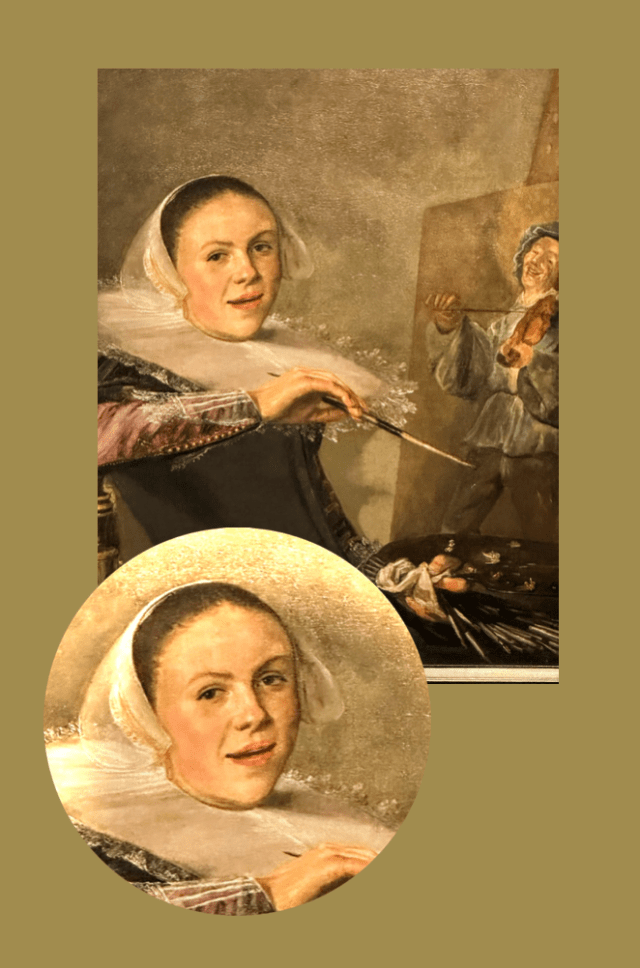
Judith Leyster’s self-portrait offers a glimpse into her life and artistry. Created before her admission to the guild in 1633, the portrait encapsulates a moment of confident creativity and engagement. Leyster’s self-assured expression, characterized by a confident smile and parted lips as if to speak, exudes a sense of self-assurance and mastery. The casual pose, with one arm nonchalantly resting on the back of her chair, hints at the artist’s ease and comfort in her own studio.

It is difficult to photograph art. I captured many works beautifully. However, this painting was the finale of the show, and was heavily lit with warm light. 

Shot on an angle, the lighting was evaded, and it seems to be closer to many photos of it. Still, it seems no 2 photos are the same.
Photos in this post © Resa McConaghy

The liveliness and freedom evident in Leyster’s brushwork mirror her spirited approach to art, capturing a fleeting pause in her work as she glances toward a potential visitor. This subtle interaction suggests a moment of connection with a viewer, possibly a patron, inviting them to share in the experience of a work in progress.

In this self-portrait, Judith Leyster not only presents herself as a skilled artist but also provides a glimpse into the vibrant and dynamic world of creativity that she inhabited.

Today, Judith Leyster is celebrated for her creative spirit, artistic innovation, and lasting impact on the history of art. Her legacy continues to inspire and engage art enthusiasts and scholars around the world.

Resa – Well, Rebecca, so ends our series on Self Portraits. It’s been a pleasure and an honour having you here with me. Thank You!

I look forward to your return, to discuss some engravings on paper by Catherine Brandinn and Geertruydt Roghman. These are of utmost interest as the images depict the working poor, not a big subject of artists in those times.

Rebecca – Thank you, Resa! It has truly been a privilege to explore these amazing women through “Making her Mark” with you. Your photographs allowed me to virtually experience the joy of viewing these paintings. Thank you for celebrating and honouring these artists. Their resilience and creativity continue to inspire and empower us today, even as they provide a vital legacy for future generations of women in the arts.

I’m eagerly anticipating our next discussion on the engravings by Catherine Brandinn and Geertruydt Roghman, as the portrayal of the working poor offers a unique and important perspective that, I believe, deserves more attention in the art world.

As you say so eloquently, “Art Remembers Us.”

Click on X to see research links & a fabulous video on her

Making Her Mark – Self Portraits V

Welcome back to discovering another female artist from the past, with co-host Rebecca Budd, curator of Chasing Art! 

Resa – So, Rebecca we travel back to the 1600’s Netherlands and find this amazing woman, Anna Maria van Schurman. Are you dizzy from our time travel globe trotting, and your research homework, yet?

Rebecca – Our journey back to the 1600s in the Netherlands was nothing short of extraordinary. Meeting Anna Maria Van Schurman, a remarkable figure of her time, left a lasting impression on me. Her intellect and artistry were truly inspiring, and I felt privileged to witness the world through her eyes. Resa, you orchestrated this incredible adventure, taking me on a whirlwind exploration of history and culture. I am deeply grateful for the memories created during this remarkable experience.

Resa – Aw, thank you Rebecca! Without further ado, here is Anna Maria van Schurman.

“No Pride or Beauty”

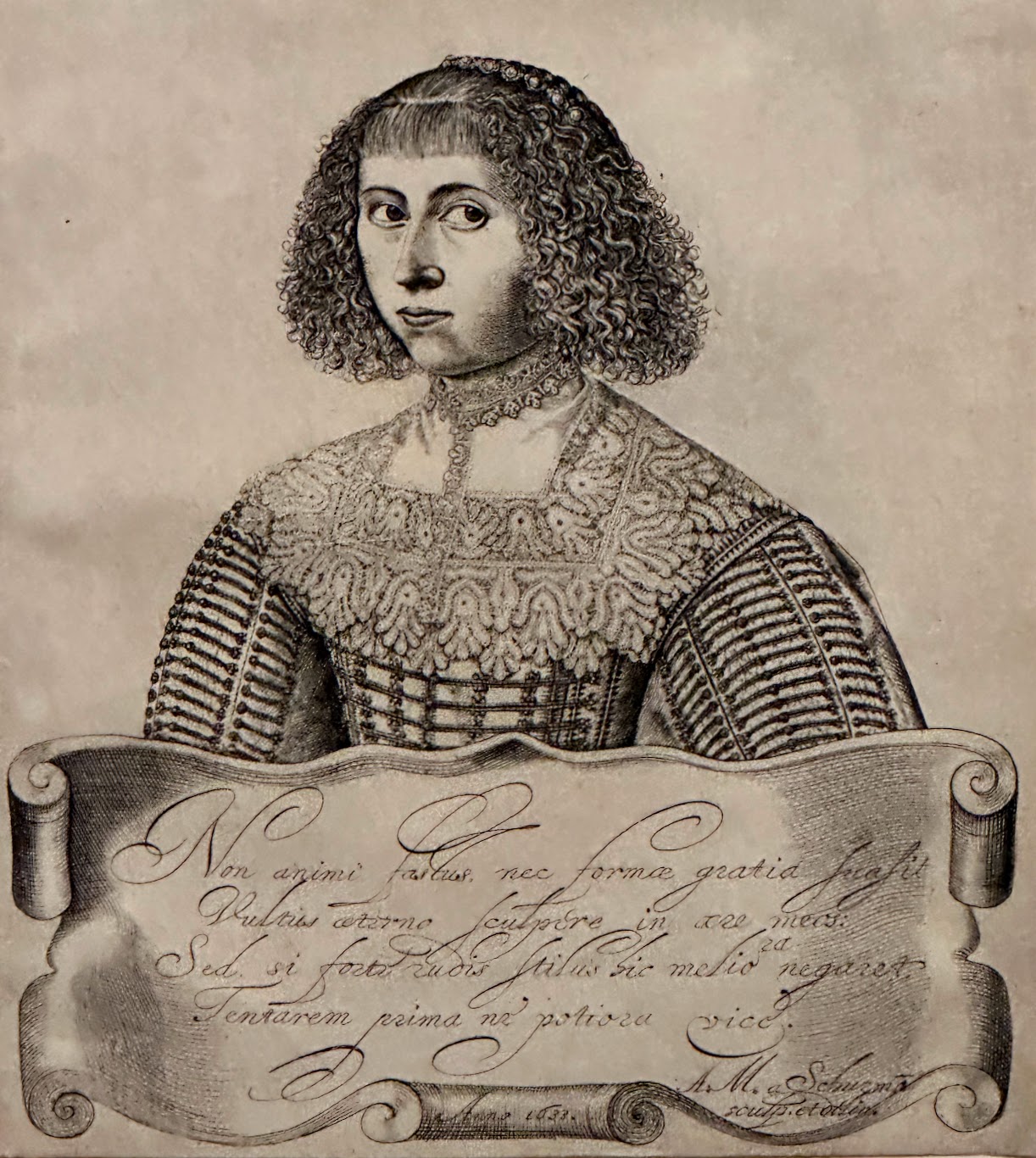
Anna Maria van Schurman (November 5, 1607 – May 4, 1678) was a remarkable figure in Dutch history, known for her diverse talents and her advocacy for female education. She was a painter, engraver, poet, classical scholar, philosopher, and feminist writer. She is best remembered for her exceptional learning and her defence of female education.

With outstanding proficiency in multiple disciplines, including art, music, and literature, Van Schurman’s remarkable intellect and dedication to learning set her apart. She left a lasting legacy as the first woman to unofficially study at a Dutch university.

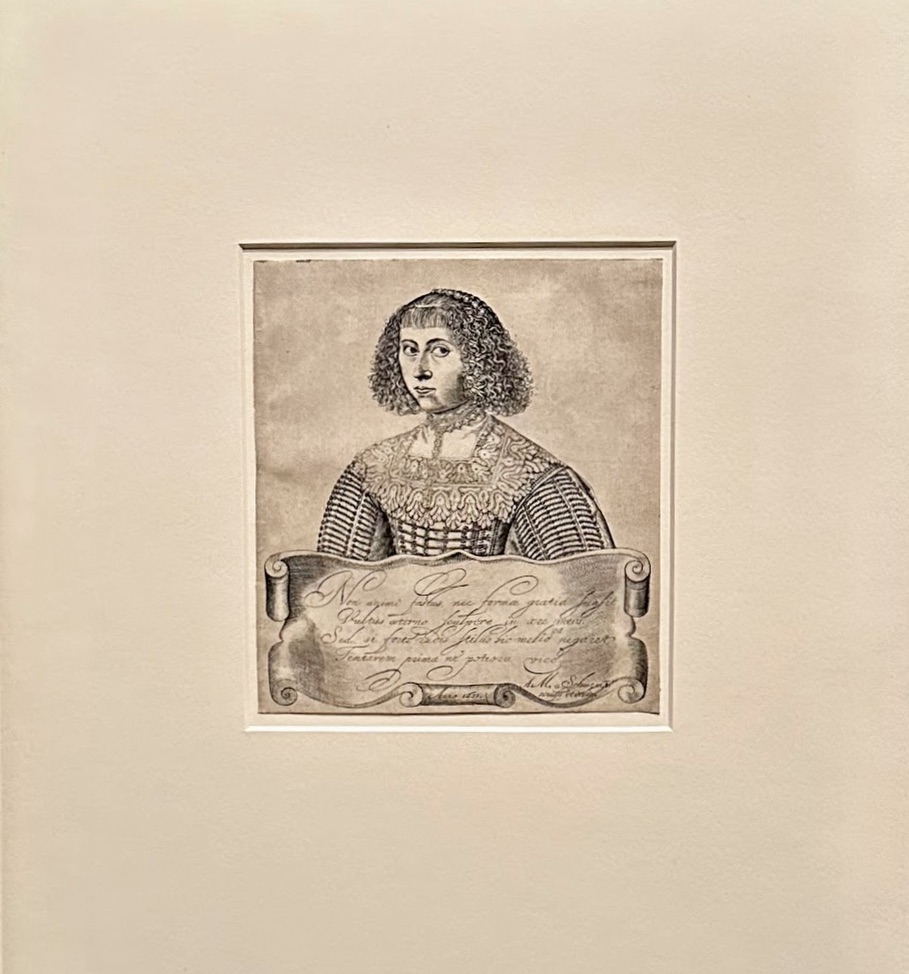
Self Portrait – Age 33 years
No pride or beauty prompted me
to engrave my features in eternal copper;
But if my unpractised graver was not yet capable of producing good work,
I would not risk a more weighty task the first time.


Education and Achievements

Anna Maria van Schurman received a strong classical education from her father, establishing herself as a child prodigy. By the age of seven, she demonstrated exceptional proficiency in reading and translating Latin and Greek. Impressively, by age eleven, she had also acquired proficiency in German, French, Hebrew, English, Spanish, and Italian. Furthermore, she delved into the study of art, ultimately becoming a distinguished artist in the disciplines of drawing, painting, and etching, albeit with few surviving examples of her artwork.

Following her years of fervent advocacy for women’s education, van Schurman was finally extended an invitation to attend the University of Utrecht at the age of 29, marking a significant milestone as the first female student. However, her presence in the university was subject to the stipulation that she conceal herself behind a curtain during classes, a measure taken to prevent any potential distraction for her male counterparts. Despite these challenges, she graduated with a degree in law, consequently becoming the first female to achieve this educational feat.

A polyglot adept in fourteen languages, her linguistic abilities encompassed Latin, Ancient Greek, Biblical Hebrew, Arabic, Syriac, Aramaic, Ethiopic, as well as various contemporary European languages.


Van Schurman’s journey exemplifies her relentless pursuit of knowledge and her groundbreaking contributions to female education.

Professional engraver Magdalena van de Passe taught Anna the art of engraving.

In an 8 x 10 frame next to a 6 X 8 frame in the AGO, one can see how tiny the self portrait is.

Advocacy for Female Education and Intellectual Contributions

Anna Maria van Schurman’s unwavering commitment to advocating for female education and her active participation in intellectual discourse significantly contributed to the advancement of women’s rights and intellectual equality in the Dutch historical context.

One way Anna Maria van Schurman advocated for equal education for women, was through her prolific writings during the 1640s and 50s. In her notable work “Whether the Study of Letters is Fitting for a Christian Woman,” published in 1646, she passionately argued for the educational rights of women, upholding that individuals with aptitude and principles should have the opportunity to pursue learning. She ardently believed in the importance of women receiving comprehensive education across all subjects, provided that it did not impede their responsibilities within the domestic sphere.

Resa – Were you surprised to get an email, while working on this post, with a link to Anna van Schurman’s book The Learned Maid (1659)? I know I sure was.

Rebecca – It was indeed a surprise, Resa! I read that Anna van Schurman’s “The Learned Maid, or, Whether a Maid may be a Scholar” emerged from her extensive correspondence with theologians and scholars throughout Europe, focusing on the crucial topic of women’s education. She argues that educating women not only enriches their lives but also benefits society as a whole! I was astonished by Anna’s progressive stand in a time when women’s education was often discouraged. To state boldly that knowledge is not limited by gender was a courageous endeavour.

Click on the book to read it, photographed page by page!

Notably, van Schurman actively engaged in the dissemination of articles elucidating the intellectual equality between men and women, countering the prevalent notion that women were solely suited for roles as wives and mothers. Her contributions to contemporary intellectual discourse were expansive, involving exchanges with influential cultural figures such as philosopher René Descartes, philosopher  Marin Mersenne, and writer Constantin Huygens  . These interactions further solidified her influential presence within the intellectual circles of her time.

Later Life and Involvement with Labadism

Toward the end of her life, Anna Maria van Schurman became involved in a contemplative religious sect founded by the Jesuit Jean de Labadie known as Labadism. This mystic offshoot of Catholicism preached the significance of communal property and included the directive to raise children communally. Van Schurman, deeply involved in the sect, became de Labadie’s primary assistant and journeyed with the sect as it traveled. Her association with de Labadie facilitated the publication of her final book “Eucleria,” in 1673, which is considered one of the most comprehensive explanations of Labadism.

Her engagement in Labadism at the later stage of her life showcased her continued pursuit of spiritual and intellectual endeavours, further enriching her diverse legacy.

Resa  I’d never heard of Labadism, until this article. Interestingly, Van Schurman refers to herself as “that incomparable Virgin” on the opening page of “The Learned Maid”Do you find it odd that such a scholar would join up with a religious offshoot? It sounds like a cult.

Rebecca – That is a very good question, Resa! In her 60s, Anna van Schurman became a prominent figure among the Labadists, a religious group that emerged in the 17th century, characterized by their communal living and strict adherence to a mystical interpretation of Christianity.

While some critics labeled the Labadists as a cult due to their unconventional beliefs and practices, including their rejection of mainstream religious authority and emphasis on personal revelation, supporters viewed them as a genuine spiritual community seeking to live out their faith in a more profound way. The debate over their classification often hinges on the definitions of cult versus legitimate religious movement, reflecting broader societal attitudes towards alternative spiritual paths.

ResaRebecca, thank you, thank you for joining me in this series on self-portraits from the MHM exhibition!

Rebecca – This has been a marvellous series, Resa. Your innovative approach entices us all to enter the“rabbit hole”of creativity. When we go back to honour artists, we give honour to our time. And when we give honour to the “now”, we become more creative and give our voice to the future.

Click on the above banner to see Rebecca’s research links!

You can also listen to Rebecca and her guest on her podcasts!

Photos taken by © Resa – May 14, 2024

Art Gallery of Ontario, Toronto, Canada
Making Her Mark – Self Portraits IV

Welcome back everyone! Today Rebecca Budd curator of Chasing Art  and I are going to present and discuss the 18th century artist, Anne Guéret!

Resa – Rebecca, how wonderful to have you back! I know it is believed that this is a self portrait of Anne Guéret but no one can verify it. Still, I have included it in this series. I hope you are good with that?

Rebecca – I am delighted that you have included Anne Guéret’s Portrait of an Artist with a Portfolio, Resa! This painting revolutionized the portrayal of women artists. I believe that it is an essential addition to your “MHM”* series.

Resa – Well, let’s get to everything you found out!

Mlle Guéret the Younger

Anne Guéret (1760–1805), also known as Mlle Guéret the Younger, was a notable French painter who was active at the end of the 18th century and the beginning of the 19th century. Despite being orphaned as a child, she and her sister Louise Catherine Guéret were fortunate to be adopted by the renowned dramatist and librettist Michel-Jean Sedaine.

His act of adoption not only provided the sisters with a stable upbringing but also served as a catalyst for their artistic pursuits, shaping their future as prominent figures in the art world of the late 18th and early 19th centuries. Under Sedaine’s care, they were introduced to esteemed painters Henri-Pierre Danloux and Jacques-Louis David, who provided them with valuable art lessons.

Salon Debut

Anne Guéret’s debut at the Salon in 1793 marked the beginning of her successful exhibition career. She continued to showcase her work in Salons until 1801, focusing primarily on presenting portraits of notable individuals. Her dedication to portraying prominent figures through her artwork and her lasting impression on the cultural heritage of France have solidified her status as a noteworthy figure in art history.

Portrait of an Artist with a Portfolio”

Resa – This particular “Salon” she first showed at is very famous. I’m just hearing about it now, and I think other female artists of the era presented there?

Rebecca – Indeed, they did! The Salon aka Paris Salon had its debut in 1667. It was the official art exhibition of the Académie des Beaux-Arts in Paris. Between 1748 and 1890, it was arguably the greatest annual or biennial art event in the Western world. The Salon played a significant role in the exhibition and recognition of artists during the 18th and 19th centuries.

While the official inclusion of women artists in the Salon was a gradual process, it did eventually provide opportunities for them to exhibit their paintings. Contemporaries of Anne Guéret, Anne Vallayer-Coster and Adélaïde Labille-Guiard, also participated in the Salon. Their contribution marked progressive attitudes towards women artists during that period.

Portrait of an Artist with a Portfolio

Anne Guéret’s “Portrait of an Artist with a Portfolio” was prominently displayed at the Salon of 1793, marking a significant moment in her exhibition career.

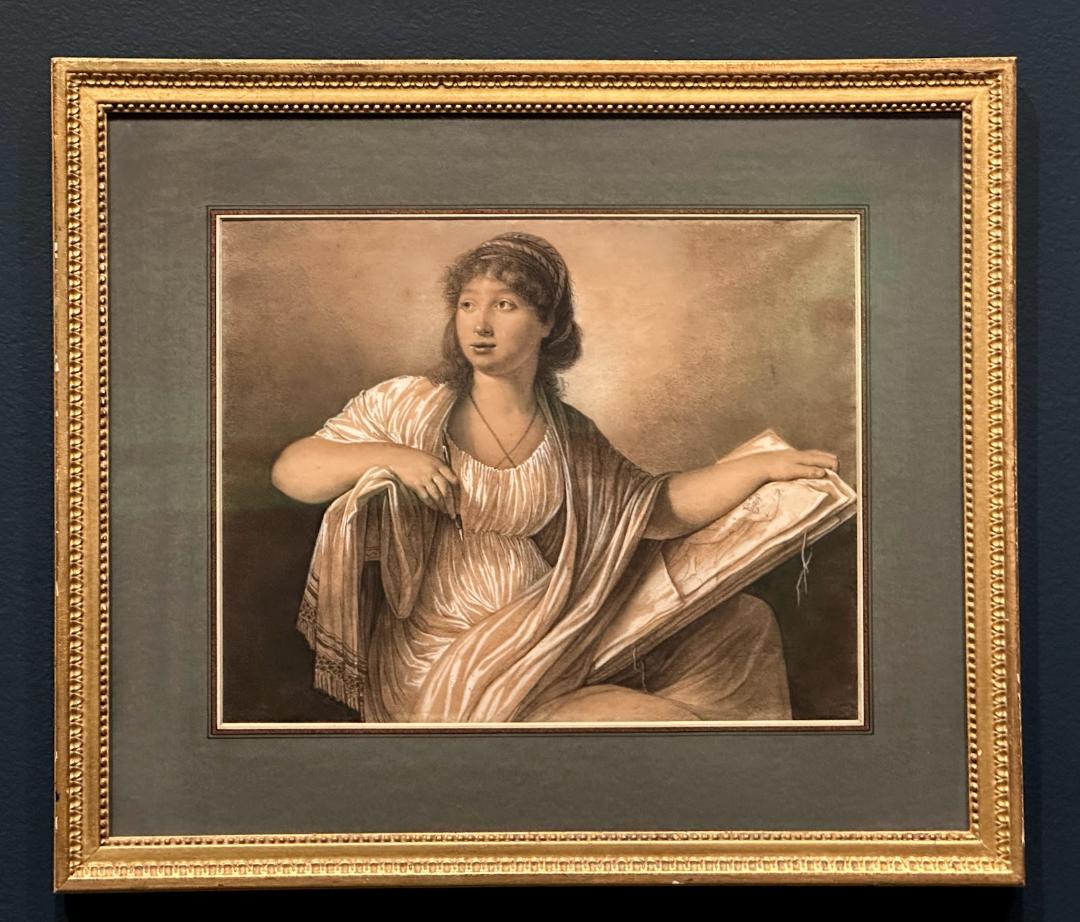
From a 21st-century perspective, the portrait of a young woman drawing by Anne Guéret (possibly a self-portrait) may appear unremarkable at first glance. However, upon closer examination, it represents a significant turning point in the history of women artists in Europe.

Click on pic to better see the nude drawing

The depiction of the seated woman drawing a nude male figure, albeit likely from a print or sculpture rather than a live model, signifies a progressive shift in attitudes towards women artists in the late 18th century.

Resa – Yes, the nude figure is remarkable for that era. Very few women dared.

Rebecca – According to historical records and analysis, Anne Guéret was not the first woman artist to paint a nude figure. Previous female artists, including Artemisia Gentileschi and Lavinia Fontana, portrayed nude figures in their artwork.

However, Anne Guéret positioned herself drawing a nude male figure, which holds significance in the context of late 18th-century art. Anne Guéret’s choice to depict herself engaging in this subject matter challenged traditional gender roles, contributed to the evolving status and recognition of women artists and carries symbolic weight to the changing perception of women artists during that era.

This remarkable piece of artwork, executed with black chalk, stumping, pen, grey ink, and grey wash on buff paper, measures 320 x 404 mm (12 5/8 x 15 7/8 in.) and reflects Anne Guéret’s distinctive artistic style and technical versatility.

The Evolving Status and Recognition of Women Artists

Anne Guéret’s relatively limited body of work available to us today can be attributed to several factors. As a female artist during the late 18th and early 19th centuries, she faced societal and institutional barriers that restricted her artistic opportunities and recognition. The historical context of the French Revolution and its aftermath created a turbulent environment that may have impacted the production and preservation of her artwork.

These combined factors may have contributed to the scarcity of paintings attributed to Anne Guéret. Despite the scarcity of paintings attributed to her, Anne Guéret’s enduring impact and revolutionary artistic vision continue to inspire and enrich the cultural heritage of France and Europe.

Anne Guéret’s indelible mark on the art world of the late 18th and early 19th centuries transcends the limitations she faced as a female artist during that era. Her dedication to her craft and the symbolic weight carried by her artworks serve as a testament to the evolving status and recognition of women artists.

Currently held in a private collection in France, this portrait serves as a monument to Anne Guéret’s enduring impact on the art world of the late 18th century.

Resa – I’m so glad we’ve shared this portrait by Anne Guéret, especially since so little of her art survived.

Rebecca – Resa, thank you for the invitation to join you on “MHM” series of posts. This experience has truly been a transformative journey of self-discovery for me. Anne Guéret challenges us to embrace boldness in our creative pursuits, urging us to push boundaries and explore new possibilities without fear of failure. Her message serves as a powerful reminder to step outside comfort zones and unleash creativity without reservation.

For Rebecca’s research links not included in the text, click on the above banner.

You can also visit Rebecca in her Reading Room!

Photos of Portrait of an Artist with a Portfolio taken by © Resa McConaghy – May, 2024

Art Gallery of Ontario – Toronto, Canada
“MHM”* – Making Her Mark”

Making Her Mark – Self Portraits II

ResaWelcome back to “Making Her Mark” – Self Portrait Series! I’m your host, Resa with special guest host Rebecca Budd – curator of Chasing Art.

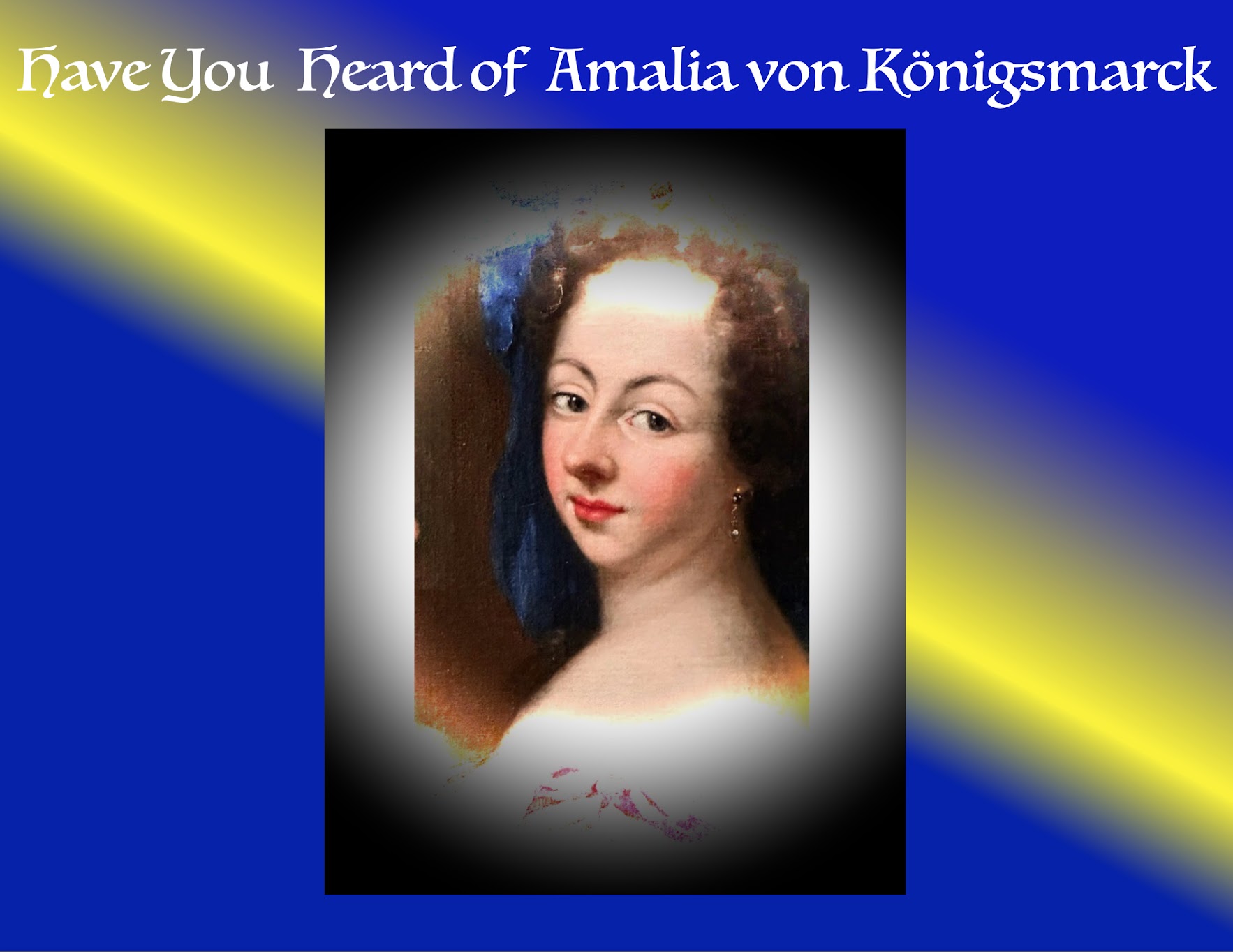
Resa So Rebecca, today we’re shining the spotlight on another accomplished female artist once buried by history, Amalia von Königsmarck.

I “fell in love” with our last artist, Sarah BiffenAmalia von Königsmarck does not inspire the same “fell in love” in me, yet hers is nonetheless a valuable contribution to the world of art, and art remembering us. Can you speak to that?

Rebecca – Amalia von Königsmarck’s contribution to the world of art is indeed remarkable, especially considering the complex, perilous and politically charged environment in which she lived. The intricate dynamics of the royal court, especially during the Great Northern War, as well as her spouse’s involvement in the service of Augustus II the Strong, led to dire consequences. Given her status as a dilettante painter and her involvement in painting as a hobby or pastime, it is likely that her primary motivation for creating art was personal enjoyment and creative expression.  I believe that in the midst of uncertainty, Amalia chose to follow her creative spirit, which is a reminder to me that art generates positive outcomes.  That thought resonated with me when I viewed your photographs.

Resa Okay, now I’m “fell in love”with Amalia, too! So, Rebecca, let’s check out the details on what you’ve said and what else you have discovered about Amalia von Königsmarck!

Amalia von Königsmarck – A Dilettante Painter

Amalia von Königsmarck (1663–1740) hailed from a distinguished German-Swedish noble family. Her paternal grandfather, Field Marshal Hans Christoff von Königsmarck, notably served on the Swedish side in the Thirty Years’ War and was subsequently honored with the title of a Swedish count. Meanwhile, her father, Conrad Christoff von Königsmarck, held notable roles in the Swedish possessions of Bremen and Verden, among others.

Amalia von Königsmarck married Carl Gustaf Lewenhaupt, a Swedish nobleman, in 1686. Their union was a significant aspect of her life amidst the complex dynamics of the royal court.

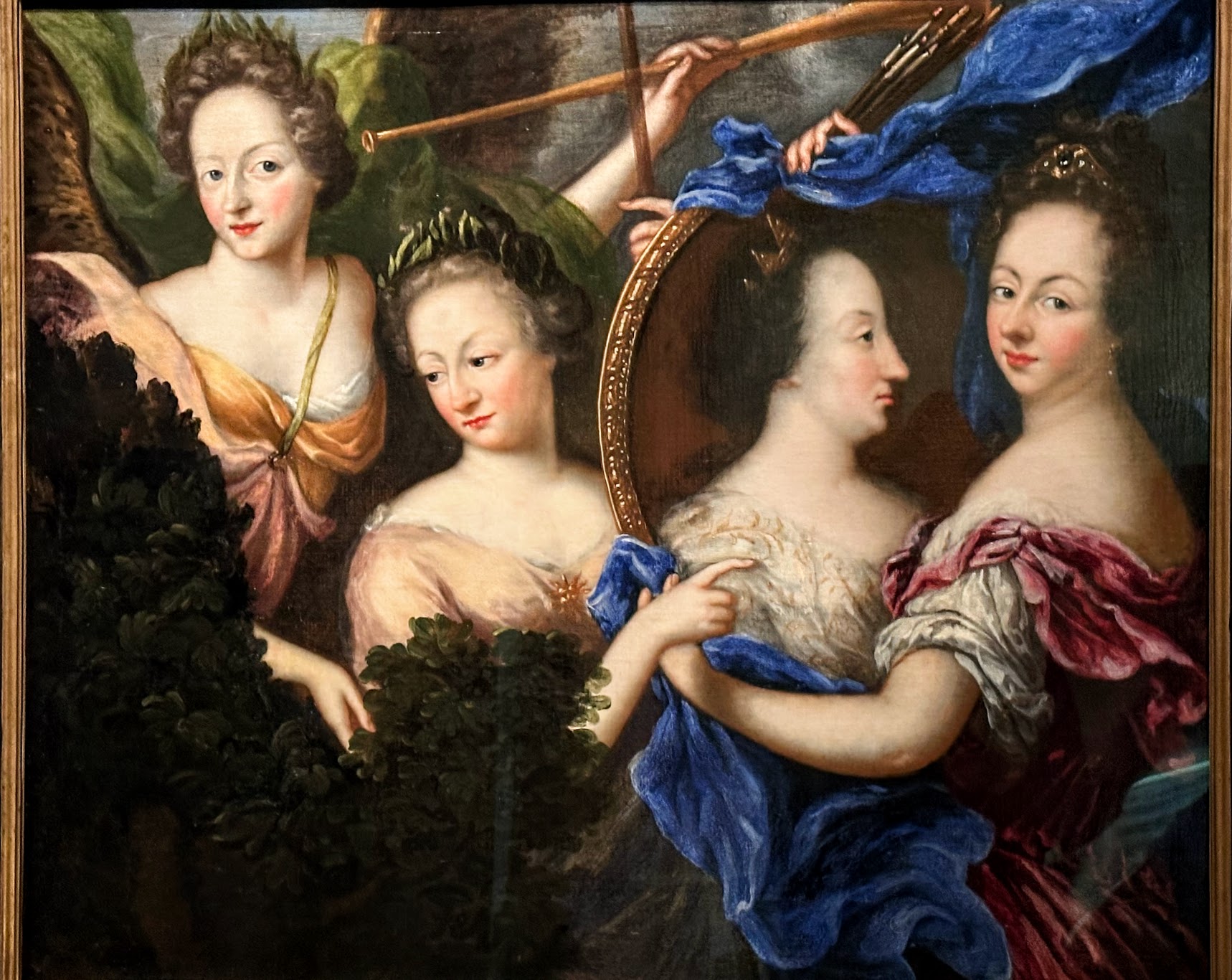
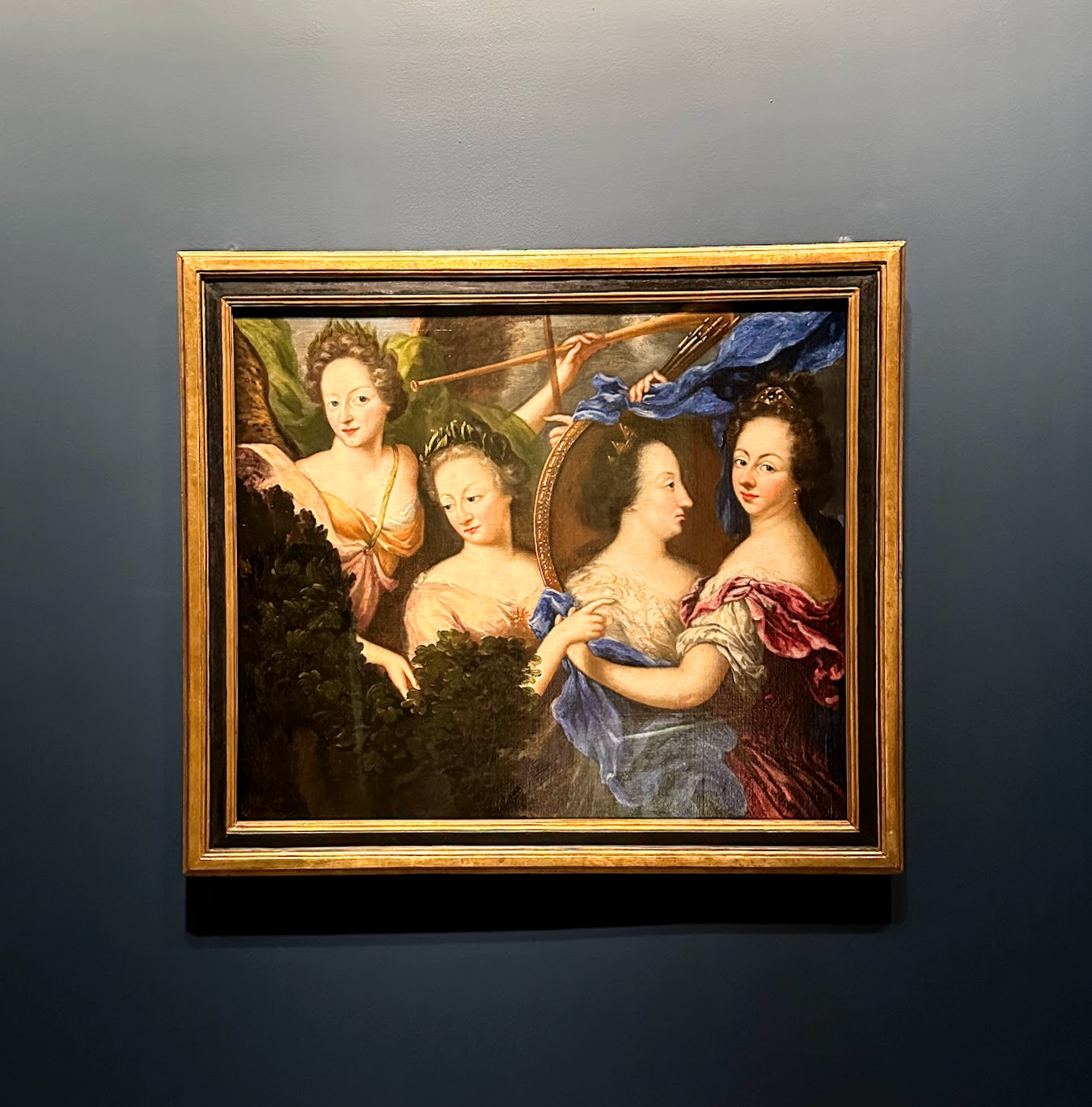
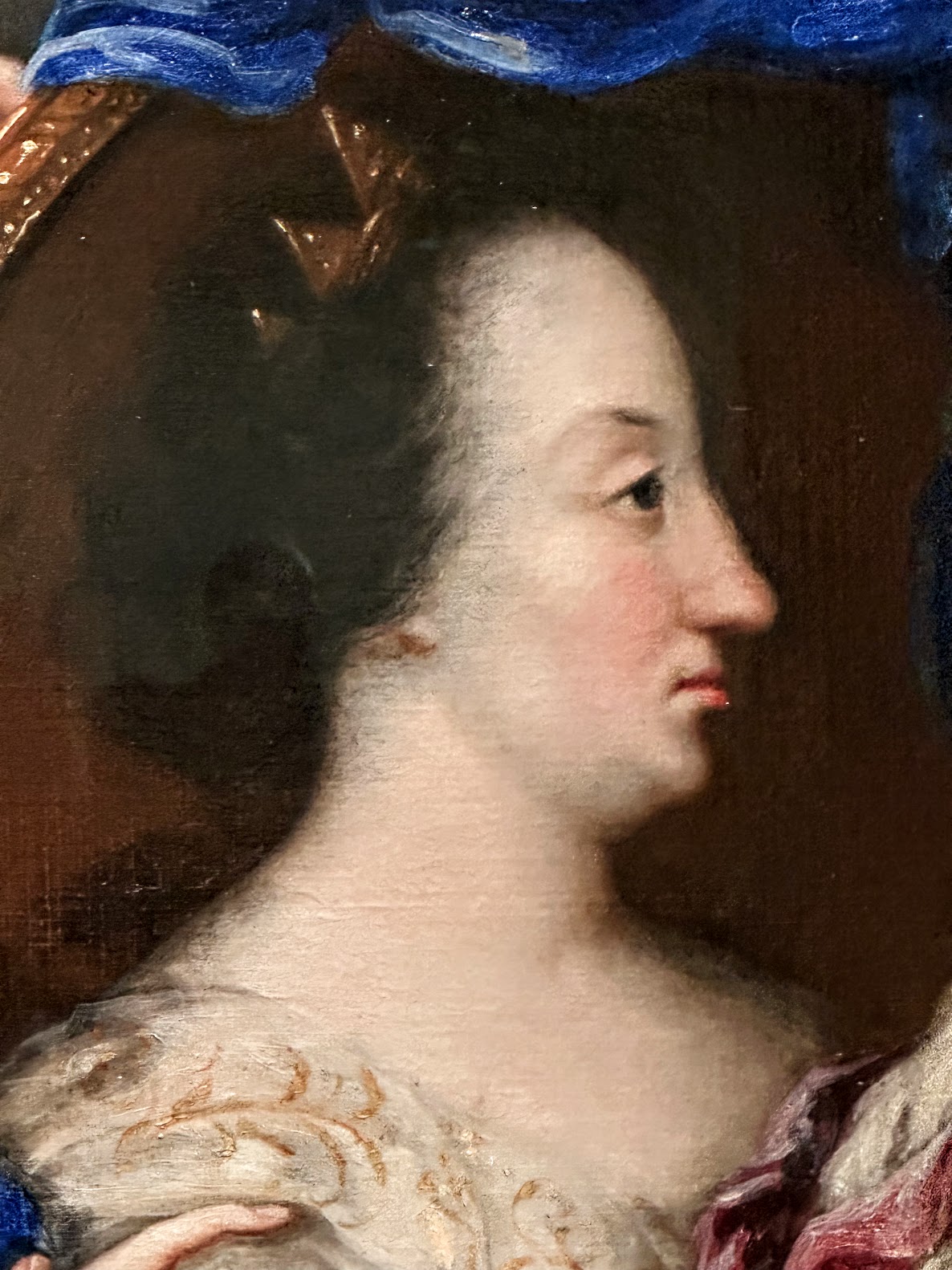
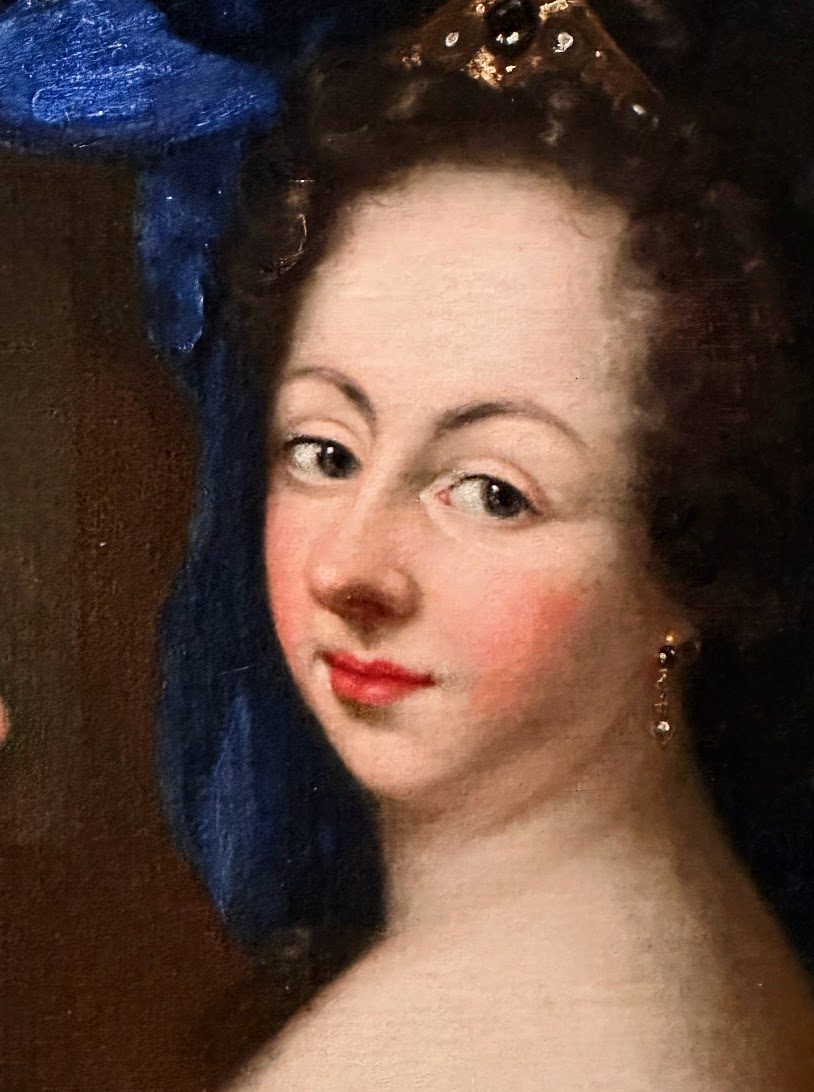
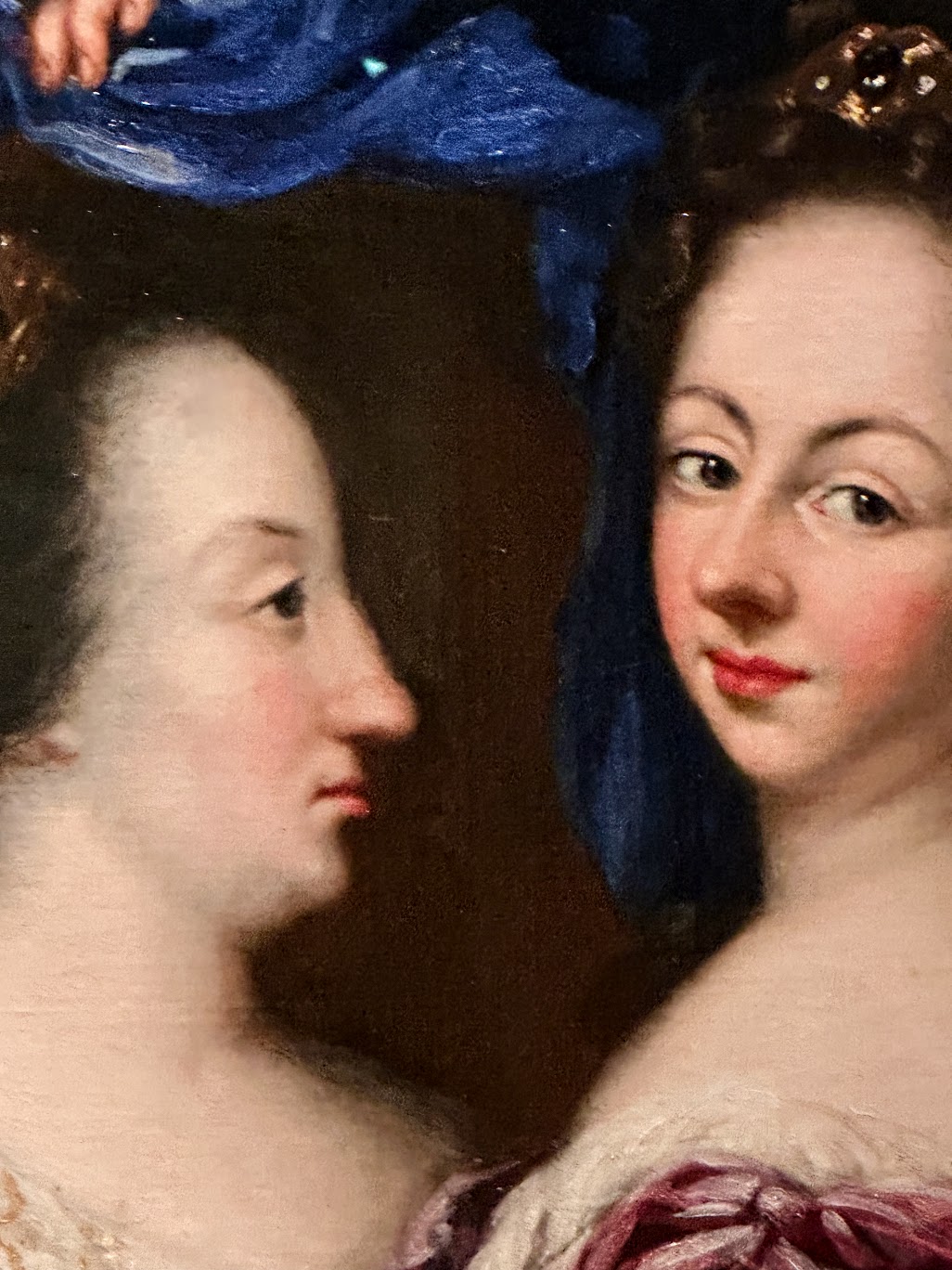
Allegory with Self Portrait and Profile Portrait of Queen Eleonora – 1689

Resa – The above photo I took is from the “Making Her Mark” exhibit. I was lured in by its richness. This painting was not behind glass, and on close inspection I gasped when I saw the 335 year old cracks in the oils. I thought – Rebecca would love these cracks.

Rebecca – I do love those cracks, Resa!!  This is a 335-year-old painting!!  I believe that those delicate cracks add to overall aesthetic appeal of the artwork by providing a sense of history and authenticity. The cracks, also known as craquelure, can be seen as a unique feature that showcases the passage of time and the natural aging process of the artwork. I find that the presence of cracks enhances the texture and visual interest of the painting, giving it a distinct character that sets it apart from newer, flawless pieces.

Amalia von Königsmarck’s Artistic Pursuits

Amalia von Königsmarck was known for her literary and intellectual achievements as well as for her artistic endeavors. As a member of the royal court, she delved into the world of painting and portrayed various notable figures of her time. One of her renowned paintings is a self portrait dating back to 1688, offering a personal glimpse into her life and artistic expression.

In addition to her accomplishments in visual arts, Amalia participated in the amateur theatre of the royal court, an endeavor encouraged by Queen Ulrika Eleonora of Sweden. This involvement in the theatre highlighted her multifaceted interests and contributions to the cultural life of the royal court.

In the painting, Amalia holds her portrait of Queen Ulrika, a bold nod to her relationship with the queen.

One of her hands holds paintbrushes, depicting herself as a painter. (see full painting)It is the first known image of a Swedish female painter.

Although Amalia had studied under David Klöcker Ehrenstrahl, a Swedish nobleman and portrait painter, Amalia was a dilettante painter. This refers to an individual who engages in painting as a hobby or pastime, without pursuing it as a serious or professional occupation.

Dilettante painters typically approach art with enthusiasm and interest but may not have undergone formal training or dedicated extensive time and effort to develop their skills to a professional level. Their works are often created for personal enjoyment or as a form of creative expression, without the intention of displaying or selling them in a professional art context.

Amalia and the Great Northern War

In 1695, amidst the intricate dynamics of the royal court, Amalia Lewenhaupt (Königsmarck) persuasively influenced her spouse to enter into the service of Augustus II the Strong, who was at that time engaged in a romantic relationship with her sister Aurora. However, this decision led to dire consequences, as her spouse faced the confiscation of property and a sentence of death in his absence by Charles XII of Sweden in 1703, during the tumultuous Great Northern War. Tragically, her spouse passed away in exile in Hamburg, Germany, in the same year.

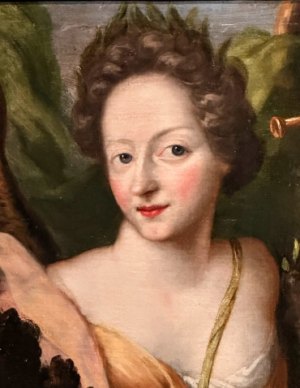
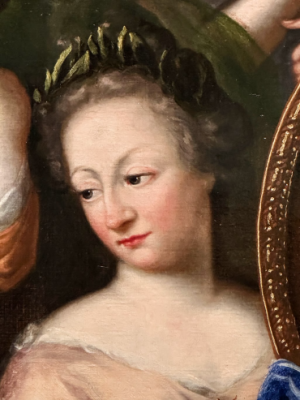
The other 2 women in this allegorical portrait:

Left – winged and holding a trumpet is likely Fama, goddess of rumour and fame.

Right – The woman points to the queen while gazing out of frame.

Resa – So Rebecca, I add the thought here that the pointing indicates that Amalia is saying that Queen Eleonora is of rumour and fame?

Rebecca – While the specific meaning of the painting, “Allegory with self-portrait and profile portrait of Ulrika Eleonora the Elder” is open to interpretation, the inclusion of the self-portrait alongside the profile portrait of the queen suggests a significant personal connection between Amalia and Queen Ulrika Eleonora. The portrayal may convey Amalia’s admiration for the queen and her acknowledgment of the queen’s reputation and prominent status. Queen Ulrika Eleonora was renowned for her religious devotion, patience, mild demeanor, and charitable nature, which endeared her to the public. Her modest beauty and dignified presence further enhanced her image as a symbol of hope and lasting peace. Embraced with enthusiasm by the public, she was perceived as a beacon of optimism, and her personal merits bolstered her popularity, solidifying her status as a beloved and influential figure in her time.

Amalia’s Return to Sweden

Following the upheavals and challenges she encountered, Amalia Lewenhaupt eventually journeyed back to Sweden in 1722. Notably, her return to her homeland was accompanied by the fortune-teller Höffern, perhaps seeking guidance and solace after the tumultuous events she had endured.

In 1740, at the age of 76, Amalia Lewenhaupt peacefully passed away in Övedskloster, thereby transcending the trials and tribulations of her lifetime. Her final years were marked by the tranquility of her surroundings, providing a contrast to the tumultuous events she had previously experienced.

Regrettably, Amalia Lewenhaupt’s poignant story was further shadowed by the tragic fate of her firstborn son, Charles Emil Lewenhaupt, who faced condemnation for treason and was ultimately executed in 1743, thus adding another layer of sorrow to her enduring legacy.

Resa –  Rebecca, I can’t thank you enough for being here with me to present Amalia von Königsmarck. It’s somewhat jolting to realize that she was on earth 361 years ago.

Rebecca – Thank you, Resa, for this extraordinary opportunity to collaborate with you on “Making Her Mark”. It is truly fascinating to unravel the multifaceted contributions of remarkable women from past centuries and to witness the enduring impact they have on the world of art and culture. These women have left a profound legacy that continues to inspire and shape our artistic landscape today. By delving into their lives and artistic endeavors, we gain invaluable insights into the richness of history and the enduring influence of these visionary individuals.

Thank you again and again Rebecca!

You can visit Rebecca on Chasing Art! Also for links on the research, just click on the above banner!

Blind Artist Seeks Audience for his Fab Art

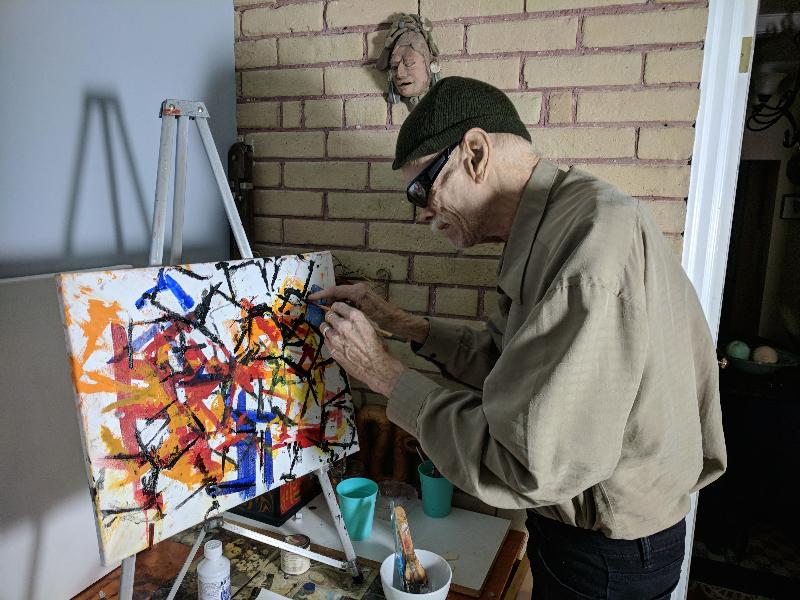
My friend Vernon went blind 20 years ago. Yet, he still paints! I asked him if he remembers colors, & uses that memory?

Artist Vernon Milette at work on “Primary Squares” – Photo © Sal Buccellato

“Yes”, was his answer. He added “And I always paint in oils”

Artist: Vernon Milette – Photo © Sal Buccellato

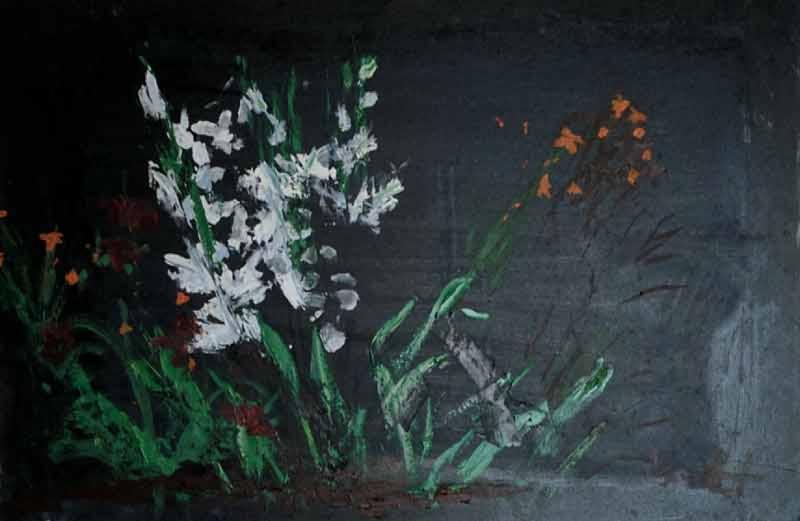
The above oil painting titled “White Glads at Night” is my fave. It blows my mind that he painted it, blind, with a knife. Vernon also designs gardens to this day.

Vernon told me, ” I can show you the exact spot in my garden where these Glads grow”

Artist: Vernon Milette – Photo © Sal Buccellato

Above in mixed media, is  “Soup”

Vernon said, “I used several stencils from the Dollar Store for the background. The word SOUP & the A & Z are on raised wood blocks (about 1/8th of an inch). It’s an homage to braille, in that it is tactile.”

Artist: Vernon Milette – Photo © Sal Buccellato

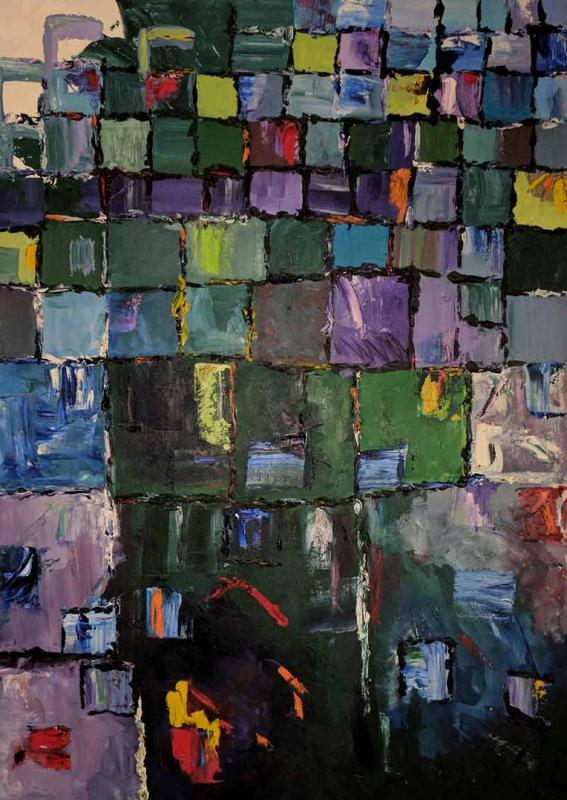
There are lots of colors in the above painting, “Tenements”. I asked Vernon how he knows which tube of paint is what color?

Vernon answered, “I have a bar code reader, that reads out loud to me. On the tubes of paint, the color is listed in the code. I line them up accordingly. Tenements is done in 3 colors, mixed in variations and applied very thickly”.

Artist: Vernon Milette – Photo © Sal Buccellato

“Rhapsody in Blue”

This painting was inspired by a jazz evening w/Molly Johnson at the Soul Pepper Theater . Molly is an amazing singer, & friend of Vernon. He sat in a front row & is still inspired by the love and recognition Molly showed him when she sat at his table.

Vernon noted, “thoughts inspired by Molly were: “cello note”, Molly lead, ultra marine.  All other singers = other blues. The shades progress to a light turquoise for depth. It’s painted using a cardboard template, with a brush. Check out Molly’s Kensington Jazz Fest

Artist: Vernon Milette – Photo © Sal Buccellato

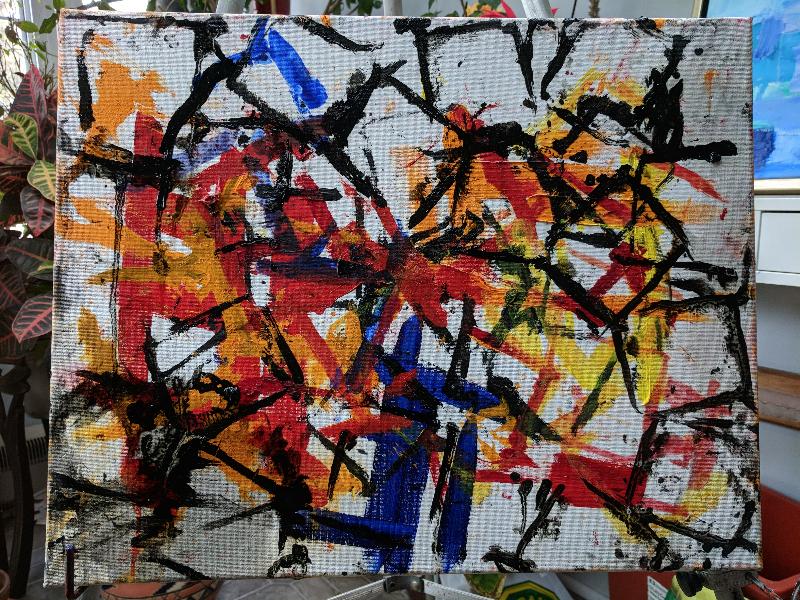
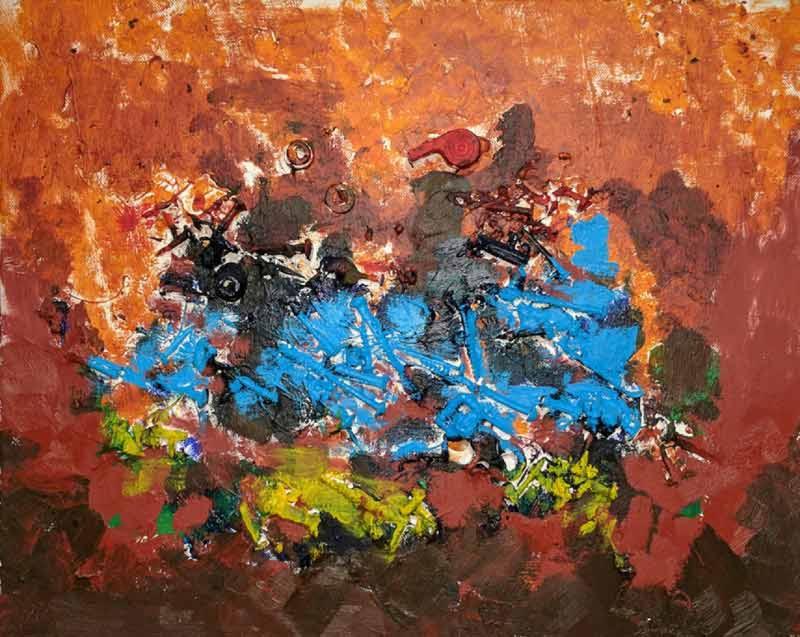
“Construction”

Vernon told me, “this painting is based on a construction site’s nails, screws, black nails, rot & climaxes in rust. All colors represent something  at a construction site.

Vernon at the beach with his seeing eye dog, Jewels. Photo © Sal Buccellato

Visit  Vernon’s Website where you can read his bio, inquire about showing his art at your amazing venue, or simply buy, or commission one of his works of art. A direct email link is available on the site.

Photo © Sal Buccellato

❤️ ❤️ Vernon, I love you! ❤️ ❤️