

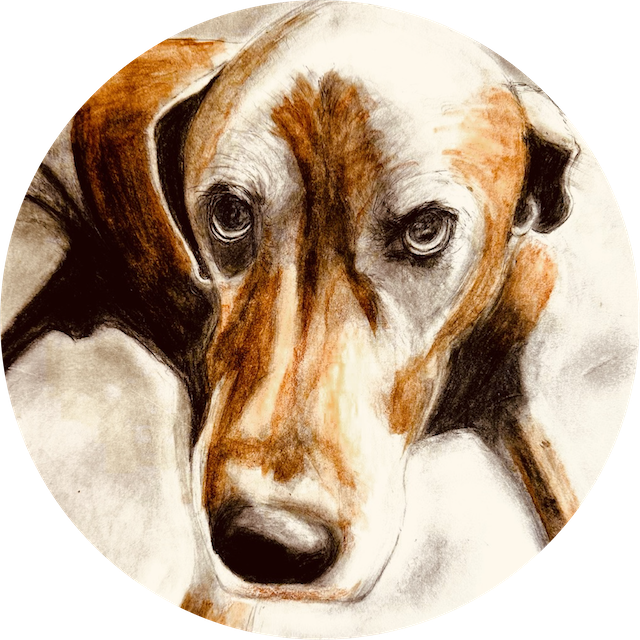
I fell in dog love with Copper when I read, Copper Boy (Ever So Gently, also in King Copper)
"His white choppers shine as if
they've never caused any commotion..
never mind when he attempted
to eat the barbecue!"
Somehow, to me, animal love is proven with those words. I was always asking about him, and one day drew him. It is my first and only animal portrait.

When Copper crossed the “rainbow bridge”, Lauren was heart broken. Concerned with how the healing was going, I asked a few questions.
Resa – In the book you say it was 4 months after Lucky Girl was gone, when you adopted Copper into your family. It’s been a bit longer than that since Copper passed. Are you thinking of adopting another puppy/dog?
Lauren – We will most likely adopt another dog in the future, probably an older dog that needs a loving home. But we’re not ready yet. As I mentioned in my book, every one of our family dogs has been special. Yet, it was in Copper’s amber, soulful eyes where I felt a deep connection. I’m doing better with occasional teary moments, but still grieving his passing. I wish I could hug him again, you know…
Resa – Yes, I know. I feel the same about my cats who are gone, especially my baby Jeep. (& Johnny & Pupkin & Cabbage & Mom & Potato)
Lauren – My mom passed shortly after Lucky Girl, and my kids were home and then leaving for college. Life was busy; dynamics were different, so after a few months, I was ready for another furry family member. And we’re so glad Copper trotted into our lives. Copper was also the first dog where we had to make that heart wrenching decision, and even though it was the right thing to do, it was the hardest decision I’ve had to make.

Lauren – I wanted my son and daughter’s support from out of state via phone, and of course, my husband, Matt, was with me, but ultimately, it was up to me. The emergency vet was very compassionate. She told us that she would support any decision we made, and she had told many pet owners “no” before. But she knew Copper would suffer tremendously if we prolonged his life, and the thought of him suffering shattered my heart as well.
Lauren – Though it still wasn’t easy, so before I decided, I looked at her, crying my heart out, saying, “I don’t want to be an adult right now. I want you to tell me what to do.” I knew it wasn’t her decision to make, so I nodded my head. Matt was silently emotional sitting in a chair, and I sat on the floor with Copper’s head on my leg while he peacefully left our world. I buried my face in his fur and sobbed like I’ve never sobbed before.
After that fateful day, my husband and I needed some time to let our emotions settle. As our daughter says, “We need to give ourselves grace.”
Recently, I heard in a movie, “Love is worth the grief.” It truly is…
So, I don’t know the timeline, but we’ll know when the right time comes. ♥️
Resa – When Copper passed, you fell on your pen, and wrote King Copper. Can you put into words how writing was a catharsis? Did you go through stages, a journey, as you wrote?
Lauren – I had written several fun poems when Copper was with us, so when he passed, it felt natural to write through the grief. Instead of moping around the house and crying all the time, my grief found a destination in poetry form. Writing kept me busy, kept me focused to the end of a poem, and then another was inspired. Sure, I had down time to fall in a chair and simply cry for a few minutes before I ‘got up again.’ But those times didn’t consume me because of the writing.

One More Moment
A dog barks in the
distance causing me to pause,
it sounds like Copper’s
a wild imagination
longing for one more moment
Lauren – I can’t say if there were stages, but it was an emotional journey that felt like I had been sucker punched. I’m grateful to be a writer so that my grief had a place to go. I can’t imagine what those days, weeks, and months would have looked like without being able to put my emotions down on paper. Before I knew it, a poetry collection had evolved, and that’s when I decided to pay tribute to Copper in book form. I’m so glad I did, not only for me, but for my family too.
Resa – Where do you find yourself today, your missing of Copper, now that the book is out there and people have been reacting?
Lauren – My book has received beautiful and touching reviews, so it’s heartwarming to know how Copper has touched the hearts of those who have loved and lost a pet. Many friends have fallen in love with Copper, and that warms my heart. He didn’t know how lovable he was. He didn’t know how handsome or regal he was, but all 80 lbs. of him was pure unconditional love.
In some poems, Copper writes to Lauren
ALWAYS BY YOUR SIDE

I see you dry your tears; how sad you seem to be.
Please know that I am here, but I'm also feeling free.


- Copper Boy
Lauren – I’m emotional as I type. Sigh…I’m just grateful for the reception my collection has received. And I hope my poems provide comfort for those who are also grieving the loss of their dog or cat. Life is part joy and part loss then comes acceptance. This is what King Copper is all about. We know he’s frolicking in lush, green meadows with our dogs who had previously passed and he’s not in pain anymore. Knowing this allows acceptance in our minds because he lives in our hearts forever. 🤎🧡🤎

About Lauren Scott

This is a wonderful book!
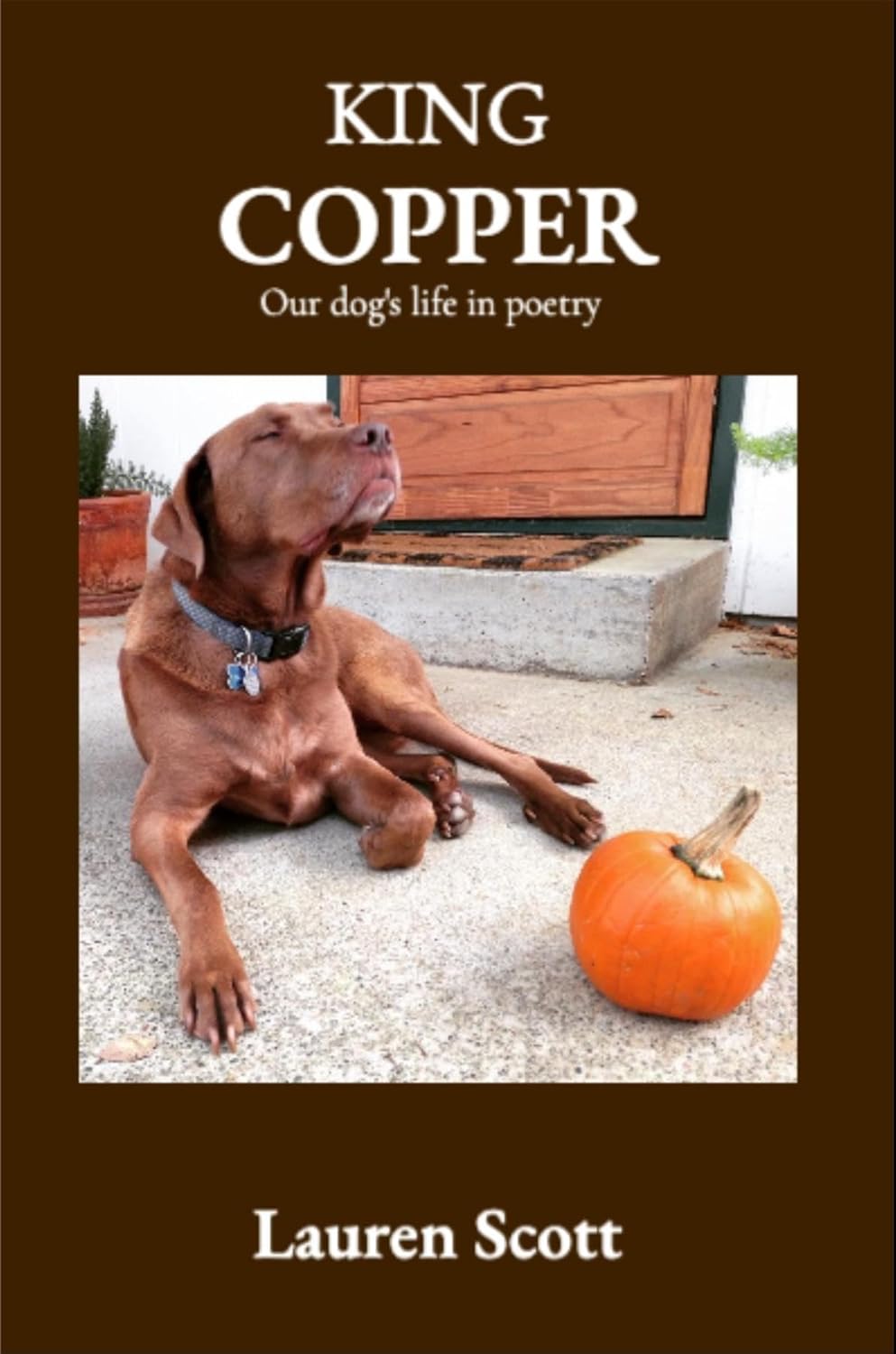
King Copper is available on Amazon worldwide. Click on the book cover, and go to King Copper on Amazon USA

My heartfelt thanks to Lauren, for sharing her heart here today!





























 Graffiti Lux Art & More
You must be logged in to post a comment.