
It was an extreme pleasure to view 2 of Angelica Kauffmann’s paintings at the Making Her Mark exhibit, at the Art Gallery of Ontario (AGO).
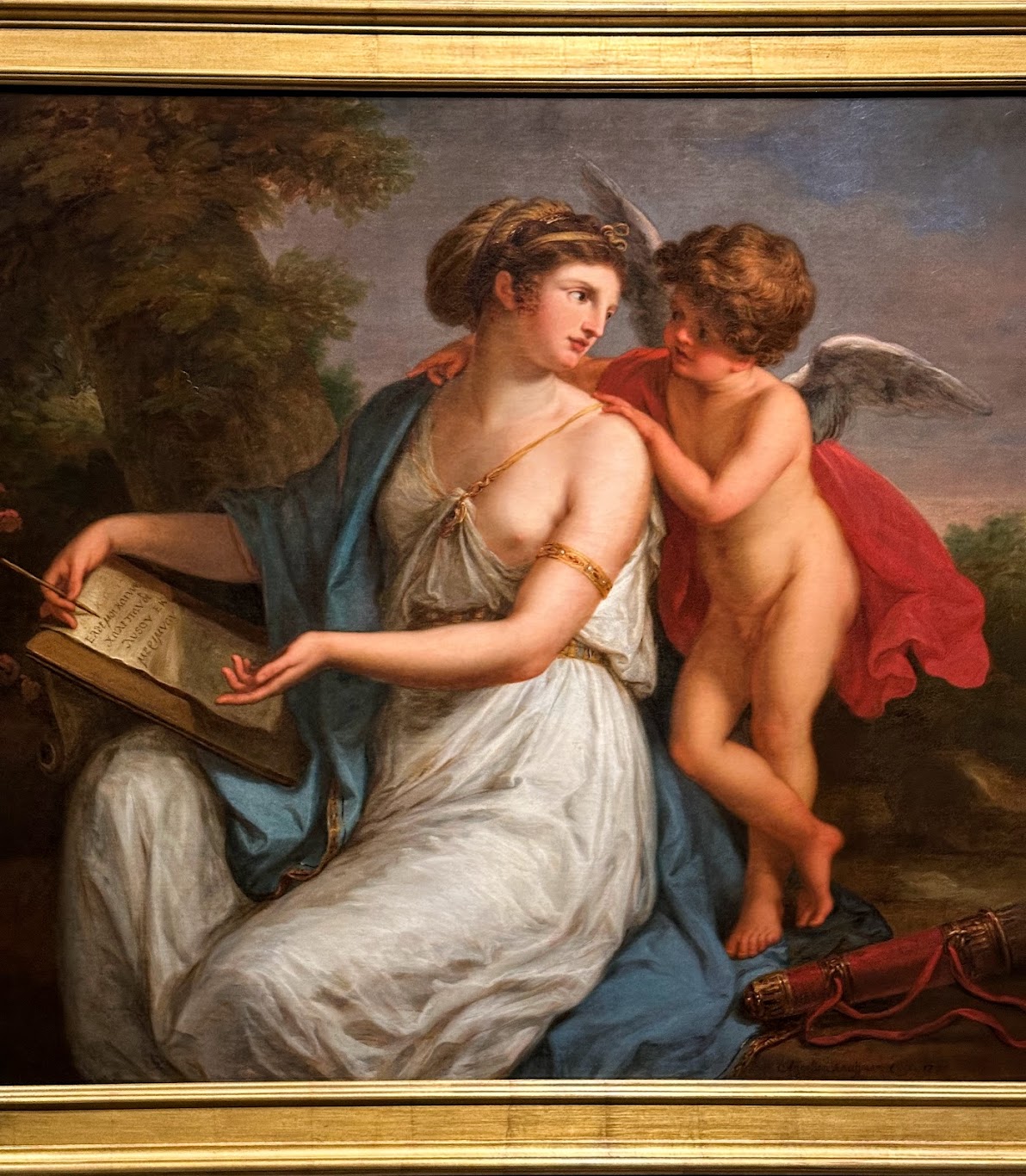
Sappho Inspired by Love
1775 – Oil on Canvas
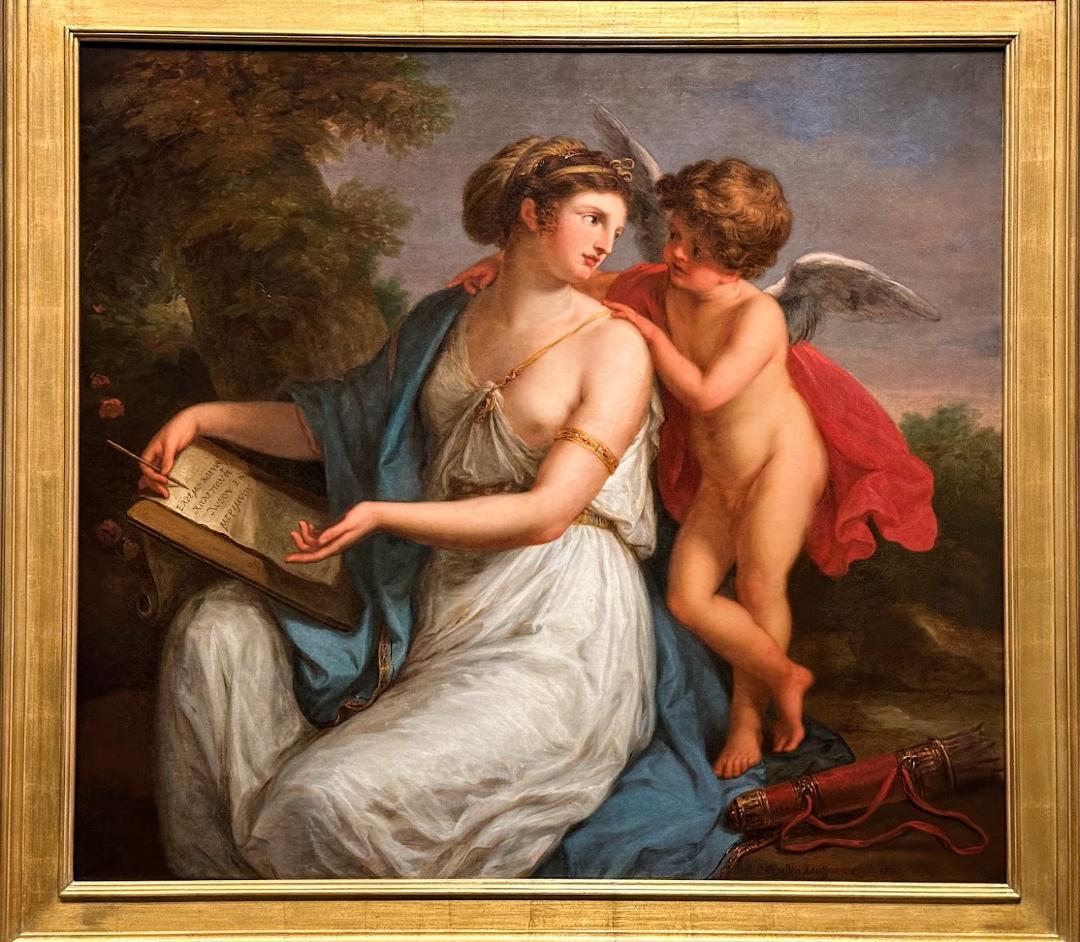
Born in Switzerland in 1741, Angelica studied under her father, muralist Johann Joseph Kauffman. By 12 years of age she was considered a prodigy, could sing (soprano) and was soon fluent in German, Italian, French and English.
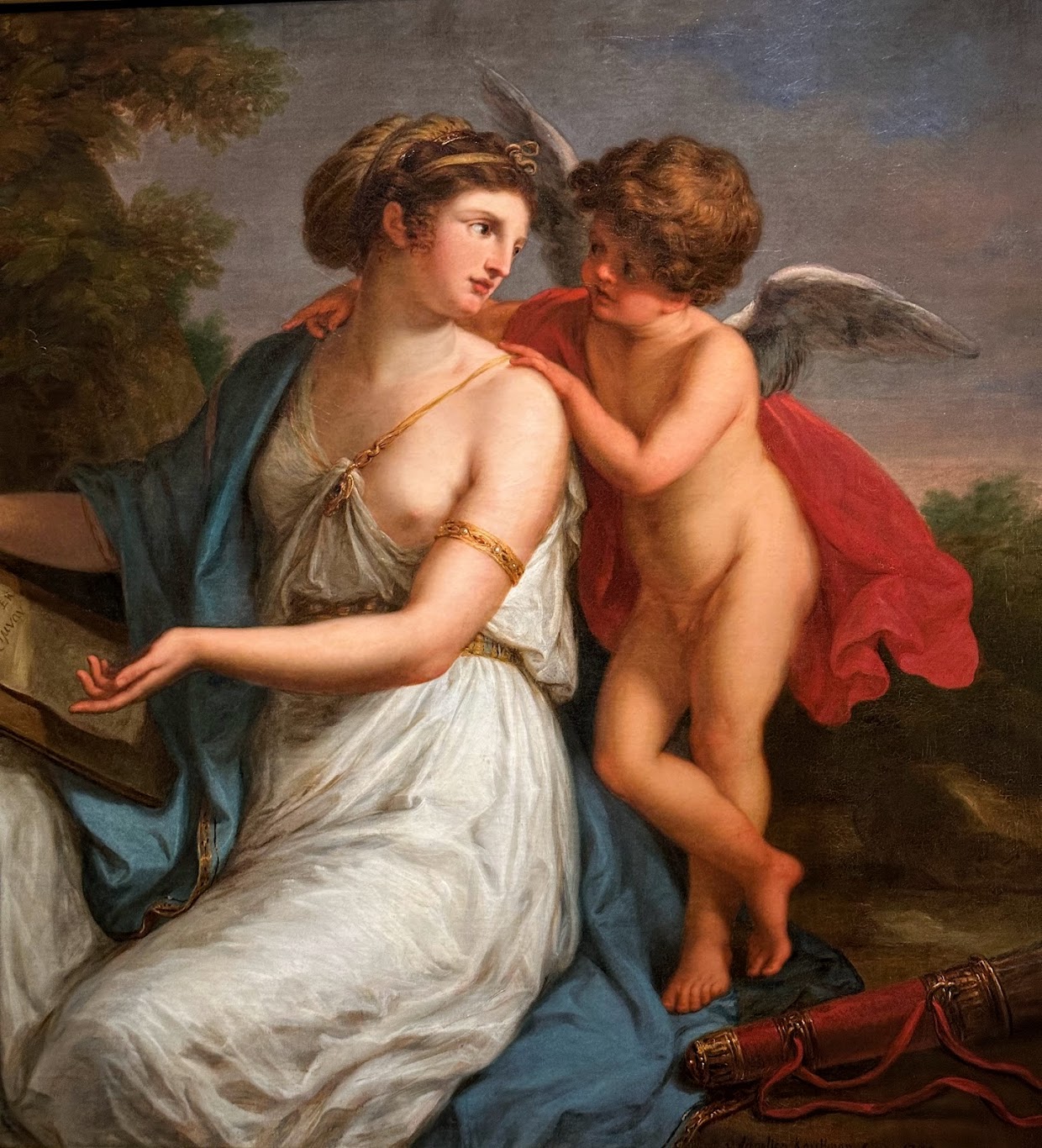
In the early 1760s, a transient life travelling through Switzerland, Austria, and Italy, as her father’s assistant, introduced her to classical and Renaissance art. She also became familiar with the emerging art movement, Neoclassicism.
In this painting-
“the Greek poet Sappho – (around 630-around 570 BCE) – known for her poetry about desire between women – collaborates on a verse with Cupid, the god of love.” -AGO
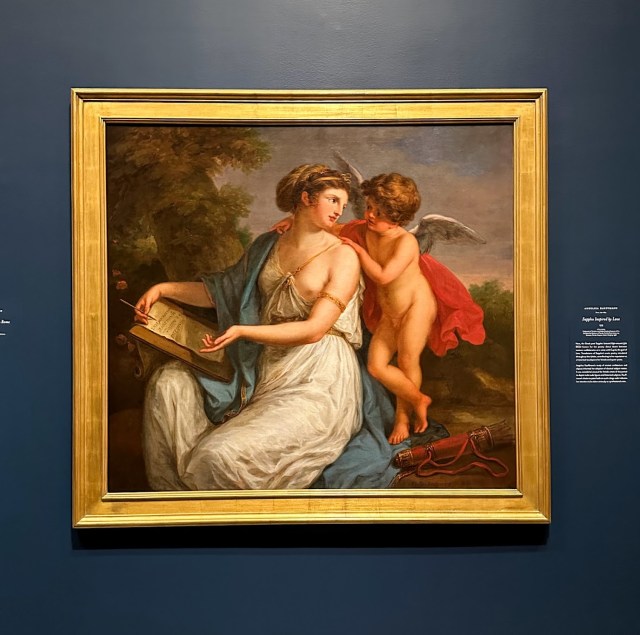
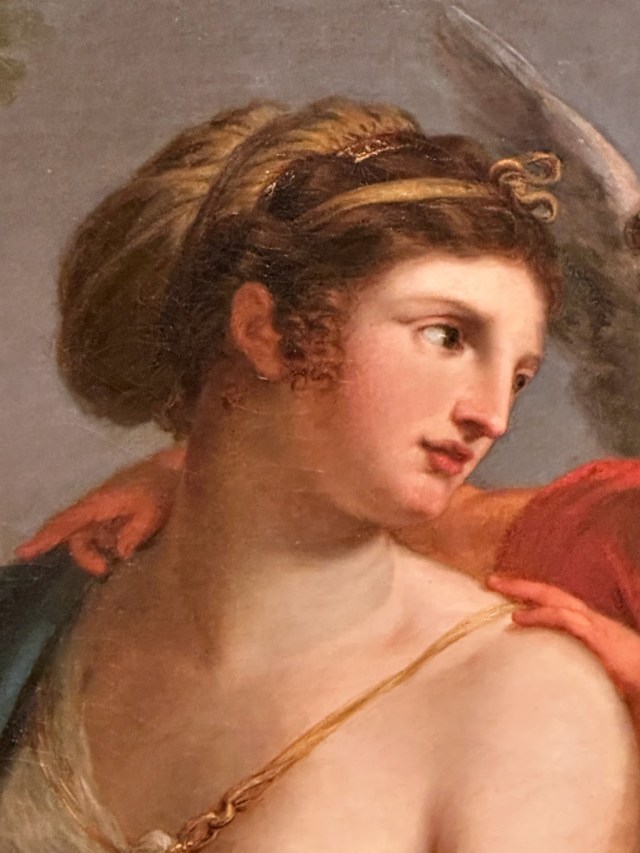
“Translations of Sappho’s erotic poetry circulated throughout the 1700’s, contributing to her reputation as a historical touchpoint for female and queer poets.” – AGO
In 1765 Angelica was elected to Rome’s Academia di San Luca, in recognition of her works.
Accompanying Lady Wentworth, Angelica moved to London in 1766. Here she became the demanded portraitist for aristocrats and royalty.
In 1767, she married a fraudulent Count Frederick von Horn, clergyman. Later that same year, Angelica found herself abandoned. The imposter had been found out and fled the scene.
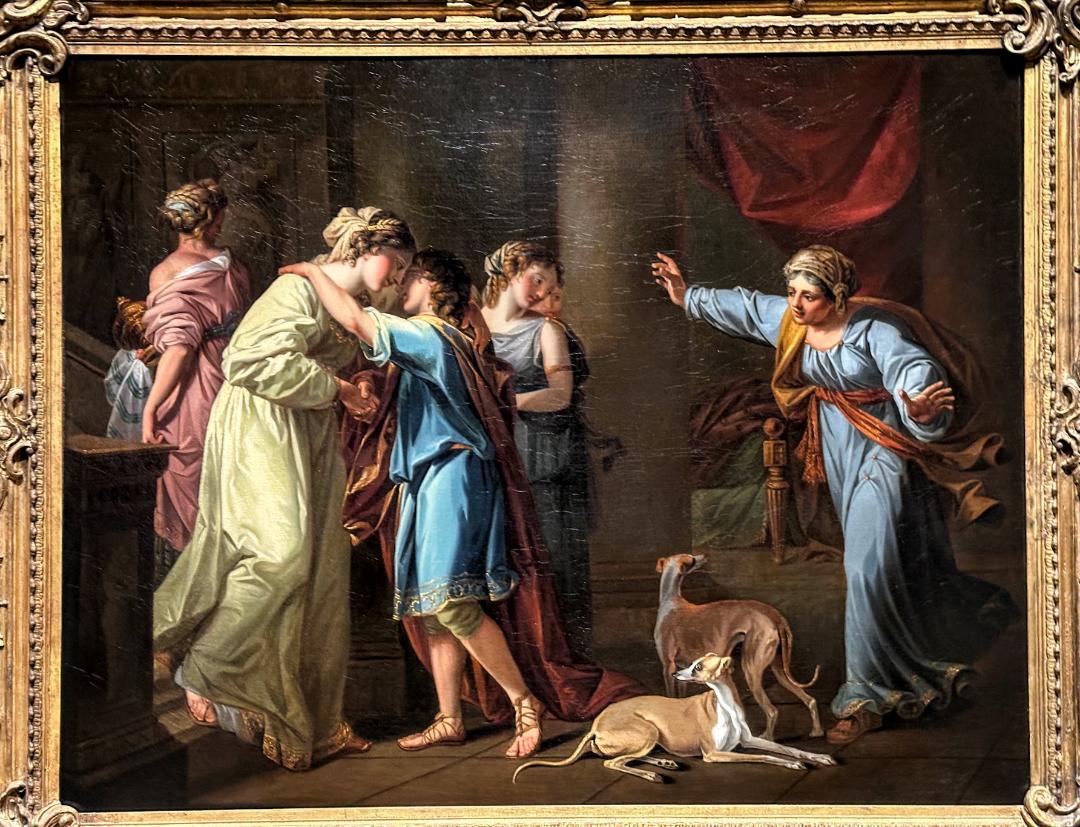
Telemachus Returning to Penelope
circa 1771 -Oil on Canvas
In 1768, Angelica Kauffmann and Mary Moser, became the only female painters among the founding members of London’s Royal Academy of Art. Her work showed regularly at the Academy for the next 16 years.
Angelica formed a personal style of painting women from classical history and mythology. This strong brand of hers evolved from the reality that women were not permitted, excluded from life drawing classes.
In the 1770’s, she became part of a team painting interior designs for Robert Adam. A Scottish architect and designer, he, with his brother James, transformed English Palladian Neoclassicism into the airy, light, elegant Adam decor.
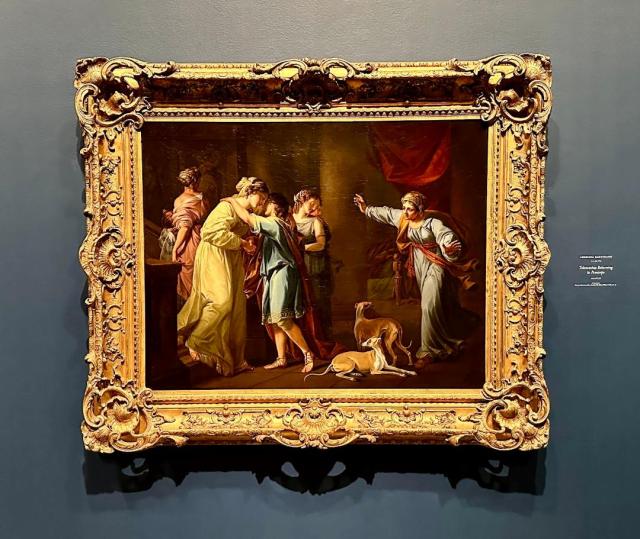
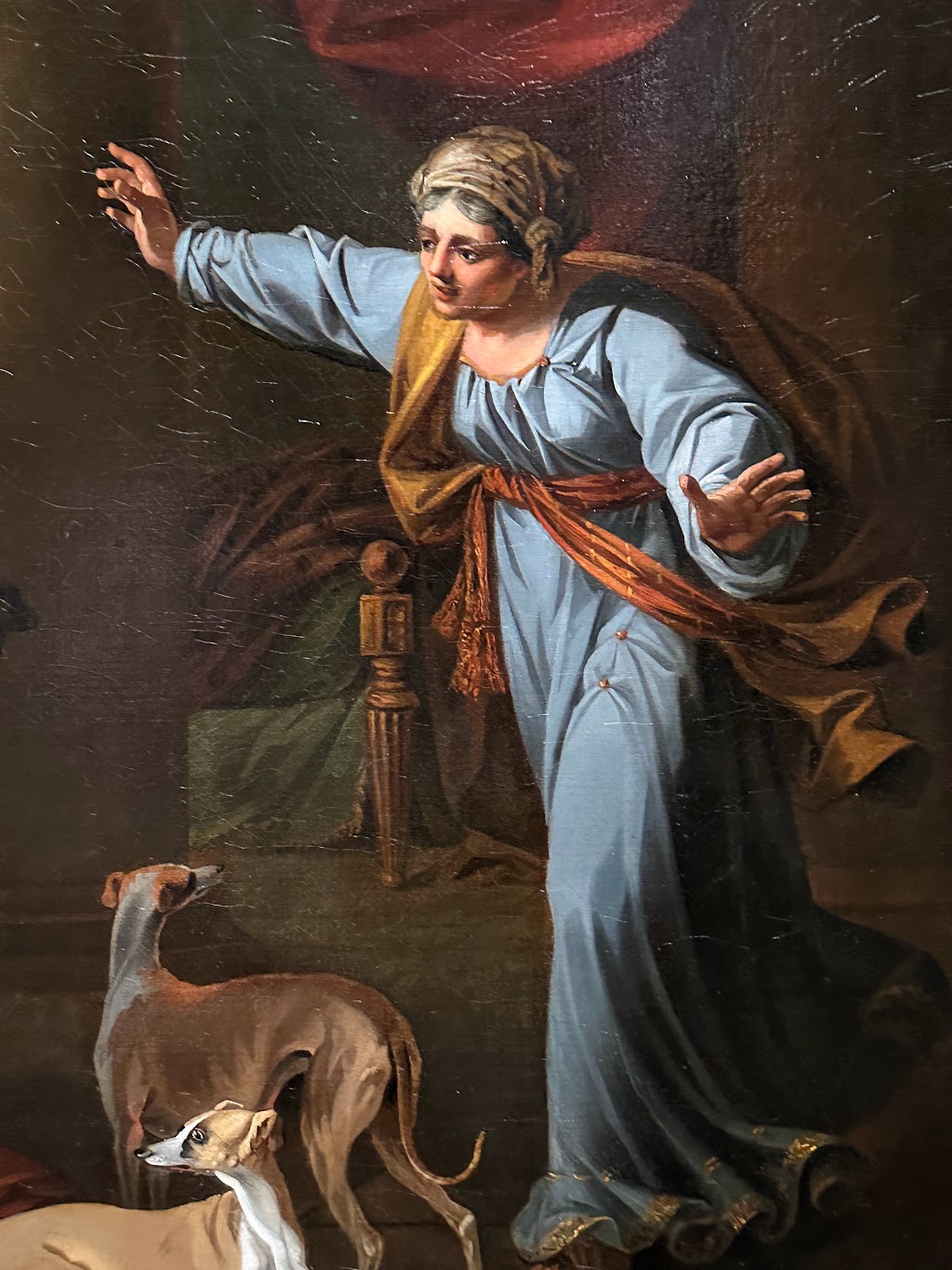
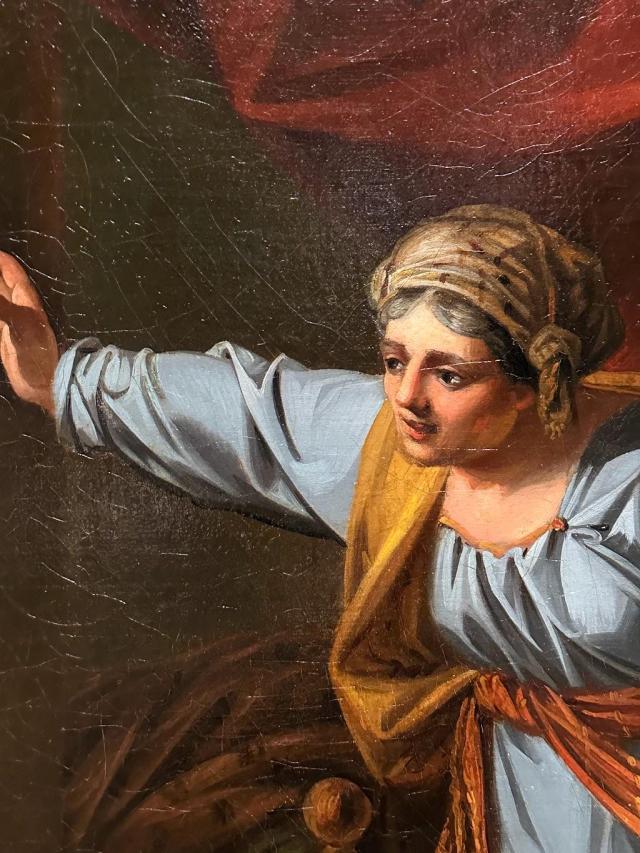
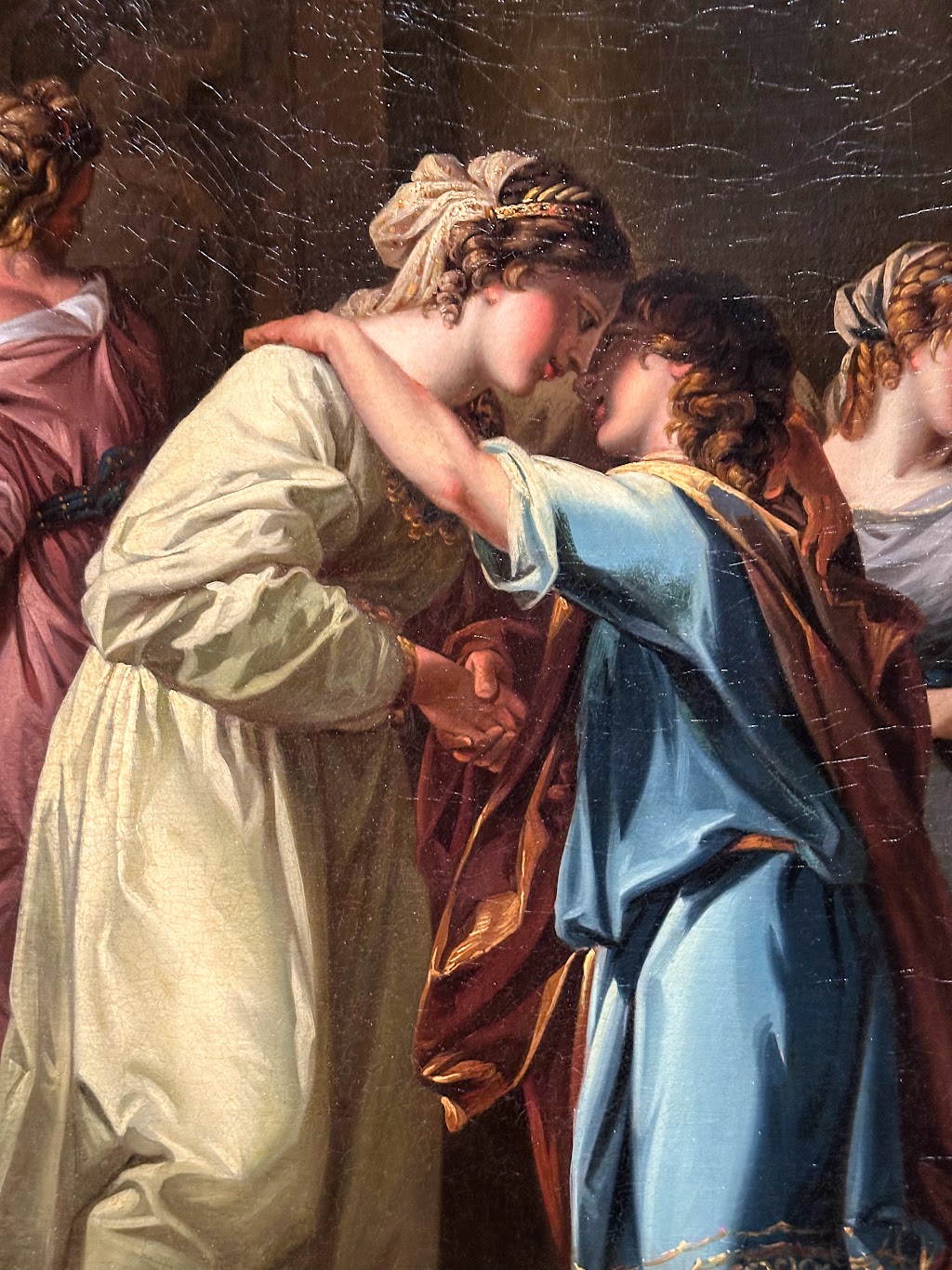
Telemachus, the son of Odysseus and Penelope, is now a man and a warrior. He has aided Odysseus in slaying the unwanted suitors of Penelope, and is back at home in Ithaca.
In 1781, at 39 years of age and after the death of von Horn, she is remarried to the Venetian painter, Antonio Zucchi. He succeeds Angelica’s father as her business manager.
The marriage contract guarantees her the rights to her income.
She retired to Rome in the early 1780s with her husband, Antonio Zucchi.
In 1782 Angelica Kauffman opens an internationally attended studio beside the Spanish Steps (a Baroque stairway in Rome, connecting the Piazza di Spagna with the Trinità dei Monti church.) It becomes the “In Place” for intellects.
In 1787, Angelica Kauffman becomes a dear friend of Johann Wolfgang von Goethe. She paints his portrait and becomes part of Goethe’s innermost circle.
Angelica Kauffmann died in 1807. She had become exceedingly famous by that time; so much so that Antonio Canova (prominent Neoclassical sculptor), directed her funeral. It was inspired by the funeral of the Renaissance master Raphael.
Photos taken by © Resa McConaghy – May 14, 2024
Art Gallery of Ontario – Toronto, Canada
To view all posts from the Making Her Mark exhibit, click on the banner at the top of the side bar.
A female artist in the 18th century, Angelica Kauffman’s liberation was an onerous victory.
 Graffiti Lux Art & More
Really great art from the past. I always love the detailled paintings. Thanks for sharing and the explaination, Resa! Since i had forgotten, please take my best wishes for a blessed, healthy and successful New Year. May all your wishes come true, and your work enlighten the world a better place. Best wishes, Michael
I agree, Michael. The art is wonderful.
I wish you a wonderful 2026, too, all the best to the world!
It seems she enjoyed great success–unusual for a woman. Thank you for sharing. I especially like Cupid’s crossed legs pose. Adorable!
Yes, unusual.
One thing that seems to stand out in the bios I’ve been doing on female artists (1400 – 1800) is that most were trained by fathers or uncles, often along with or in lieu of a brother.
In any regard, they were trained so they could assist (free labour) the male who was training them.
Love Cupid’s pose, too!
I think that is true for many women in many professions in past times–also widows who took over their husband’s business, but of course, in art, one must also have some talent, too.
😊
Yes, I agree. The talent was a ticket to freedom.
Many of these women were more talented than the male who taught them, and the male wound up being the business manager.
😺
In some cases, depending on when and where, a man would have been a business manager because of laws, especially for a married woman who might not be permitted to sign contracts without her husband, for example.
I understand that. I also understand it was difficult to inherit your husband’s wealth when he died. It went to a brother or male cousin.
There was a woman named Amanda America Dickson. She was lighter skinned, the daughter of a white plantation owner and a slave.
The slave got pregnant, and the owner raised the girl as his white daughter. After the Civil War he died and left her everything.
Of course this was challenged in the courts, not just because she was female (at that time property inheritance was a law in most places, but not the financial capital), but she was also black.
She won this ground breaking challenge, to become the wealthiest black woman in the USA.
Jennifer Beal played Amanda in the movie, Sam Waterston was the father and Tim Daly was the lawyer. (I did the costumes – A House Divided) As an historian you probably know this.
Yet, at this time in history, it is only better for women in some countries.
Merril, I love that you know history (adore Heather Cox) so I am 100% up for any corrections.
Inheritance law is very complicated, and of course it varies from country to country and time period. In the US, it’s determined by states, so it’s different in every state. Under British Common Law, widows were entitled their “thirds,”–a third of real estate. Of course, a man could leave his widow more, or because of creditors and debts, she might receive very little. George Washington married a wealthy widow, Martha Custis, and he became wealthy, as a result. But, I believe–not certain, that she retained rights over the some of the chattel, including enslaved people. A single women was a feme sole and could own property in her own name. Married women could not prior to changes in laws, but widows could.
I had heard of Amanda America Dickson, but I wouldn’t have remembered her name. Of course, with that amount of wealth, it was a unique case. I don’t know the movie, but I’m sure the costumes were fun to do.
Heather Cox Richardson is brilliant! I listened to her talk last night. I like that she always tries to end her talks on a positive note.
So interesting, thank you Merril!
Yeah, the costumes were a joy. A happy time filled with hard work, stress, appreciation and camaraderie.
Love Heather Cox Richardson. Thank you for turning me on to her in one of your Monday posts!
It’s not only that she leaves us on a positive note; her purview of today is through an historian’s lens, not a politician or lawyer or pundit.
You’re welcome, Resa!
Yes, I love the way she ties things together.
Her short podcast today was so encouraging.
They often are.
What a great biography. We take the women that have come before us for granted so often- and this is a prime example. Her work is gorgeous- and makes me more appreciative of the Rubenesque physique.
Art is one place where we can see what women were capable of in times past.
As time passes, I take less and less for granted, about our sisters from the past.
Lol, don’t get me going on female suppression!
Love the Rubenesque physique.
A genius of a feminine kind, whose rarity is due to men’s faults!
Her exquisite painting style endows the image with a soul that resonates with us. The man’s world has much to learn!
Thank you very much, dear Resa, for giving us the wonderful chance to discover this extraordinary artist and her stunning masterpieces.
🥰🤩🙏💖🎯🎨
Yes, men have run the show since time immemorial, and not that well IMO.
Agree, Angelica’s art is fabulous. She is inspiring.
Aladin, it is a joy to to work on this series about female artists (1400 -1800)
I have another half dozen posts to go… maybe a few more.
Thank you for your visit and lovely comment!
❦🕊~ ♥︎ ~ 🕊❦ (😽🌼)
Dear Resa, you will be doing us all a great favour.
👏🤗💖👍
❦🕊~ ❤︎💎❤︎ ~🕊❦
An onerous victory for art, culture and humanity. A pleasure to experience the Making Her Mark exhibit vicariously through your trained eye. Bravo and Thank you🎨👩🏽🎨👏🥂
You’re right on, EF!
Thank you for joining me on these MHM posts! Seeing those 230 pieces by women come out of the shadows and into the light, at the MHM show, moved me greatly.
❦🕊~ ♥︎ ~ 🕊❦
PS – Thank you for getting back to me on the M post. That was lovely of you!
Thanks for the education and tour Resa.
You’re welcome, Brad!
Thank you for showing us her talent ❤️
You are most welcome, Esther! ❦🕊
I the days before women become lost to rich men. Days that treated them ‘bad’. Sad, very sad when looking back. All the best, TOF
Yes, I agree about the plight of women in history. Unfortunately, that history has never left some parts of the world, and is enjoying a come back in others.
Thank you, TOF!
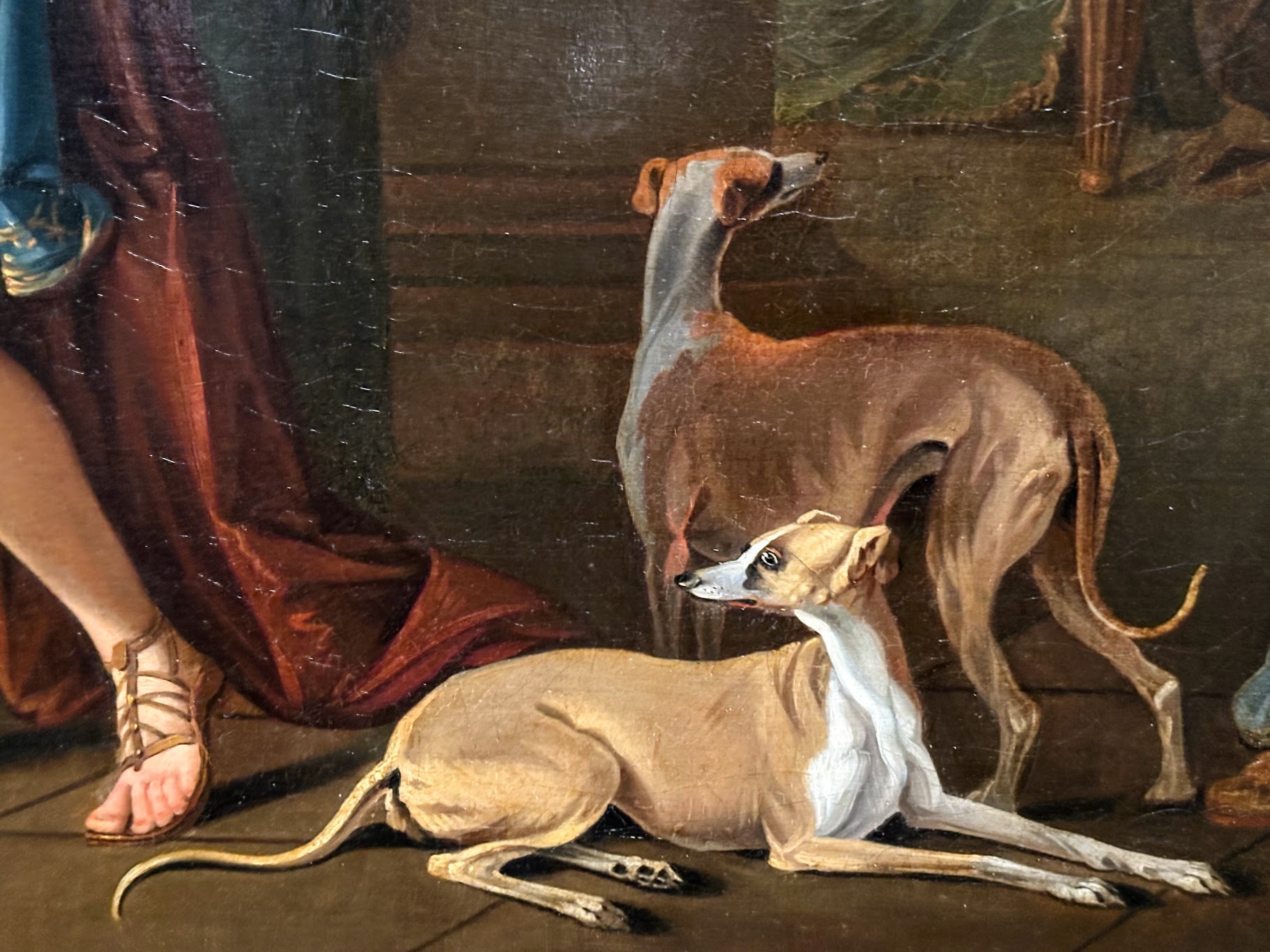
What a talented woman. Her paintings are exquisite. The details are amazing. I love the inclusion of the dogs. Thanks!
You’re welcome!
I agree, and I adore those dogs, too. Thank you, for your visit and comment Darlene!
This is fabulous, Sorceress.
Thank you for these series. I particularly love Angelica’s style of painting. It is full of life and light and the details are wonderful; as Merril said, that pose Cupid has taken – whimsical and lovely!
xoxoxoxoxoxo
You’re welcome, Thunder!
Seeing that show was an emotional experience. It did something to me that I can quite articulate, yet.
Yeah,, Cupid’s crossed legs are a neat touch. Makes him seem human, sort of.
xoxoxoxoxoxo
I can only imagine. And I love that you saw it.
Truly! Only a woman would give such a detail.
xoxoxox 🪄🧚🏼♀️ xoxoxo
xoxoxoxo⚡️💥xoxoxoxo
She must have been a strong-minded woman as well as a talent, to weather abandonment and go on to make such a name for herself. Not everyone could claim Goethe as a friend xx
True enough , Jo, thank you!
Her talent, her barriers and then Goethe on top of it all make her amazing, even in today’s world.
xx
Resa, what a gift it is to read this through your eyes. You don’t just catalogue Angelica Kauffmann’s achievements. You stay with her, allowing us to feel the unfolding of a life shaped by talent, constraint, resilience, and choice. What moved me most is how clearly her humanity comes through. She was a prodigy travelling with her father, a woman navigating betrayal and reinvention, an artist shaping her own path when doors were quietly closed to her. Standing before those paintings at the AGO feels, through your words, less like viewing objects and more like meeting a presence. Thank you for honouring both the art and the life behind it. Many, many thanks!!
Thank you so much, Rebecca!
You are quite right about meeting a presence. When I am standing beside these paintings, and with certain others, I do feel a life line connection.
I did not feel that with Rembrandt’s art. Yes, it was amazing, but the connect was not there for me as it was with Angelica’s and other women’s art at the MHM show.
I did feel a powerful energy at the Jesse Mockrin exhibit. But it was somewhat different. I believe that has something to do with the fact that she is still alive and fairly young. Hopefully I will find words for that connect when I do the post on her work.
Angelica Kauffmann is more documented than many other women artists of her time. I think that has to do with the fact that she was a founding member of the London Royal Academy of Art. There were pieces by Mary Moser at the show, too. So, perhaps I’ll do her next.
HUGS!
Resa, you’ve articulated something so vital and true. That feeling of meeting a presence is real, and it doesn’t happen with every great artist. It’s deeply personal, and when it does happen, it stays with us. It’s also fascinating what you note about Angelica Kauffmann. How documentation, visibility, and historical footing shape our ability to meet an artist across time. I am looking forward to read your reflections on Mary Moser next.
Beautiful photos and terrific information. Thanks, Resa.
You’re welcome, John! OX
🐂
Beautiful, breathing art, Kaufman’s work is perfection. Thank you for sharing it with us.
xoxoxoxo
You are more than welcome, dear Holly Meece!
Her work is phenomenal, as is much of the art I saw at MHM.
xoxoxoxoxo
(I’ll write you this weekend about when we want to do Keith. I have lots of pics ready to review and select the best for you to choose from.)
Sounds good Meece. ❤️
❦~ ❀✾✿ ~ ❤︎ ~ ✿✾❀ ~❦
xoxoxoxoxo
xxxxooooxxxxoooo
Oh I love your post honoring Angelica Kauffman, Resa! Each photo gives insight into the gifted person she was. Thanks for sharing this with us and hugs to you. XX
Thank you dear Cindy! I’m so happy you got to see this. She was truly gifted, and that gift helped her to be a person in a world where women were personae non gratae. xxxx
You’re sooo welcome and she sure was! Hope all is well with you!! Been wanting to email but you know… life!
♥️
Yeah, life…especially these days. Lots to worry about, lots to say!
You are wonderful, the bee’s knees!
❦~ ❀✾✿ ~ ❤︎ ~ ✿✾❀ ~❦
What a wonderful post. It’s high time these talented, gifted women stepped out onto the page instead of sitting on the shelf when it comes to art history. You have brought Angelica to life and what an artist she was. I’ve been to he Spanish Steps. Nice to think she had a studio there.
Yes, Angelica accomplished a lot in a time when it was harder for women than it is today.
Oooo, the Spanish Steps. Wow, Angelica’s Studio was there 250 years ago.
Yes, it is nice to think, Shey!
xxxxx
Yep… the Steps are also home to the Keats/ Shelley house. Quite the cultural area methinks!
WoW!
I agree! xxxxx
I didn’t know re her studio but we saw round the Keats/ Shelley house.
Was it fabulous?
It was what you would call of its time. Not too big but full of atmosphere.
Very cool!
I’d no idea there was a Keats/Shelley house there. The big tourist bit is the steps themselves. So it was nice to see round.
Another great post on the history of women artists.
Thanks Tim!
This series is important to me.
It’s been a hectic couple of days.
I finally have a chance to sit at my computer, and just listened to the song, again.
Wonderful post, Resa. Loved it.
Thanks Gi!! There’s at least 6 more to finish the series. I’m quite happy about it.
Still, I want to do a post on Jesse Mockrin’s art first. I’m so in love with her it! xxx
You are doing a lot for lost female artists. I think it’s wonderful. Bringing them to life.
I love it!
I know you do and it shows. ❤️
What a talent!
Agree, and for her to have succeeded way back then…brilliant!
What a remarkable woman!! Thank you for sharing her story and some of her paintings.
My pleasure, Liz!
There’s still 6 – 8 posts to go in this series. Nice to have a pet project.
I look forward to the rest of the series!
YAY!
❦~ ❀✾✿ ~ ❤︎ ~ ✿✾❀ ~❦ (emoji art)
Thank you, Resa. I was swept right up into her story. Surprised to be back in 2026.
Yes! What a great way to put it Cheyenne.
I spent about 3 hours at the MHM exhibition, and when I left it was like a forward time travel.
Art is powerful.
Sounds heavenly…
Sometimes I feel like I just want to hide at the Art Gallery, and live there.
enjoyed the post and cheers to female artists
also – in the comments I thought it was interesting about training women to help as free labor – makes sense and then it led to some talented artists
Thank you, Yvette!
Yes, cheers to us and our past sisters.
Agree, it led to some talent emerging, and allowed a few women (very few) to be emancipated.
😊🧡🧡🧡
❦💎❦
Thanks for another enlightening and entertaining MHM series! Love learning about Angelica Kauffmann, and her paintings are incredible!! Can’t wait to see more paintings you captured from your visit.
Hope one day I get to visit AGO with you… how fun would that be!
XOXOXO
♥︎ · 𑣲 · ᢉ𐭩 ·· ❤︎ · ❦
Yay!
I am loving doing his series. There’s more to come.
It would be a blast to go to the AGO together.
XOXOXO
❦~ ❀✾✿~❤︎~✿✾❀ ~❦
Looking forward to more of this series from AGO, woo hoo!! 🪢 🖼️ 🧵 🧶 🎨🖌
Me too!
There’s an odd one coming up that I will definitely attend. I say odd because it is photography. 1964-65 Paul McCartney took docu-type photos, as the Beatles began gaining their massive fame.
That sounds intriguing.
You are a 💎❦❦💎❦❦💎
Oh that does sound intriguing!! I’m not into the Beatles though I like some of their songs, but I know my hubby would enjoy it as he’s really into photography.
You are a GEM too!! 💎 Loving the emojis, as always 🌹💌🏹♥️
Same here, I like some of their songs.
What will be intriguing is seeing history being made. The early frenzy documented, as The Beatles helped change the pop music world!
XOXOXO
❦🕊~ ❤︎💎❤︎ ~🕊❦
This is a wonderful post to read. The artworks are amazingly detailed. Thanks for sharing, Resa.
My pleasure, Robbie! I’m thrilled you enjoyed it.
These pieces are sumptuous and it’s no wonder, coming from the brilliant mind of a Renaissance woman like Angelica.
Haunting to believe she walked the earth 250 years ago.
I wish everyone would enjoy history. The world might have better todays.
Just a thought!
That’s unbelievable. Talk about ahead of her time!
Not only read and enjoy history but to learn from history. Imagine!
MUAH!
MUAH!
This is a fascinating history, Resa. The way she highlighted all the draping and wrinkles in the fabrics is stunning — even the glossy coats of the dogs. Hugs.
Now, we have cameras.
Then, we had artists to capture images of reality.
Although these are paintings of mythical tales, they still show us – as you say – fabrics, dogs, some furnishings and light in a time before electricity.
Portrait painting is the only way we know what people (mostly royalty & celebrity) of the past looked like.
We would have almost no record of the past without the arts.
Hugs!
That’s very true. People should never distain art as less important than other things.
Agree!
Personally, the arts are my world.
❦🕊~ ❤︎♥︎❤︎ ~🕊❦
Wow! Thank you for this post and wonderful art.
Oh, you are so welcome!
It’s a passion doing these posts.
Long live our sisters from the past, through their art!
Loving these Make Your Mark and empowering creative women of the past. I also like that it’s labeled as erotic art from that time period. Always fascinating here Resa. Hugs 💜💜❌⭕❌
Thanks Debby!
I agree! lol…erotic art of the period.
Uch! This is another missed comment. My apologies, and I thank you for visiting.
Adore you!
XOXOXO
Lol, no worries my friend. It must be difficult to catch up with 1837478 comments, lolol. You rock! xoxoxo
LOL!!!
I checked … 67,000 comments.
You rock 2!
xoxoxoxoxo
Lololol. 🤣😂😍🥰🧡xx
xoxoxoxoxoxoxoxo
Pioneers I always find impressive. Fighting the restrictions of their age. We do need more of those.
Thank you Resa.
Be Good. (With a capital G.)
🤗💕🌹
xoxoxoxo❦🕊