
Josepha Ayala
Portuguese: 1630 -1684
Josefa de Ayala, aka Josefa de Óbidos, was a novelty. She was celebrated after her death; the only woman known to have worked as a painter in Portugal, during that period.

Josepha learned to paint by helping her father, Baltazar Gomes Figueira. In her lifetime, Portugal was monetarily unstable and often at war. However, much of her artwork was for patrons in Coimbra, a wealthy area boasting a university.

At 29 years old, her parents gave written permission for her to be to be a Donzela emancipada. (emancipated woman). She remained unmarried and independent for her entire life.
She received many commissions, during her lifetime. However, Josepha was wealthy from real estate investments and was able to refuse work at the Portuguese court.

She signed many of her artworks, as Salvator Mundi. Thinking this was a male painter attracted clients, and prevented her from being forgotten over time.
Lavinia Fontana
Italian: 1552 -1614
Born in Bologna, died in Rome; Lavinia Fontana painted in the Mannerist style she was taught by her father, Prospero Fontana.

An important portraitist in the late 16th century, she also produced many religious paintings. Lavinia was celebrated for the vibrant colour and detail of the clothes and jewels her subjects wore. She also became one of the first women to render publicly funded, large scale figure paintings.

In 1577 Fontana married Gian Paolo Zappi. An inferior painter, he pivoted to becoming her business agent.
Some of her paintings are signed with her married name.
Lavinia was the mother of 11 children.
Enjoying the patronage of the family of Pope Gregory XIII, Lavinia painted portraits of much of the elite.
In 1604 she painted the Martyrdom of St. Stephen, for San Paolo Fuori le Mura in Rome. An altarpiece and her largest work, it was destroyed when the basilica burned down, in the fire of 1823.
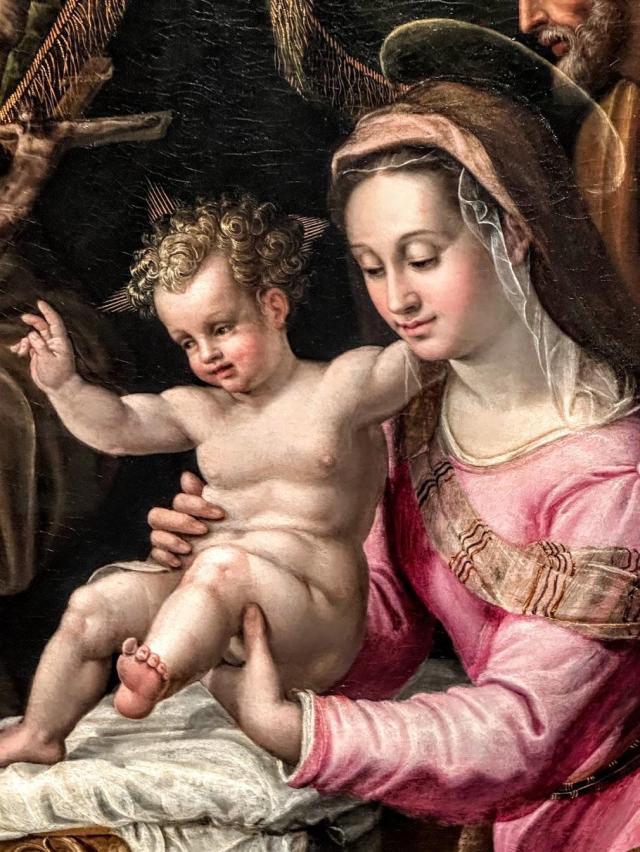
This is an oil on canvas painting, and there were at least 2 others by Lavinia Fontana in the Making Her Mark exhibit. I’ll show those at another time, with a few more tidbits of her extraordinary life.

In the meantime, should you be interested to learn more about her, you can check out the links at the end of this post, search her online or in libraries.
Barbara Longhi
Italian: 1552 – 1638
Known primarily for her religious paintings, Barbara Longhi’s work can be difficult to differentiate from her father’s work. Her father, Luca Longhi, was a renown painter and miniaturist. Barbara began her art journey, by assisting him with altar pieces.

She expanded beyond her father’s teachings by studying the works of Parmigianino and Correggio. Barbara painted primarily religious images, including several depictions of Madonna and Child with Renaissance style and features. I’m intrigued that parted drapes exposing landscapes was one of the elements.

Giorgio Vasari commended her for having “purity of line and soft brilliance of colour”.
Her ability to capture human interaction kept her one of the few successful career women of her day.
The Art Gallery of Ontario has obtained this 42.5 × 34 cm. oil on canvas painting for its permanent collection.
” Longhi’s painting, alongside two other gifted paintings by women artists (Mary Ann Alabaster (1805–1879) and Rosa Bonheur (1822–1899)), extends the AGO’s holdings of European Art by female artists three centuries deeper into the past.” – AGO
Photos © taken by Resa McConaghy – May 14, 2024
 Graffiti Lux Art & More
Perhaps of the beauty of the ‘Poem of the Cid’? Whatever it is, this is wonderful. Regards, TOF
Most interesting TOF. I had t look up ‘Poem of the Cid’. Thank you! I just keep learning.
I agree, these are wonderful paintings. I’m intrigued that the arts was an area where a few women managed to to be persons in their own right.
Another fabulous post on female artists, Resa! I love the light and glowing colors in Fontana’s painting.
(I thought ugly babies was a male artist thing, but apparently not. Also, the kind of strangely placed breast. 😉)
Thank you, Merril! I’m so excited about all the fabulous, female artists I’ve learned about from that 1 archival exhibition.
Now, by sharing the art, I’m learning more.
It’s unfortunate that the collection was only shown in 2 cities. It inspired me greatly and continues to do so.
(Hahaha! yes…the babies are … not the prettiest. Crazy how there are so many anatomical breast errors in a time when they painted so many nudes.)
You’re so welcome, Resa. Thank you for sharing. I’ll probably forget their names, but I’ll know where to go to find them! 😊
The babies and breasts always make me laugh!
Yay!
I guess breasts were not to be looked at in reality back then; only allowed in paintings.
I’m sure they were looked at! 😉
OH!
btw –
I went to the Jesse Mockrin exhibit at the AGO.
WOW!!!!!!!!
I can hardly wait to share the pics I took, and her messaging about women.
Wonderful! I’ll look forward to it!
In addition to the beautiful artwork, the history tells us of the struggles these women faced. I admire their talent and perseverance.
I agree Dan!
These sisters from the past managed to rise above cultural chains of their day. It seems to me that the arts was one of the few paths.
Thank you for checking out the post and your lovely comment!
Each of these artists has produced beautiful work.
Yes!
I’m slowly working my way through all of the art from the MHM exhibit. There were many, many female artists’ work presented, but only a small handful known today.
Thank you, Robbie!
YES!!!! Female artists. The ones we were never taught about in Art History. xxxxxxxxxxxxxxxxxxxxx Resa.
Agree!!!!
xxxxxxxxxxxxxxxxxx Shey!
Amazing art Resa !
These women were very talented.
Thank you for sharing 🥰
Agree, and thank you, Maggie!
Most of these women(from the Making Her Mark collection) have waited hundreds of years to be recognized, and celebrated..
I am celebrating my sisters from the past with. this series. 🥰
And it is wonderful that you are Resa 🥰
They deserve it for so many reasons!
Thanks again for the share.xo
Pleasure! xox
I love the art you share with us, and I aways learn so much from you. the hidden history of the female artists
Thank you, Beth!
First, I learned that these women existed when I saw the MHM exhibition.
Now, I am learning more about them, as I share the pics I took and some bios.
Here it is: a captivating collection of exceptional feminine art. Each painting showcases a consistent quality of womanhood. In particular, the Jesus by Josefa stands out—I have always felt that Jesus embodied a profound anima. 😉🤗💖👏💞🎯🎨
Yes, I agree with you on the Josepha painting portraying the anima in and of Jesus.
Great observation and comment, thank you Aladin!
xx❦🕊❦✨
My dear Resa, your wonderful article always inspires me.
🤗💕😘
❦✨🕊
What a feast! This was so interesting. Thank you for showcasing these amazingly talented women.
You are welcome Violet!
There’s more to come of these women artists, largely hidden in the past. They are coming into the light.
Oddly, some of that has to do with technology that allows us to see what is under the paint. It’s crazy how many men painted over women’s signatures with their own.
I so very much enjoyed this introduction to these three accomplished women artists of the 16/17th centuries, Resa.
Thank you, Jet!
I went to a show called “Making Her Mark”, that had a profound effect on me. It was about female artists from 1400-1800 whose work has largely and purposefully been been hidden in the shadows of time.
If you want to read about more of these women, the link to their posts is at the top of the side bar.
Thank you so much for visiting and this lovely comment!
Fantastic and informative post, Resa. I’m familiar with with many of these paintings, but did know much of the history of the artists.
Thanks Tim!
I’m enjoying researching these artists.
However, I only knew the Lavinia Fontana painting. The other 2 were totally new to me.xx
Between art history classes and visiting museums in Spain, France, and Italy, there are a lot of paintings I recognize, but I rarely remember the artists’ names.
Ahh, yes, you would have seen a lot of classic art in those 3 countries.
Although not large, our AGO has a decent collection of European classics.
However, the AGO’s claim to art collecting fame, is the world’s largest collection of Henry Moore sculptures, and the largest Group of Seven and Tom Thompson paintings.
The Group of Seven and Tom Thompson’s work is stunning, but it fails to captivate me.
In Madrid, we went to the Prado and Reina Sofia every week on their free admission days. When we spent 3 weeks in Paris in 2013, the apartment we rented was 1 kilometer from the Louvre. We bought passes for the Louvre and went every day except the day it was closed because el presidente was there. Then we made the rounds to all the other museums from one day to the next after spending a few hours in the Louvre. We were a block from the Opera House, and did get to see an opera, Caesar and Cleopatra. It was expensive, but what an amazing production.
Wonderful!
It’s so perfect that you took advantage while you were there!
It is so interesting and fascinating to read and to learn about those female painters one had never heard of during art education! Thank you so much, dear Resa!
Have a wonderful weekend!
Yes, it seems in art education I learned only about some male artists. I’m thrilled the women and their art is coming into the light.
Have a fab weekend too, Martha! xxx
I’m familiar with Josefa do Obidos but not the other ladies. In this age of ours it seems very odd to have to hide behind a man’s name to produce painting or literature xx
Agree! I’ve enjoyed personal freedoms ever since I left home.
Still, many women in the world are not free. Men still own them and their bodies.
Thank you for popping by, Jo!
xx
Beautiful, Resa. Such accomplished women. Thanks for sharing.🐂
Agree!
And accomplished in the era they lived is a big deal.
I love sharing this art.
🎨𝓧 🐂
You share it so well, too. 😊X
Many thank you’s! 🌟X 🎄X
😀X
My computer is dying. Stays on for a minute or 2 then goes black. Need to buy a new one. See you asap! OX
Oh dear. OX
OX
I was unaware of these women artists, Resa. Their recognition accompanies the recent rediscovery of women composers, whose works I often hear on CBC classical music programs and elsewhere.
YES!
It’s crazy Audrey. It’s still a man’s world, by and large. We are lucky enough to live where we do.
No radio in Afghanistan!
Women in the Middle East … pathetic positions in life.
There’s history and herstory.
Herstory has not been heard enough, or loudly.
Thank you so much for sharing these wonderful paintings, with your interesting explanations, dear Resa
It is my pure pleasure, Luisa. Thank you!
Resa, Making Her Mark has truly been an extraordinary journey into the past. What moves me most is how these women do not remain “historical” once you sit with their work. Their lives, choices, and courage speak directly into our present moment. Seeing Josefa’s independence, Lavinia’s mastery amid family life, and Barbara’s quiet devotion reminds us that influence does not fade with time. The past is not finished with us; it continues to shape how we see, create, and claim our place in the world today. Thank you, thank you, thank you, for bringing these voices and visions forward with such care.
OMG!
You are so welcome, Rebecca!
“Making Her Mark” had a profound effect on me. There’s lots of women’s paintings left in the collection, for me to share.
And, I went to the Jesse Mockrin exhibit at the AGO 2 days ago.
WOW!
Hers is a new voice, on old & new matters concerning women, and society.
Her work is stunning. I’m so excited to share it in the New Year.
Resa, I agree wholeheartedly! Making Her Mark does really does open doors. Once you step into that lineage of women artists, you start seeing how much is still waiting to be uncovered and shared. And Jesse Mockrin at the AGO! WOW!!! Ican’t wait to see how you bring her work forward in the New Year. There’s something deeply satisfying about watching these conversations between past and present continue to unfold.
I agree!
Not sure how much I will be online next coming days. Computer keeps crashing. I’m getting a new one. I don’t want to go to the Apple Store. I’m going to a small Apple/Mac licensed & products shop up the street.
At least I’ll be supporting a small local business AND it’s owned and run by women!
HUGS!
Resa, that sounds like a wise and very you decision. Supporting a local, women-run shop feels like a very meaningful act. I hope the new computer brings ease and fewer interruptions. Been there – very frustrating!!! Hugs right back to you. 🤗
It’s up and running!
Hopefully there will be no new computer hiccups.
I feel $$ poor, but happy!
Hugs!
🤗🤗🤗
🤗🤗🤗
Thanks for sharing your insights, Resa, and giving some light to the work of long ago women artists. I supposed painting subjects that were “Godly” helped their work be acceptable to people of the time. Have a wonderful weekend. Big hugs.
Yes, religious paintings and paintings of women’s domesticity were most accepted.
Still, there were very few female artist.
Then portraits and allegories were okay, if you were in the right circles. Most of the women who did portraits trained under their portrait painting father or other male relative, and inherited clients.
You have a fab weekend, too! Hugs! Big!
Many thanks for researching these artists and telling us their stories, Resa. The links page alone will keep me reading for several visits!
You are welcome, Cheyenne! I’m quite enjoying learning about our sister artists from the past.
I would like to have known the emancipated Josepha Ayala. I love that her Christ-child in Mary’s arms has some dirt on the sole of his foot.
It’s crazy that Josepha’s parents had to give permission in writing. Talk about being a prisoner without bars.
Ha! I just checked out the dirt on the foot.
Someone give that child a bath!
That permission document is what captured my attention! I thought the dirt on the foot was a subtle expression of Christian theology (God made man).
A permissions document, for a woman to live her own life … uch.
This morning I saw a report on how Iran is having a water crisis. The taps in Tehran are just dribbling. Some believe the drought is the fault of women who are not wearing hijabs properly. Guess “they’ll” just have to remove whatever permissions woman have, to stop the drought.
UCH!
Interesting thought on the foot dirt. (God made man, or did man make god?)
Blaming a drought on women’s attire?! That’s really backward, even for Iran.
Agree!
Another wonderful post, Resa. So informative and you brought those lost artists to the forefront. Applause.
They deserve forefront, along with the men who got all the glory.
All this art makes me happy!
Informative, fabulous, and Festive! Savoring, especially the Christ Child as Pilgrim🇵🇹💙🌾
Christ Child as Pilgrim – that was one of the first paintings I saw at the exhibit. I was amazed and amused at this vision/version of Jesus.
I never saw anything like it.
❦🌟🎄
Resa – you do such a great jobwith researching these artists and sharing thei stories with the art!
Yvette!
I love doing these posts.
The show – Making Her Mark – effected me greatly.
It was inspiring and maddening all at once.
The aim of the show was to bring these female artists out of the corners of history, and into the spotlights of herstory.
I’m just keeping it going!
🎄🌞🎄
❦🌟❦✨🕊
So beautiful, Resa, and wonderful that these women were able to make careers for themselves so long ago. That’s so rare. I’m not especially drawn to religious artwork as a theme, but knowing the histories of the artists makes me sit up and take note. Lavinia Fontana’s style is lovely. How did she ever find the time with 11 children!!! I look forward to learning more about her. 😀
Howdy Diana,
I’m not drawn religious art, either. However, like you I appreciate the talent and the history that art leaves us with, especially (primarily for me) women artists.
I would never have guessed the art world to be as sexist as it was, and still is to a notable degree.
I’ve been mostly going to women’s art exhibitions at the AGO. I went to the Rembrandt show – yeah! but meh!
In February, I will attend (really looking forward to it) the collection of Paul McCartney’s photos from 1968/9. ❦🌟❦
That sounds cool. And we need to celebrate and validate the work and contributions of women, even today. That’s a given! Thanks for doing your part!
I love this beautiful and insightful post about female painters, Resa!! The paintings are striking, all the meticulous details, gorgeous colors, etc. Simply amazing! It’s too bad bad that some like Josefa de Ayala had to pretend to be male artists in order to not be forgotten… what a travesty. Whoa, Lavinia managed to juggle her life as an artist and care for 11 children, I honestly have no idea how women could do all of that. I could barely keep it together and I don’t have a single kid, mwahaha!
Barbara Longhi’s painting is the most unique, I don’t think I’ve ever seen a painting of Mary nursing baby Jesus before. I too am intrigued by the landscape exposed by the parted drapes! Thanks for sharing this magnificent art, you’re the best, Resa!! XOXOXO
I love sharing this art, and I love you because you want to see it!
Many posts still coming up.
I’m buried alive in posts I want to see, and emails. I had no computer for 3 days. Had to run out and buy a new one.
I’m $$poor, but happy!
XOXOXOXO
Oh no! Sorry to hear about your computer, I really can’t imagine even a day without my laptop… but then again my daily work involves computer use, ahah. Well, your comeback post is such a delight, so well done!! ♥︎ · 𑣲 · ᢉ𐭩 · ❦
I’m enjoying your celebrating women of the arts series, Resa. So many talented women without proper recognition. You’re giving them respect. But I do have to say, that portrait of the woman breast feeding is not properly scaled. I’ve never seen breasts that rest not far below the neck, lol. Holiday Hugs 🥰💜💜❌⭕
Thank you dear Debby!
Yes, it has been pointed out, and I have noticed many times that many artists of the far past were often anatomically wrong with women’s breasts.
I guess the made love in the dark, or just closed their eyes….. so as not to sin, possibly.
❦🌟❦xxxx
Lolol, you’re hilarious. Or perhaps, men are timeless for not understanding women. 🤣😍🧡🧡❌⭕
YES! I just knew there was something about timeless about men…. and I just don’t mean they’re not wearing a watch!
xo❦🌟❦🕊🎄🌹✨
🤣😂🤣😍🧡🧡
Such an extraordinarily gifted artist. Her paintings are exquisite. I couldn’t dream of choosing a favorite each and everyone is perfection. Thank you so much for sharing these Resa. So many wonderful female artists in the world , past and present and I’m quite sure future.
❤️
xoxoxoxoxo
Thanks Meece!
I love showing their work.
Lots more to come.
xoxoxoxoxoxo
it’s so beautiful it’s jaw dropping. So delicate and soft , lifelike.
xoxoxoxo
They really did paint to capture life.
When I think about it, the Camera Obscura was invented in 1826 & then the Daguerreotype in 1840’s was the beginning of art taking on new forms, like Impressionism… then on to other styles.
We didn’t have to paint reality if cameras captured it for us.
Just a thought.
xoxoxoxo
I’m fascinated by the paintings, but what really caught my attention was the fact that so many were essentially apprenticed to their fathers. I couldn’t help wondering whether that might have been because there were no sons in the family? As an only child, I know my Dad lavished a lot of time and ‘teaching’ on me because he had no one else. Probably helped that I was a chip off the old block too. 😉
No sons… possibly. Good thought, Meeka.
And yes, apprenticing for fathers and uncles was a big thing.
Thanks for reading and the cool comment!
LOL – You were a chip off the old block – I was chipped off the old block. (became the black sheep) 🤗
LMAO! And what a talented black sheep you became.
Baaaaa!
🌟❦🕊🎄
Lmao – have I told you that we have two Dorper sheep? They’re the ones with black faces. Our two woolly dogs. 🙂
Ohh, how wonderful! ❦🌟
They’re wethers and have so much character! Let’s just say we were surprised! lol
It took a lot of guts for women then to make their own way.
Great post. As a note don’t you find the costumes wonderful? A testimony of each period… (I’m sure you’re thinking: ‘Hmm. That’s a neat drapé.”)
My goodness! These paintings are remarkable. Cheers to Josepha!
These paintings, I agree, are fabulous.
It’s about time women artists, from herstory, are having a light shone on them.
Yes, Cheers to Josepha!
Thank you for checking out the post, and leaving this lovely comment, Jennie!