
Welcome back to another instalment of Making Her Mark! I’m joined by Rebecca Budd, curator of Chasing Art to discuss how the poor were documented, by female artists.
Resa – Welcome back, Rebecca! As you point out in your introduction, times were changing. Do you have a main take away from your research?
Rebecca – Thank you for the opportunity to participate in this amazing look back into art history, Resa. One key takeaway from my research is how Geertruydt Roghman, Catherine Brandinn, and Maria Louisa Catherine Cecilia Cosway used their artwork to honour the ordinary moments of life. I was inspired by how these artists challenged societal norms and created space for the voices of the underrepresented.
Resa – We’ve had many amazing sisters. Well, let’s have a look at these 3, with art as our window.
16th Century
In the sixteenth century, change was in the air. Northern Europe witnessed a significant cultural shift as the Protestant movement emerged, challenging the established norms of the Catholic Church. This movement advocated for a personal connection with God, eliminating the need for church intercession.
Art responded. Religious imagery became less prominent, as the focus shifted away from traditional depictions of saints and biblical scenes. This transference in artistic focus not only reflects the broader societal changes brought about by the Protestant Reformation but also underscores the importance of recognizing the value of everyday experiences in art.
17th and 18th Century
During the 17th and 18th centuries, the art world was dominated by the portrayal of aristocracy and religious themes, leaving little room for the representation of ordinary people. The prevailing social hierarchy and the patronage system dictated that artists primarily catered to wealthy patrons who commissioned works that glorified their status and achievements. This resulted in a paucity of artworks focusing on the lives and experiences of the common populace, who were often relegated to the background of grand historical or mythological scenes.

Geertruydt Roghman
Dutch – 1625 – 1657
Geetruydt Roghman was born in Amsterdam into a family steeped in artistic tradition. Her upbringing in a creative household, with a father who was an engraver and a great uncle who was a celebrated painter, likely influenced her perspective on art.
A Pioneering Figure
Artists began to explore new themes that reflected the everyday lives of individuals, leading to a rich tapestry of subjects that resonated with the public. Geetruydt Roghman dedicated her work to depicting ordinary women engaged in their daily tasks. Her series not only showcased the realities of their lives but also contributed to a broader understanding of women’s roles in society during the seventeenth century.

Despite her limited output, Geetruydt Roghman’s work offers a glimpse into the lives of women, challenging the norms of her time and highlighting the importance of their stories. This marks her as a pioneering figure in a time when few artists chose to highlight the experiences of women. .
Celebrating Geetruydt Roghman’s Art
Exploring Geetruydt Roghman’s engravings on paper allows us to connect with the essence of humanity, as they capture the nuances of everyday life and the stories of real people who lived before us. These sketches serve as a mirror reflecting our shared experiences, emotions, and struggles, reminding us of the beauty found in simplicity.
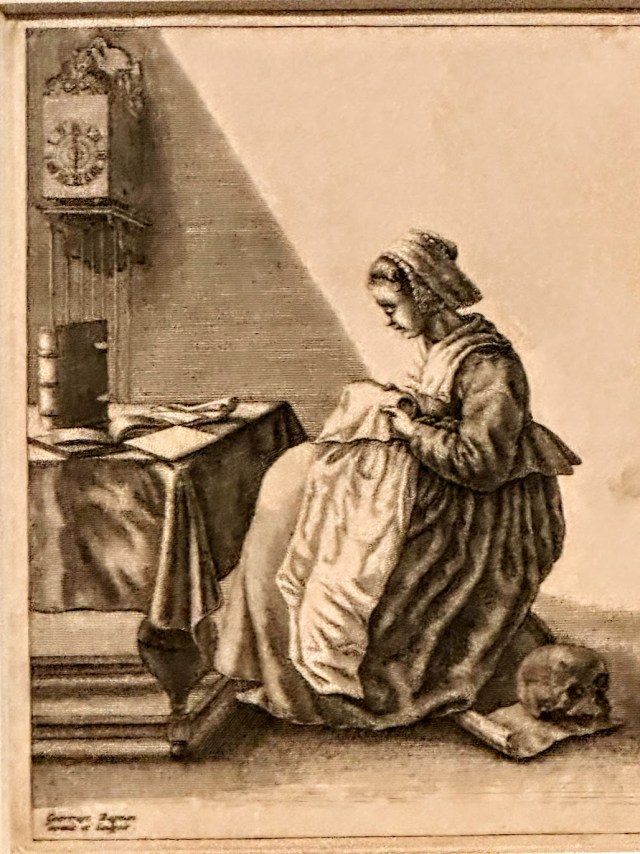
By exploring Geetruydt Roghman’s work, we gain understanding into diverse cultures and perspectives, fostering empathy and understanding in a world that often overlooks the significance of the ordinary. Such examination not only celebrates the artist’s talent but also encourages us to appreciate the richness of human existence in all its forms.
I believe that Geetruydt Roghman invites us to appreciate the beauty and significance of the ordinary, enriching the narrative of art history.
“Making Her Mark” exhibition encourages a reevaluation of her work, which advocates for the recognition of everyday life as a worthy subject of artistic exploration.


Note how small these engravings on paper are. They are in 8 x 10 frames.
Counter clockwise from the top: Young Girl Sewing – The Dressmakers – Woman Spinning
1640 – 1647
Resa – Amazing art history, Rebecca. Now, on to Catherine Brandinn! You had some difficulty gathering information about her. For a while it looked like all we were going to have to remember her by was her art. Then you discovered Johann Christian Brand‘s name appears alongside hers, which seems to muddy the waters. Do you think this is another case of the disenfranchisement of women in the arts?
Rebecca – I was fascinated by the connection between Catherine Brandinn and Johann Christian Brand, which highlights the complex interplay of gender and recognition in the art world. Without question, Catherine Brandinn’s artistic legacy has often been overshadowed by the presence of Johann Christian Brand, whose name frequently appears alongside hers.
This phenomenon raises important questions about the historical disenfranchisement of women in the arts. The association of Johann with Catherine could suggest a similar pattern, where her identity and artistic achievements are overshadowed by his prominence.
However, I believe that there may be another explanation. Consider that Johann Christian Brand’s recognition may have been a means of validating Catherine’s work. In a time when female artists struggled for acknowledgment, the inclusion of a well-known male figure could lend credibility to her art. Consequently, while Johann’s association with Catherine may complicate her legacy, it could also provide a platform for her art to gain the recognition it deserves.
Resa – You make a good point how difficult it was for women to be recognized in the arts. We may never know of Johann Christian Brand’s intent. However, her art is remembering her, not him.
Catherine Brandinn
Austrian? 18th century

The history of painting has predominantly celebrated the lives of the elite and significant events, often neglecting the stories of ordinary people. This selective representation raises questions about the value placed on different experiences and the narratives that have shaped our understanding of the past. The absence of everyday moments in art suggests a hierarchy of importance, where only the lives of the wealthy and powerful are deemed worthy of immortalization on canvas.
If painters had chosen to depict ordinary moments, our historical narrative would be richer and more inclusive. Imagine a world where scenes of daily life, community gatherings, and simple joys were captured alongside royal portraits and grand battles. Such representations would not only provide a more comprehensive view of society but also highlight the shared human experience, fostering a deeper connection to our collective history.
The transition in art from religious themes and the portrayal of affluent patrons to the representation of ordinary people began during the Renaissance and continued into the Baroque period. This shift marked a significant change in the subject matter of paintings, as artists started to explore the lives of the common man, and the beauty found in everyday activities. The rise of humanism encouraged artists to focus on individual experiences and emotions, leading to a more relatable and accessible form of art that resonated with a broader audience.

Catherine Brandinn portrayed ordinary people, capturing the essence of everyday life through her unique artistic lens. Her work often reflects a deep appreciation for the beauty found in the mundane, showcasing individuals engaged in daily activities. Her name is intricately linked to artist, Johann Christian Brand. This connection raises questions about her identity and the role this artist played in her life. When the artwork of Catherine Brandinn is viewed, Johann Christian’s name often appears alongside hers, suggesting that her narrative is largely defined through her relationship with this artist. This intertwining of identities hints at a deeper story waiting to be uncovered.
Catherine Brandinn’s painting, “Mädel mit Waldholz (Peasant Girl Carrying Wood),” created in 1775, captures a poignant moment in rural life. The artwork portrays a young peasant girl, her delicate frame burdened by a large bundle of wood, symbolizing the labour and resilience of women in agrarian societies. Catherine Brandinn’s use of soft colours in her engravings on paper evokes a sense of warmth and intimacy, inviting us to appreciate the girl’s strength and determination amidst her modest surroundings. The composition of the painting draws attention to the girl’s expression, which reflects a mixture of pride and fatigue.

“Mädel mit Waldholz” stands as a testament to the often-overlooked contributions of women in history. By focusing on the everyday tasks of a peasant girl, Catherine Brandinn elevates her subject to a figure of dignity and importance. This image encourages us to reflect on the narratives of those who have historically been marginalized in the art world and society at large.
Resa – So Rebecca, we move on to Maria Louisa Catherine Cecilia Cosway. You mentioned that in researching Maria Louisa Cosway, you saw lots of her artwork, but not this one particular work Home Industry, that showed at “Making Her Mark”. Do you think I’m crazy to think that we have something special here?
Rebecca – I don’t think you’re crazy at all, Resa. I am beyond thrilled that you were able to capture Home Industry in a photo. You have an amazing ability to find art treasures wherever you go!! Home Industry” is a gem!!
Maria Louisa Catherine Cecilia Cosway
English – 1760 – 1838
Maria Louisa Catherine Cecilia Cosway, an accomplished artist of the late 18th and early 19th centuries, was known for her diverse portfolio that included both prominent figures and ordinary individuals. Born in 1760 in Florence, Italy, she moved to England where she became a prominent portrait painter. Her ability to portray significant historical figures speaks to her talent and the esteem in which she was held in artistic circles.
A Progressive Artist
Maria Cosway’s artistry extended beyond the elite, as she sought to represent the lives of everyday people in her work. This inclination towards inclusivity allowed her to bridge the gap between different social classes, showcasing the beauty and dignity of ordinary life. Through her artwork, she celebrated the humanity of her subjects, making her art accessible and relatable to a broader audience. This commitment to portraying a diverse array of individuals marked her as a progressive artist for her time.
Home Industry tells a story of resilience and the quiet strength found within the home, serving as a reminder of the essential work that occurs beyond the public eye. Through her portrayal, she elevates the mundane to the extraordinary, encouraging us to recognize and honour the stories woven into the tapestry of domestic labour. It is a nostalgic reminder of a time when craftsmanship flourished within the domestic sphere, emphasizing the value of handmade goods and the skills passed down through generations.

We are invited to reflect on the importance of labour in a rapidly changing world and consider the implications of progress on the cultural fabric of society. During the late 18th and early 19th centuries, when Maria Cosway created this piece, the landscape of work was undergoing significant transformation due to the onset of industrialization.
Cottage industries, which had long been a staple of rural economies, faced increasing threats from mechanization and factory production.
This piece tells the story of a specific moment in time, evoking a narrative about the challenges faced by families during the industrial revolution. As industrialization encroached upon traditional ways of life, this artwork stands as a testament to the resilience of home-based labourers.
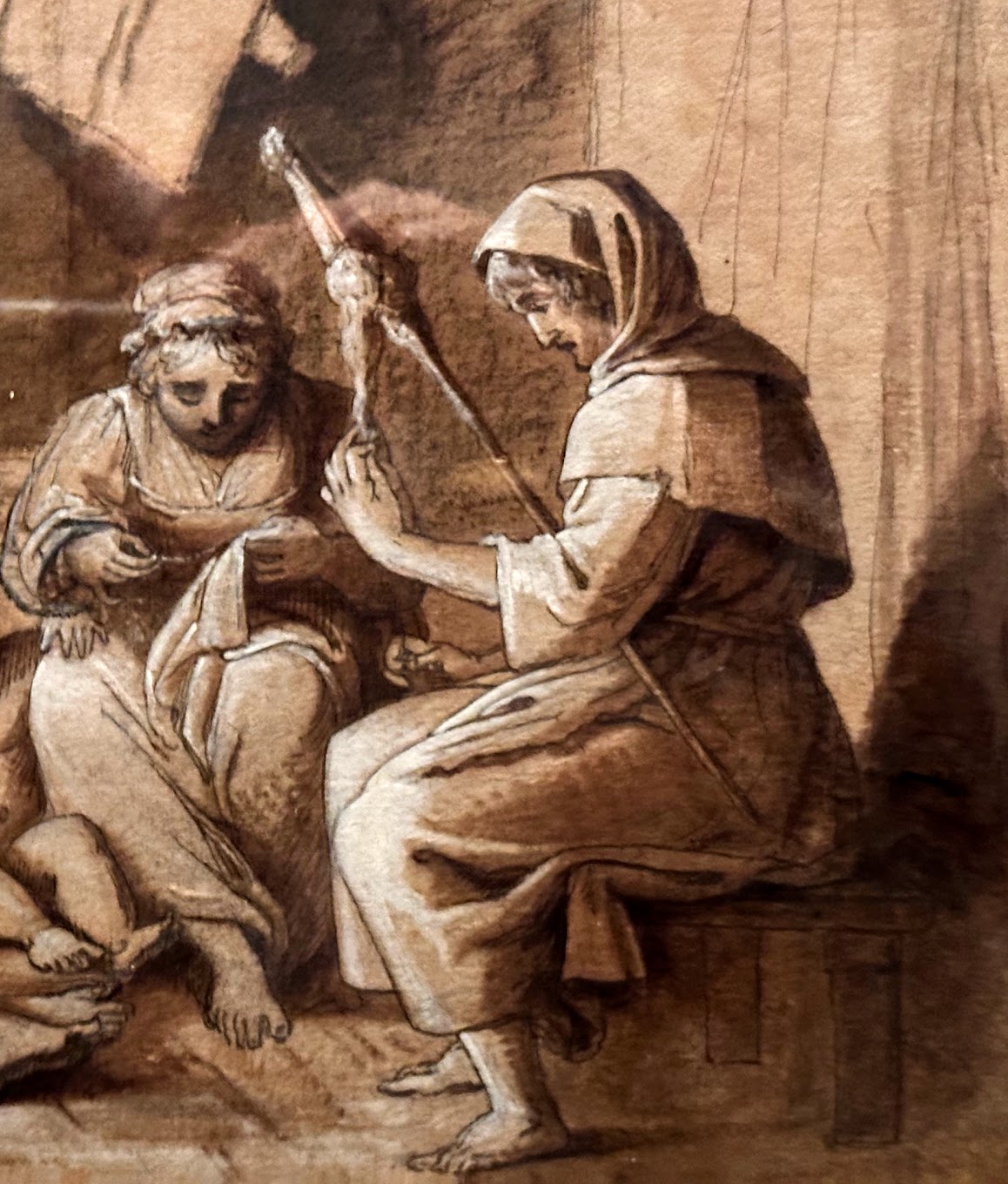

Home Industry also speaks to our time in history and is a relevant reflection on the balance between innovation and tradition.
Resa – Wow! Thank you Rebecca! Your co-hosting here on the “Making Her Mark” series has made it a much richer experience. Still, there’s lots to go. May I be allowed to try and tempt you to co-host another time, no rush, just sometime in the future? I have some juicy topics and artists I can present to you!
Rebecca– Hi Resa! Thank you so much for your kind words! I’ve truly enjoyed co-hosting the “Making Her Mark” series with you, and I would love to collaborate again in the future. Your topics and artist suggestions sound exciting, and I can’t wait to hear more about them. Let’s definitely keep the conversation going!
Resa – Yahoo! You know Rebecca, we might just be artoholics!

Click on above banner for source information!
Photos taken by & © Resa McConaghy – May 14, 2024
Art Gallery of Ontario, Toronto, Canada
 Graffiti Lux Art & More
The days of the rich and the poor and nothing in between. So sad. A splendid blog, as always. It’s a fine read, Regards, TOF
Hello TOF,
Yet, it seems today’s world is still largely rich and poor, with a mere splattering of middle class in between. Thank you for taking the time to read, and now that you’re done, please give Rosie a pet for me!
Thank you Mike, for your heartwarming comments. Resa’s idea to feature ordinary moments resonated with me. She has the best ideas, doesn’t she?
I adore our art chats!!!!
Another interesting series! I liked how many of these artworks focused on women’s work.
Maria Cosway’s career coincided with the time when cookbooks began to be popular in Great Britain and the US. These books also included housekeeping and childcare advice and home remedies for illnesses, as many women no longer lived near their female relatives who would have helped them.
Home Industry is poignant with its sleeping babies around the toiling family members.
(You might want to correct the bold typo in the first line. 😊)
Merril,
THANK YOU for pointing out the type O! Yet, another of my many humiliations. I checked my working draft, and apparently I was writing about Mer People from draft 1.
I love your knowledge of history. It is intriguing & sobering to think that the advent of cookbooks and housekeeping tips books coincided with the industrial revolution.
Does this speak to a larger middle class?
As today, modernization makes some wealthier, and leaves some behind. The poor babies sleeping around the toiling poor is a sad statement. It seems for the lower classes early childcare was and still is an issue.
These works of art were all there was at MHM, out of about 325 pieces, that depicted the poor.
There is lots left to share, but I thought the Poor deserved a spot near the beginning.
You’re welcome, Resa! I do that sort of thing all the time.
I think middle class would be later in the century, and then you get Godey’s Lady Book and such.
I’m reading a novel now where the narrator is telling about her time in a rural, isolated part of southern Italy in the 1960s, not 1860s. There is no running water, little education, (also archaic views on rape and no divorce), and she is trying to set up a nursery school.
This might be where we’re headed.
Thank you for sharing the art!
Thank you Merril for your comments, which opened a rabbit hole that I had to jump into. The cookbook idea reminded me of my grandmother’s cookbook that I have carefully stored away. She even had soap recipes from her mother. One of the first notable cookbook publications was “The Virginia Housewife,” written by Mary Randolph in 1824, which became a significant reference for home cooking. Anyway, I found the cookbook on Amazon.ca for free. I am beyond excited.
You’re welcome, Rebecca. A fun rabbit hole to go down!
Yes, Mary Randolph’s was an important early cookbook, but there were a few important ones earlier, such as Hannah Glasse and Amelia Simpson. Back when I did research on this, I found a bunch of digitized cookbooks at the Library of Congress. There were lots of them in the late 19th century and early 20th century that are fun to read. Probably there is something similar in Canada.
I am so grateful for the digitization process, Merril. Heading over to the Library of Congress. The past becomes known!!!! I LOVE our conversations – thank you.
You’re welcome, Rebecca!
💙
Rabbit hole…you mean Rebecca Hole?
Lol, kidding, but you are a researching Tasmanian Devil.
Ahh, the cookbook sounds very cool.
Maybe you should publish your grandmother’s cookbook?
All I see, is, women, being, OPPRESSED by their assigned sex, because we’re women, are we, destined to, SLAVE our lives, away???
To your point, yes, many women do slave their lives away. Many men do as well. Perhaps it’s not only an enslaved female issue, but also an enslaved population…by the extremely wealthy.
“Half of the world’s net wealth belongs to the top 1%. The top 10% of adults hold 85%, while the bottom 90% hold the remaining 15% of the world’s total wealth.”
Women have had, and still have in many countries, a raw deal. In some countries, we have a better deal but still not equal.
I did search it, again. Iceland comes in #1 with 91.2% equality to men. Then Denmark. The USA & Canada are not even in the top 10.
The USA is #43 in gender equality. Canada is #30.
Women will always be lesser in any society that is ruled by wealthy patriarchs.
Then there’s religion adding to the issue of female inequality.
So yes, considering the past, until now and into the foreseeable future our assigned sex destines us to be lesser in society.
I have enjoyed this look back into history because it is upon reflecting of what has come in the past, that progress continues. As we examine this historical context, it becomes clear that the challenges women faced were not merely a reflection of their capabilities but rather a complex interplay of societal attitudes and structural inequalities that have persisted over time. Understanding these dynamics is crucial in acknowledging the contributions of women in the art world and advocating for a more equitable representation today. I am cheered by art exhibitions such as Making Her Mark. I am cheered by the strength of character and courage is displayed in the women featured in this post. One of my favourite artists of today challenged me with these words:
“The only thing I have learned is to find strength in yourself. No one can help you, no one can do anything for you, you have to do the work yourself.” Marina Abramovic, performance artist
Well said Marina Abramovic, and Rebecca!
Thanks for sharing. Catherine Brandinn’s art is my favorite; it’s so moving — the Peasant girl Carrying Wood, her eyes fixed on the ground in front of her, moving forward step by step, carrying her load. Depicting everyday, mundane, activities can reveal so much. A great series, indeed! Thanks for sharing 🌸😊💜
Thanks for the visit and comment Ada!
I like Catherine’s art as well. She does depict the harshness of a poor female’s life in her time, in a heart rending light.
Unfortunately many women are still living a life of harsh labour. Women and girls walking with buckets or giant urns/pans of water on their heads come to mind. Back and forth, from a water source, all day is what some know of life.
Art, all the arts are definitely windows into our past, and present.
i am so pleased that you enjoyed this look back into history, Ada. I am honoured to be collaborating with Resa on featuring remarkable women artists that have broken down barriers. They challenge me to live boldly and embrace my creative spirit. When I look back into my life, it is not the grand moments that I treasure most, but the small seemingly insignificant events that gave my life meaning – washing dishes with my grandmother, listening to music with my father, sewing a dress with my mother.
Right on!
A visit to an exhibit that keeps giving… Well done both in photography and history (My photos of drawings and paintings are always awful).
Very interesting artwork. It is great that these ladies gave us an eye into a world that isn’t seen as much as the large and “noble”.
A lot to comment on, but I will keep it short – I find it interesting that in “Home Industry” a broken window hangs open to a winter world exposing those half naked people to the freezing cold. Brrr. I hope they are gathered around a fire, or at least hot coals, though the one poor baby is just under that open window. I hope that was more symbolic than real, but I know that the poor freezing to death was a reality.
Anyway, can’t wait for another installment!
Trent,
Thanks about the photography. There are so many issues taking pics of art. In the art gallery, the lighting is difficult to shoot around. In some instances impossible and unforgiving. Glass, plexiglass cases, sheen of the oils and the frames are also hindrances.
Yikes, I hadn’t thought of freezing to death. Just looking at Home Industry makes me shiver. Whether or not symbolic in the painting, it’s probably an honest statement of the reality.
This was a difficult topic to research, and Rebecca did a marvellous job. Catherine Brandinn and her artwork in particular are mired in the fog of history.
I’m excited about more instalments as well. You are right, the exhibition just keeps on giving!
Yes, Rebecca did a great job researching it all.
I’ve photographed art in several museums and in a few small galleries, and, yeah, a lot of issues!
Trent, thank you for knowing how hard I work trying to capture the pieces! It means a lot to me.
Of course many patrons at the gallery think I’m nuts.
I really enjoyed your comments, Trent, especially the detail that you brought out Home Industry. The poor freezing to death was a reality. In Canada where winters are extremely cold, this reality continues to be a challenge.
Yes! I went almost a week without central heating, but had a few space heaters. I kept thinking about all the people on the planet going without heat.
You did a great job with these three ladies and their art 🙂 It has been a very cold winter in New Hampshire, so that open window was the very first thing I noticed.
Slightly different subject, that picture in particular reminded me of in the book “Bleak House” the visit they made to the house of a very poor laborer.
Yes, Dickens painted the poor with his words.
Fantastic conversation and information, Resa and Rebecca! It’s great when “everyday” people are represented in paintings.
Thanks Dave!
Rebecca is so fabulous to chat with about art, and the history it reveals.
I’m grateful for her research and input. I was wildly inspired and learned a lot at the exhibition. Rebecca has helped expand the knowledge for me.
Out of about 325 works, these were all that depicted the poor. If women were marginalized, the poor are all but forgotten.
Yes, Resa, different levels of marginalization… 😦
You and Rebecca bring a LOT of knowledge to your conversations and posts!
Thank you, Dave!
I think Rebecca is the bees knees!
🙂
Thank you, Dave. The question that I asked myself when I was in the middle of the research was: Do artists today continue to focus on important people and notable events. Or is there more equality in our art. Do artists feature ordinary moments today? There seems to be movement in this area, which reflects a broader societal interest in inclusivity and the recognition that everyone’s story holds value. However, traditional art forms continue to celebrate historical figures and pivotal events, emphasizing their impact on culture and society.
That was an excellent approach for you to have, Rebecca! I think there is more equality in art today, though of course there’s still plenty of emphasis on the rich and the “important.”
There is indeed, Dave!
👍
I’d like to see a poor nobody on the cover of “Time”. Person of the Year? Why not? 1 poor nobody representing all the poor nobodies in the world is a powerful statement.
If it’s based on a person’s influence and importance in a given year, don’t the poor have a massive influence en masse?
Apparently not.
I like the way you think, Resa!
😊
🙂
I think the art of photography has opened up the creative narrative on everyday people.
Great observation, Resa!
Thank you, Dave!
You’re welcome, Resa!
I agree wholeheartedly!!!
🤗
This is a super post. Great conversation and wonderful images for the exhibit.
Thank you Tim!
It was such an inspiring exhibit. Rebecca has been a huge bonus adding to my knowledge of what I saw.
It’s a lot of art fun with her!
Thank you Tim!! Resa was able to gather a treasure trove of images from the Making Her Mark exhibition. I felt like I had been there at the AGO with her.
You were there with me… and at the Tissot exhibit. I can’t even walk by the AGO without thinking of you.
Hi Rebecca, three impressive female artists linked by their attempts to portray ordinary women. Very interesting to me. Thanks for hosting, Resa
Hello Robbie!
Rebecca sure had her hands full researching this art. The poor are not art and history’s fave topic.
In an exhibit of about 325 pieces, this is all that depicted the lives of the poor women, et al.
There’s lots of art remaining and Rebecca will be back to help with some in the future. Yay!!!
Hi Resa, I can believe that the poor and their plight were not popular. These were also topics van Gogh explored and why he painted The Potato Eaters. I look forward to further collaborations between Rebecca and you.
Thanks Robbie!
As you know, colabs are a lot of fun, and satisfying!
Yes, they are fun.
Thank you Robbie. Resa’s idea to feature the “Making Her Mark” exhibition has enabled others to experience the beauty of an evolving art world. It was an honour to collaborate with Resa. She has the most amazing and creative ideas.
🌹
Hi Rebecca, you are right. You make a great team.
😊
Thank you!!! Hugs!
Hugs
I really enjoyed reading this piece. It is always nice to see history and how art is changed by the times.
Honestly, I look at the photographs you took of these famous paintings and it feels like a reminder of how women have always had such a hard time. The drudgery of being a women during these time periods you cover. Also the reminder of how everything resolved around the rich for so long. I love the women’s art you chose to focus on and my favorite piece is Catherine Brandinn.
I really enjoyed this conversation:
“This phenomenon raises important questions about the historical disenfranchisement of women in the arts. The association of Johann with Catherine could suggest a similar pattern, where her identity and artistic achievements are overshadowed by his prominence.”
I also agree that it would have added so much to have included the art depicting the poor, those who showed the challenges of the working folks, along beside those who were rich, for example all the royalty you see when you visit a famous museum like the Prada in Spain. Although I could have spent a month there so easily. However, I thought that was a very good point.
Thank you so much for sharing this interview and your great photos with us, Resa. I love hearing about the challenges women faced in getting recognition for the great art they do. This is just a reminder to me that after all these years, it is still a man’s world.
Great post and I don’t know how you got such great photos of these famous paintings as I can never get a perfect photo of my own collection and yours are gorgeous. Big hugs and blessings, Joni
I am beyond delighted that you enjoyed this post, Joni!! Resa has the best ideas and her ability to capture these art pieces with her camera made it possible for us to gain a greater understanding about the evolution of art.
I loved it. So well written and the photos of the art were excellent. I loved the women you picked and your interpretation of each one along with the history. So thank you and Resa again and I think you truly did a phenomenal job both of you. Thank you for recognizing women that deserve to be in the spotlight. It was an honor to read it and look at their works. 🤗
There’s more coming!
The main thing I saw at the Making Her Mark exhibition was how fabulous and talented women were.
The art world has begun to give us our due, but I fear many from the past will be hidden under a dense fog of history.
Well you two did an amazing job I will be watching for what talent you discover as it is fascinating. I really did enjoy it. Have a wonderful weekend coming up. Big hugs 🤗
Same to you!
Bigger hugs! ❤️❤️❤️
🌟
Oh, you two are positively artoholics and your art journey is absolutely fascinating! Thank you both for such a wonderful post!
Hugs and love!
xoxoxoxoxoxoxoxo
I LOVE that title, Marina! Artoholics!!! I am so pleased that enjoyed this discussion. I learned a great deal from collaborating with Resa. She is so much fun and her ideas open up many rabbit holes for me to jump into!!!
🐇🕳 ❦
You are welcome dahling Marina!
Of course as far as artoholics go, it takes one to know one!
Hugs and Love!!!
xoxoxoxoxoxoxoxoxo
A lovely post, Rebecca and Resa. You certainly have some amazing discussions for which I’m grateful.
We are most grateful for your presence, John. Your support and encouragement of these conversations are truly heartwarming. Many, many thanks!!!
😊
Thank you, John!
My discussions with Rebecca have made my world richer.
🎨𝒳
I can imagine that, Resa 🌎X
What a lovely comment to read this morning, Resa. Thank you.
Hugs!
Fabulous post. I love the way her three works of art look framed. I never heard of her, of course. Wonderful way to reclaim our woman artists from the back rooms men have put them in. Bravo to enlightening us and bringing our sisters into the light.
Thank you Gi!
“Making Her Mark” exhibition was doing exactly that, and when one was in there surrounded by so much of the art our sisters did pre 1800, you felt it, knew it.
Crazy how such an important exhibition only showed in 2 cities worldwide.
That’s what sexism is. Patriarchy, buries women, erases them, silences them, steals their ideas and shuts them out constantly.
Sigh! It’s angry making!
That’s the proper response. Also, don’t forget to look up Guerrilla Girls.
I did, and will again!
Thank you why your idea to bring the exhibition to us was so remarkable, Resa. Your Making Her Mark posts have now been seen in many cities!!!
Oh… many cities, now that is cool!
I am so pleased you enjoyed this post! I had never heard of these artists before Resa introduced them to me. It was exciting to look back into the past and find the backstory. I am grateful for all the information that is available on line via museums, archives etc. It is truly a treasure hunt.
… and results in finding the treasure chests!
NOOOOO, ladies, this can’t be the end of this marvellous series. Please, please, PLEASE collaborate again in he future. I’m sure you will. We’ve all learned so much about these women I thank you both. I also loved here about this business of capturing not the rich and great but the people. I read another blog earlier this week related to this very subject.
Shey!
Rebecca said she’ll come back, so she will!
Also there’s a few posts I can do on my own, one being the fabric arts…tapestry, lace making, they had a gown from the 1700’s there. There are no artists credited, and I am versed in the fabric arts.
There were also some odd things like hair art and filigree paper art, crafts art, things nuns wrote in convents.
There were pieces that wealthy women had designed and commissioned, like china & silver ware that were on display.
The artists aren’t always credited, but only women did these arts.
It will be great even to just show the pics I took of these creations!
xxxx
Please, please…pretty please xxxxx
Yes!!! xxxxxxxx
Okay .. . . . Lol xxxx
What a wonderful idea, Resa. Textile art is fascinating. You are a master of bringing diverse materials together. Your art is stunning and harkens back cottage industries and women artists.
I come from crafts and sewing, so it will be special!
Thank you so much for your encouragement and support, Shey!! It was an honour to be a collaborator on Resa’s Making Her Mark, series!!
Such a great series, shining a light on these ladies, their brilliance, determination and creativity. So, happy dancing to read her comments here.
I much prefer artwork about ordinary people. Portraits of aristocrats/royalty doing aristocratice/royal things look like posed dolls in stiff, preposterous clothing. They have no life at all. In the engraving of the two women sewing, I could see that the woman on the left had eye strain and struggled to see what she was doing. I’d like to think that Dorothea Lange’s photography was done in the same spirit as these women artists.
I believe D.L.’s work was done in that spirit.
She was definitely a pioneer of editorial and journalistic photography.
Although early photography is now all journalistic, in some sense, the Civil War photographers may be the first to actually have had documented for journalistic purposes.
These women’s engravings are exactly that of their time, journalistic art.
Thank you for the additional information, Resa!
I wish the art gallery would have a show of her work!
That would be a wonderful exhibit!
Agree. The National Gallery n Washington and the MoMA in NYC have standing exhibitions.
Liz – your mention of Dorothea Lange reminded me of Resa’s comment on photography being a great equalizer. When I look back into my father’s photos, there are a great deal of ordinary moments. Viewing them is a great comfort for me.
Understandably!
I know just what you mean, Rebecca.
Beautiful art, such fine drawings, a delight for the eyes, thank you both Resa and Rebecca for another great post showing this great art.
I am delighted that you enjoyed this look back into art history. Resa has the best ideas of sharing creativity within our blogging community.
Yes always something interesting worth reading and discovering.
You are so very welcome, Jean Marc!
Thank you for coming here, looking at the art, reading and leaving your lovely comments! I am so appreciative! xo
Thank you Resa! In fact thank you to the dynamic duo for sharing such nice art.
It’s our pleasure.
I’m escaping into art more and more these days. It’s better than booze.
Me too…but also decided to return working, at home on some formation project, teaching what I know in geoematics and technical drafting to some peoples working for a client I had a very good relation with over the last few years, a bit of $$$, needed with my low revenues..:) Have to shut down the news…too depressing…:D
Shutting down the news works for me!
Still, I need to know the general insanity, so I can make educated decisions, like buy Canadian, who to vote for that will do the best job under the circumstance (I’m hoping Carney gets in) and when to join the underground guerrilla forces. xx
So beautiful, and important, and well-researched. I enjoyed this post, learning about these women artists and their commitment to capturing ordinary people (mostly women) in their daily lives. Brandinn’s engraving of the young woman carrying wood grabbed my attention, and what an interesting discussion about Christian’s name appearing with hers. These are wonderful and I hope you collaborate on more of them. Thank you, Resa and Rebecca, for the dive into “Making her Mark.”
Thank you Diana!
Rebecca did the research.
I’m so fortunate she has joined me in this “Dive”.
The MHM exhibit did something to me. It moved a needle. It swung a punch.
I would have shown all of the pics I took, and even had names and dates, but with Rebecca there is so much more info, and we get to chat about it.
Even just talking about it teaches.
I’m so thrilled you are enjoying the series!
Women are AMAZING!
I’m loving the series. It’s not only a look at the art, but at the artist, the historical time, and the arc of change.
Me too. I was swept away at the exhibit. It deserved to tour the world, not just show briefly in 2 cities.
Thank you Diana!!! Resa’s idea to bring Making Her Mark to life on her blog allowed us a way to celebrate amazing women artists who dared to be outliers. It was an honour to collaborate with Resa. I’m looking forward to her posts and discussions on textiles. She is an amazing artist. I learn something new every time I stop by!
Me too. She’s a marvel and the two of you together are dynamite. 🙂
You will be back, by popular demand!
This is fascinating you two. So much to learn about women in art so long ago. The painting by your first wonderful artist fAmsterdam reminds me of old photos of ancestors from long ago.
Such an unforgettable name, Geetruydt Roghman.
Catherine Brandinn and Johann Christian story reminds me of Frida Kahlo who art shears took a back seat to her husband’s artwork that is until now where her pieces have surpassed his in value.
This is a beautiful series dear ladies. So interesting and educational in the art of women.
Thank you so much!
xoxoxoxoxo
A very good point, Holly!! Thank you for mentioning Frida Kahlo who is a testament to how her art gained ascendency over her husband’s work. It seems that history has a way of equalizing what was unequal. Resa’s words “Art Remembers Us” can be applied here, I think. Art remembers the artists who persevered, despite great challenges and set backs. I had goosebumps reading your comments, Holly!!!
I wish they had lived to see her work surpass his in value. Smiles!
Me too, Holly!!!!
it’s only fair 🤗
YES!!! Wicked smile!
Yes, there are definitely parallels.
The art world has not been kind to women. Then again that goes for women in general in the world.
The most valued paining (Mona Lisa) $870 million is done by a man,Da Vinci (of a woman I add.)
In terms of what can/has been be bought and sold by collectors, Da Vinci’s “Salvator Mundi” was last sold for $450.3 million dollars US and is valued at todays market at $560 million
There is not 1 woman in the top 115 most expensive paintings. The bottom one by Zao Woi-Ki is $80 million.
Georgia O’Keeffe’s “Jimson Weed/White Flower No. 1” last sold for $44 million.
Frida Kahlo’s #1 – $35 million.
It’s hard not to get angry!
Gosh it’s hard to get out of the shadows. MHM is a good try!
xoxoxoxoxo
It’s very frustrating. And more so since we are going backward down here. Somethings got to give! 🤺
xoxoxoxoxo
Uch…
It’s completely heartbreaking what’s going on.
It’s only been 3 weeks.
The USA, the world is already changed, and will never be the same.
Stunning BS here. I’m disgusted . We really have some stupid naive people here and their going to
Pay a price they weren’t expecting along with the rest. it’s on them.
The 51st state thing is making Canadians really angry.
We’ve already begun to open more markets with the rest of the world.
He thinks he can starve us out, or something.
Fine, I’ll lose weight and join the underground.
Boycott the United States. The only way to stop MAGA is in the wallet.. On the 28 there’s a movement to buy nothing here. Of course Canadians are beyond angry . This blowhard loves to taunt and bully. We ( the majority) are against all of this crazy threatening and dangerous hateful rhetoric. We have had a wonderful relationship with Canada. Trump is cutting us off from the world with his wealthy conmen and his cowardly congressmen who are afraid of him. I am so glad that many members of the DOJ have walked out after discovering he has ordered charges dropped against his buddy The NY mayor . It has created a huge scandal for him
. I admire Trudeau and all of Canada for having none of his BS.
It’s past time for us to hit the streets and it’s happening now, though he has threatened to turn the military on the American people completely forbidden by the American constitution for which he has no respect, power and greed and mostly staying out of prison is what guides him.
It’s depressing to think the once greatest country in the world, who I looked to as a beacon of civility, is now run by a political mafia, and spineless yes men.
Even if his policies were harsh and annoying, but he was dedicated to the constitution, there would be room for grudging resects.
No respect now, as he foments hate and depravity.
I need to work on my Joni drawing more. We need to do a post about hope, love positivity.
Adore you Meece, and be careful in the streets.
xoxoxoxoxo
Dear Resa, we are undergoing a takeover here by an incompetent president who has placed inept management in every institution that we have. Corruption is rife , stealing from the poor to increase the stunning wealth of his enablers.
Our national anthem is being booed around the world and are most faithful allies are turning away and with cause. It’s incredibly sad for most of us. There’s suffering and it’s only the beginning. In the interest of our freedom and democracy I have to encourage the boycott as we are unable to find assistance inside we must look outward and money is the only language this regime understands.
xoxoxoxo
Understood!
😿😓😢
Xoxoxoxoxo
xoxoxoxoxoxo
❤️👯♀️❤️
It’s incredibly ominous.
black hearted
Thank you dear Holly!
Ahh, do you still have the old photos?
xoxoxoxox
I do have lots of old pics of ancestors. Even a pic of my great great grandfather who fought in the civil war. Yikes!
Oh wow! The Civil War was the first time photography was used for photo journalism.
Those pics are precious.
Today there are so many photos taken every day, that they have lost that special quality.
OH, I made a Valentines card for the Chicklets, with you, Marina and Dale!
These old photos are Ana king. Yes, they are primitive. The very earliest photography I would imagine. Running over to Gigi’s. Yay!
xoxoxoxoxo
xoxoxoxoxoxo
xoxoxoxoxo
They are truly brilliant and beautiful pieces of fine art. They showcase the remarkable efforts of those artists to portray their subjects with an elaborate style that avoids exaggeration! I had no idea there could be so many of them; I love that Mädel mit Waldholz!!😉🤗
Thank you once again for your excellent introduction.🙏💖🌹👏
Mädel mit Waldholz is a revealing work of art.
It is a great thing that some artists did portray the working poor of their day.
Now, with photography, many more walks of life are journalized.
Back when it took an artist, or a writer, only the wealthy could afford to be documented.
I’m so happy you read this article, thank you Aladin!
🌟🌹💖❦❦🎨
Thank you so much for your heartwarming comments Aladdin. I learned a great deal collaborating with Resa. She brought Making Her Mark to life, didn’t she?!!!
Beautiful story and work.
hello Eunice!
Yes, we see a lot through art’s window! Thanks for stopping by and commenting!
Any time I can sit I try to find your posts. ,<3
Eunice, what a lovely thing for you to say, and me to hear!
Happy Valentine’s! 🌹💘🌟❤️
Happy Valentines Day ❤
🌹❤️
I am so pleased you enjoyed this post, Eunice!!!
There is great satisfaction in working hard and succeeding. These pictures say that to me.
Great comment. Thank you, Jacqui!
How very well said, Jacqui!! There is indeed great satisfaction in working hard and succeeding.
Yes!
I really enjoyed this article and the narrative from Rebecca on the history… I found it very interesting, especially as I love to sew and in many of these drawings it was showing the art of the cottage industry of being a seamstress, or making the yarn from the raw wool… Let alone the hard labour of every day living to cook, heat water, and build a fire etc..
I love historical novels, and when you think back to how much material was in those gowns to begin with, and it was all hand sewn, and how many lost their sight too, as they would sew in dim light in candle light…
Wonderful historical drawings.. Which make you appreciate all the more how far we have come today..
Love to you both… ❤
Yes, we have come a long way.
Although some of us have gone backwards, choosing to make things by hand for zen/relaxation purposes, which is a far cry from the survival reality.
Okay, you’ve helped me make a decision.
The next MHM post will be about the fabric arts that were shown at the exhibit.
The oldest piece was a crewel work tapestry from 1650.
The handmade laces will blow your mind.
I’m all excited now. Anyway, it’s a bit in the future.
Sue thank you for taking the time to view these engravings, read and comment!
Love back to you! 🌹❦❦🎨
Yes I know something of hand made laces, coming from near the heart of Nottinghamshire Lace making…. The intricate patterns and how they were all weaved by hand with bobbins of thread IS MIND BLOWING…. 🙂 I look forward to it Resa… 🙂
💖🌹
Thank you, Sue for adding so much to this conversation. As I look back, my fondest memories are of sewing my own clothes with my sister and mother. Our living room would be taken up with material, thread, ironing boards, patterns (my sister made her own, and I was too afraid to take on that challenge) I’m looking forward to Resa’s posts and discussions on textiles. She is an amazing artist.
In today’s fast-paced world, regrettably the art of making clothes has diminished significantly, as mass production and fast fashion dominate the industry. Once, individuals possessed a deep understanding of textiles, allowing them to create garments that reflected their unique styles and preferences. This knowledge encompassed not only the choice of fabric but also the techniques of sewing, weaving, and dyeing, which were passed down through generations. As we increasingly rely on ready-made clothing, we lose the connection to the materials and craftsmanship that once defined personal style.
Resa possesses the knowledge, creativity and experience necessary to create unique clothing that truly resonates. Each piece is a stunning work of art.
Thank you, Rebecca! I firmly believe that we would have less textile pollution if people would learn how to mend, sew buttons and do a hem and making clothes last longer.
Amen to that!!!
Thank you, Rebecca!
Thank you Rebecca, Likewise, in making many of my own clothes, and my daughters over the years…
I count myself fortunate for being put to work in a textile factory aged 15 as then was the school leaving age… 🙂 It was either that or the local Boot factory .. I couldn’t stand the smell of leather and glue, So I chose the ‘Rag-Trade’ as it was fondly called here in England then.. 🙂
And it stood me in good stead throughout my life. 🙂
The art of dress making is a dying art… And I think little thought is given today for the hard sweat that goes into our cheap imports of those sitting for hours on end bent over a sewing machine…
Resa’s own process of hand sewn gowns is a testament to her own unique skill I so agree… Her Gowns are stunning pieces of creative art. Which take many hours of tedious sewing by hand…
Thank YOU Rebecca, I so enjoy reading these series 🙂 ❤
❤️
Resa’s idea to bring Making Her Mark to life on her blog allowed us a way to celebrate amazing women artists who dared to be outliers. It was an honour to collaborate with Resa. I’m looking forward to her posts and discussions on textiles. She is an amazing artist. I learn something new every time I stop by!
😊
WOW, thank you Resa and Rebecca for this most insightful and delightful post!! I learned a lot about amazing artists Geertruydt Roghman, Catherine Brandinn, and Maria Louisa Catherine Cecilia Cosway… their drawings are simply magnificent; the meticulous details are mind-blowing!
Hard to pick a favorite out of these, but if I must, I find the “Mädel mit Waldholz” piece very striking. I love how it highlights overlooked women as there are certainly more art pieces dedicated to people of royal standing. So true that Brandinn elevates her subject to a figure of dignity, the drawing itself is just stunning! I appreciate you bringing attention to this remarkable artwork that beautifully captures the stories of individuals who have often been overlooked in both the art world and society as a whole. Bless you both!
Thank you so much for your heartwarming comments for adding depth to this conversation, Ruth. I very much appreciated your thought on how Brandinn elevated her subject to a figure of dignity. I think that you are spoken to the heart of this post. These artists not only provided a voice for women but also gave them the honour and respect that they were due.
“Mädel mit Waldholz” is definitely a revealing piece of art.
Art truly is a window into the past.
The poor are overlooked, for sure. The one thing I do like about the royalty, and mythology paintings are the gowns.
Thank you so much for taking the time to read this post, Ruth and for your conscientious comment! xx
Art, history, and conversation with two of my very favorite people — what better way to start my day. Hugs on the wing!
I am so pleased that you enjoyed this post, Teagan. You just made my day. Happy Valentine’s Day, my dear friend. Sending hugs back to you on speedy wings.
Oh, I keep forgetting that’s today. The same to you and Don, Rebecca.
It’s also the 2nd Gotcha Day for the Scoobies!
I am celebrating “2nd Gotcha Day” for the Scoobies with you, Teagan!!!
Scoobies! 🌹💖❤️🌟❦❦💘
Resa, chin rubs to Misha. 😽
Aww..back to the Scoobies! 😻
🌹💖❤️🌟❦❦💘
Thank you, Teagan!
HUGS!
Thank you so much for your heartwarming comments for adding depth to this conversation, Ruth. I very much appreciated your thought on how Brandinn elevated her subject to a figure of dignity. I think that you are spoken to the heart of this post. These artists not only provided a voice for women but also gave them the honour and respect that they were due.
Both of you would have been mesmerized at the show. It was HUGE.. Where was all this art by women all these years?
A lot of it came from private sources, not necessarily collectors.
Art and history, win-win.
Taotally agree! Thank you Jennie!
You’re welcome!
Loved this empowering look into some great women of the past. No doubts there was much talent quashed back then from women. Just like writers, writing under a male pseudonym. Loving this series ladies. Hugs xox
Thank you very much, dear Debby!
What you say is true. Women are still quashed today, and women are still loaded with oodles of talent!
Hugs xoxo
Some things remain a constant. ❤ xox
xoxo 💖🌟🌹