

Welcome back to discovering another female artist from the past, with co-host Rebecca Budd, curator of Chasing Art!
Resa – So, Rebecca we travel back to the 1600’s Netherlands and find this amazing woman, Anna Maria van Schurman. Are you dizzy from our time travel globe trotting, and your research homework, yet?
Rebecca – Our journey back to the 1600s in the Netherlands was nothing short of extraordinary. Meeting Anna Maria Van Schurman, a remarkable figure of her time, left a lasting impression on me. Her intellect and artistry were truly inspiring, and I felt privileged to witness the world through her eyes. Resa, you orchestrated this incredible adventure, taking me on a whirlwind exploration of history and culture. I am deeply grateful for the memories created during this remarkable experience.
Resa – Aw, thank you Rebecca! Without further ado, here is Anna Maria van Schurman.
“No Pride or Beauty”
Anna Maria van Schurman (November 5, 1607 – May 4, 1678) was a remarkable figure in Dutch history, known for her diverse talents and her advocacy for female education. She was a painter, engraver, poet, classical scholar, philosopher, and feminist writer. She is best remembered for her exceptional learning and her defence of female education.
With outstanding proficiency in multiple disciplines, including art, music, and literature, Van Schurman’s remarkable intellect and dedication to learning set her apart. She left a lasting legacy as the first woman to unofficially study at a Dutch university.
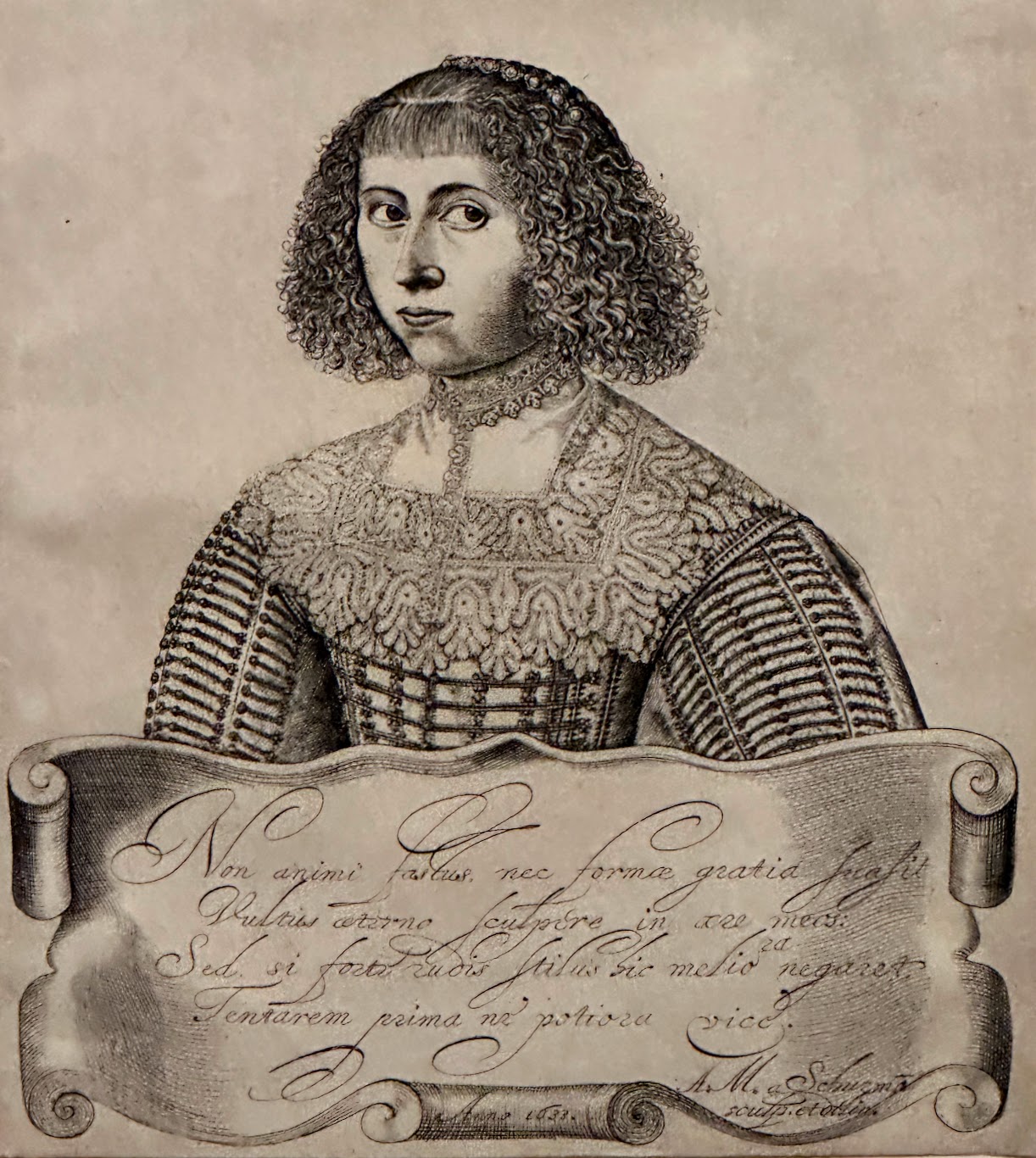

No pride or beauty prompted me
to engrave my features in eternal copper;
But if my unpractised graver was not yet capable of producing good work,
I would not risk a more weighty task the first time.
Education and Achievements
Anna Maria van Schurman received a strong classical education from her father, establishing herself as a child prodigy. By the age of seven, she demonstrated exceptional proficiency in reading and translating Latin and Greek. Impressively, by age eleven, she had also acquired proficiency in German, French, Hebrew, English, Spanish, and Italian. Furthermore, she delved into the study of art, ultimately becoming a distinguished artist in the disciplines of drawing, painting, and etching, albeit with few surviving examples of her artwork.
Following her years of fervent advocacy for women’s education, van Schurman was finally extended an invitation to attend the University of Utrecht at the age of 29, marking a significant milestone as the first female student. However, her presence in the university was subject to the stipulation that she conceal herself behind a curtain during classes, a measure taken to prevent any potential distraction for her male counterparts. Despite these challenges, she graduated with a degree in law, consequently becoming the first female to achieve this educational feat.
A polyglot adept in fourteen languages, her linguistic abilities encompassed Latin, Ancient Greek, Biblical Hebrew, Arabic, Syriac, Aramaic, Ethiopic, as well as various contemporary European languages.
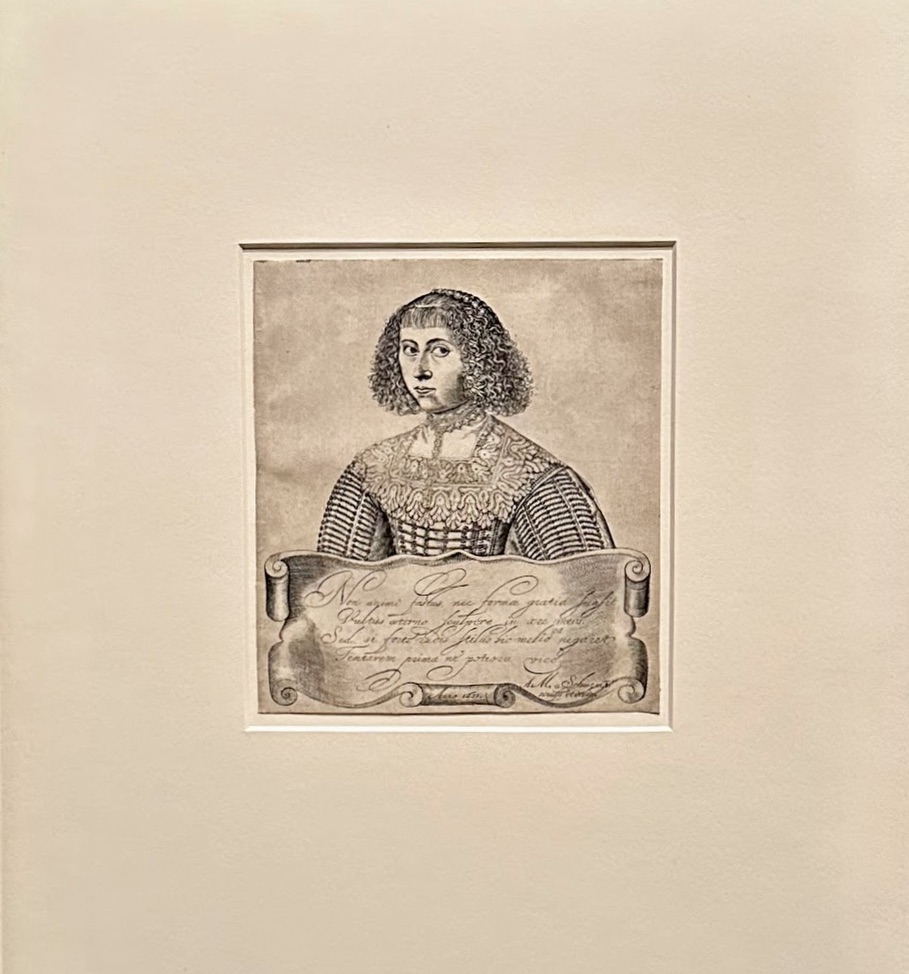
Van Schurman’s journey exemplifies her relentless pursuit of knowledge and her groundbreaking contributions to female education.

Professional engraver Magdalena van de Passe taught Anna the art of engraving.
In an 8 x 10 frame next to a 6 X 8 frame in the AGO, one can see how tiny the self portrait is.
Advocacy for Female Education and Intellectual Contributions
Anna Maria van Schurman’s unwavering commitment to advocating for female education and her active participation in intellectual discourse significantly contributed to the advancement of women’s rights and intellectual equality in the Dutch historical context.
One way Anna Maria van Schurman advocated for equal education for women, was through her prolific writings during the 1640s and 50s. In her notable work “Whether the Study of Letters is Fitting for a Christian Woman,” published in 1646, she passionately argued for the educational rights of women, upholding that individuals with aptitude and principles should have the opportunity to pursue learning. She ardently believed in the importance of women receiving comprehensive education across all subjects, provided that it did not impede their responsibilities within the domestic sphere.
Resa – Were you surprised to get an email, while working on this post, with a link to Anna van Schurman’s book The Learned Maid (1659)? I know I sure was.
Rebecca – It was indeed a surprise, Resa! I read that Anna van Schurman’s “The Learned Maid, or, Whether a Maid may be a Scholar” emerged from her extensive correspondence with theologians and scholars throughout Europe, focusing on the crucial topic of women’s education. She argues that educating women not only enriches their lives but also benefits society as a whole! I was astonished by Anna’s progressive stand in a time when women’s education was often discouraged. To state boldly that knowledge is not limited by gender was a courageous endeavour.

Notably, van Schurman actively engaged in the dissemination of articles elucidating the intellectual equality between men and women, countering the prevalent notion that women were solely suited for roles as wives and mothers. Her contributions to contemporary intellectual discourse were expansive, involving exchanges with influential cultural figures such as philosopher René Descartes, philosopher Marin Mersenne, and writer Constantin Huygens . These interactions further solidified her influential presence within the intellectual circles of her time.
Later Life and Involvement with Labadism
Toward the end of her life, Anna Maria van Schurman became involved in a contemplative religious sect founded by the Jesuit Jean de Labadie known as Labadism. This mystic offshoot of Catholicism preached the significance of communal property and included the directive to raise children communally. Van Schurman, deeply involved in the sect, became de Labadie’s primary assistant and journeyed with the sect as it traveled. Her association with de Labadie facilitated the publication of her final book “Eucleria,” in 1673, which is considered one of the most comprehensive explanations of Labadism.
Her engagement in Labadism at the later stage of her life showcased her continued pursuit of spiritual and intellectual endeavours, further enriching her diverse legacy.
Resa – I’d never heard of Labadism, until this article. Interestingly, Van Schurman refers to herself as “that incomparable Virgin” on the opening page of “The Learned Maid”. Do you find it odd that such a scholar would join up with a religious offshoot? It sounds like a cult.
Rebecca – That is a very good question, Resa! In her 60s, Anna van Schurman became a prominent figure among the Labadists, a religious group that emerged in the 17th century, characterized by their communal living and strict adherence to a mystical interpretation of Christianity.
While some critics labeled the Labadists as a cult due to their unconventional beliefs and practices, including their rejection of mainstream religious authority and emphasis on personal revelation, supporters viewed them as a genuine spiritual community seeking to live out their faith in a more profound way. The debate over their classification often hinges on the definitions of cult versus legitimate religious movement, reflecting broader societal attitudes towards alternative spiritual paths.
Resa – Rebecca, thank you, thank you for joining me in this series on self-portraits from the MHM exhibition!
Rebecca – This has been a marvellous series, Resa. Your innovative approach entices us all to enter the“rabbit hole”of creativity. When we go back to honour artists, we give honour to our time. And when we give honour to the “now”, we become more creative and give our voice to the future.
Click on the above banner to see Rebecca’s research links!
You can also listen to Rebecca and her guest on her podcasts!
Photos taken by © Resa – May 14, 2024
Art Gallery of Ontario, Toronto, Canada
 Graffiti Lux Art & More
That was an interesting and educational post! I had not heard of the artist or Labadism until now. Thank you…Jay😊
You are welcome!
This is from an art exhibit that showed in only 2 cities, Toronto and Baltimore.
It was all about not famous female artists from 1400 – 1800.
It was eyeopening and spectacular. It should have toured the world. 🌟
This was the first time I heard about Labadism too, Jay. I have learned so much from Resa’s exploration of “Making Her Mark” exhibition!! I am delighted you enjoyed this post!!
Hi Rebecca😊. Yes, it was very informative. I guess this is just one of the great things about blogs…A good place to learn! Kind regards, Jay😊
What a jolly good read. Time travel is, always has been, my one and only true interest. Thank you, Ms Resa and clearly very clever, Rebecca. I shall read again now my coffee has been imported from the Ottoman Empire, 1645…a bad year for slavery, such is life. All the best, TOF
I wish this exhibit could have travelled to more cities. Only 2 cities, Toronto & Baltimore got to see women’s art (1400 – 1800) that has been by and large sidelined.
Enjoying your book, TOF!
You made my day, Mike! Many, many thanks! I just subscribed to your blog and look forward to following your posts and writings.
So much of this post is new to me, but that’s OK. Anna was definitely ahead of her time, but society has taken many years to catch on. We’ve come a long way, but still have a way to go. Thanks to both of you for this series.
Agree on all counts, Frank!
I wish more of the world could see this show.
Interesting that Toronto & Baltimore’s art galleries worked hand in hand for years to put this exhibit together.
A lot, if not most of the work is borrowed from private collections.
I am now curious about The Baltimore Museum of Art.
I am so pleased that Resa has shared her photos and insights from MHM exhibition at the AGO. This is the first time that I had heard about Anna. It was a wonderful experience to explore her life and writings. So glad you enjoyed this post, Frank!
Wow — Anna Maria van Schurman was absolutely amazing! Thank you, Rebecca and Resa, for another riveting post about a highly accomplished woman in humankind’s patriarchal history.
Thank you, Dave, and I agree!
MHM was filled with examples of “accomplished woman in humankind’s patriarchal history”.
Great way to say it Dave. 🌟
🙂
also – Rebecca is wonderful, with her rabbit holes and quests for information and answers..ideas.
Insofar as MHM is concerned, It creates the understanding that these female artists’ works are as valuable as all artists’ works.
Yes! I totally agree, Resa!
🤗
I agree wholeheartedly, Resa! “Valuable as all artists’ works.”
Right on!
How very well said, Dave. What Resa’s MHM series has confirmed for me is that we must go back in time and seek the stories of women who have made extraordinary contributions to the story of humanity. By exploring Anna’s life, – her struggles and achievements – I have gained a deeper appreciation of our time.
Very well said by you, too, Rebecca! Although things are certainly mixed in our time, the opportunities for women are of course infinitely greater than they were in the 17th century. Looking back at history drives that point home.
Good point, Dave!
Thank you, Resa!
Welcome!
That’s what you do, Rebecca! You investigate and appreciate and then more.
Thank you!
Honestly I could not picture a woman of this stature living in 17 th Holland, I don’t know if we can name it Netherland then…so much that she has done, I guess reading these post make me just realized that there is so much to be learn, so will do it bit by bit, reading your interviews Resa and Rebecca while sipping a strong nice coffe in front of my computer, taking a break…ah sundays morning are better reading you two…:)
Aww, Thank you Jean Marc!
It’s a joy and honour making these posts.
It was also an honour to be able to walk up close to these paintings, many of which had NO GLASS covering them.
We are in a time where protesters are being loud by damaging art. I am thrilled that did not happen here. xx
Yes it is nice when we can see the art on site, and too bad that now they have to be protected, I don’t get that thing of spraying artwork to express a point of view…to me it goes against what they stand for or at least does not do anything to help their cause..
Agree!
They are like children (or some adults) throwing tantrums.
If I don’t get my way I’m going to ruin things you love!
Either pure logic or pure emotionality can be counter productive. Much of mankind seems to have an inability to grab the pendulum as it passes the middle. xx
True, should remember this one with the pendulum.., I like also this one, instead of far right or far left, I would rather go for extreme centre…:)
Oh that is an excellent thought, Resa “grab the pendulum as it passes in the middle.” You have the best one-liners!!!
Thanks Rebecca! I’m glad you get them.
I’m no Henny Youngman, but – Take my wife….please!
😂😂😂
😂😅🤣
I know exactly what you feel, Jean Marc. Resa’s MHM series has been an extraordinary journey for me. There is so much to learn , so taking it bit by bit is the best way to embrace new knowledge. I enjoy the follow-up conversations because the comments always give me fresh ideas to explore. I am grateful for Resa’s invitation to join her in this remarkable look back into history.
It’s Clanmother….
A Backward Look Forward…
You said it!
What an amazing, talented woman! Even though she is little known today, I am sure she helped shape the future, or at least planted seeds which started to bear fruit with suffrage and continues today. Great bit of research on this remarkable woman.
Thank you, Trent!
Yes, women have been taking baby steps for centuries, if not longer.
Attending MHM was a revelation, in the sense that I was learning what I already know, except now I know it better. (as much in life)
“(as much in life)” – to live is to learn… The MHM sounds like a great exhibit! Cool it had such an impact.
Yes!
We have “big shoes” to fill! I am trying to grow my feet! LOL!
True. Then, when your feet are grown, you’ll also be a poet and you’ll know it, cause your feet are long fellows!
LOL!!!
🤗
I agree wholeheartedly, Trent. She did plant those seeds – courageously, using her intellect. I can only imagine that the seeds feel on very dry and unwelcoming earth. But the seeds took hold, despite the difficult environment. Many thanks for joining Resa and me on this incredible journey of discovery.
She sounds like a brilliant, remarkable woman. Thank you for sharing and adding to our knowledge, Resa and Rebecca!
I looked at Labadism a bit more. Jean de Labadie had been a Jesuit, but then became a protestant, more attuned to Calvinism (a church of the elect), and then more pietist. Men and women were equal (as with Quakers). I think it was a sect rather than a cult. It sounds somewhat like the Shakers, except that that the Shakers were celibate, but Labadism did not demand that. In fact I read that they believed marriage was between true believers, so that you could leave a marriage if your spouse was not a Labadist. This is from a very quick search because I was curious. It was an era of such rapid changes.
Merril,
Thank you for your research on Labadism!
Besides that men and women were equal, the idea that interfaith marriage (still an issue in much of the world) was acceptable is an advanced position.
It sounds like Labadie was in search for a decent meaning to life, through religious belief.
The Catholic and Protestant churches must have hated this movement. That could be a reason it did not catch on further.
I had no idea men & women were equal with the Quakers. Hard to flourish in a patriarchal world with that kind of thinking. I just read there are about 400,000 Quakers in the world, mostly in Africa.
Haha–it was hardly research, just a quick search. So, I probably wasn’t clear. No, I don’t think they condoned interfaith relationships. The opposite, in fact, so that they probably approved an extra-legal form of divorce.
They were, I think, a form of Protestantism, but extreme. This was a time of many movements, so for example, in England the official church was Church of England (except for briefly following the English Civil War until the Restoration when it was Puritan.) Germany, then not a united country, was mainly Lutheran. So yes, the members of various sects were often persecuted.
Well, women were not given civil rights, but within the Quaker meetings, they had equality. William Penn was raised Anglican, but became a Quaker, and he established Pennsylvania (1681) as a Quaker settlement, but he also promised freedom to other religious groups–but he was also a slaveholder.
Ahh!
Thank you for the clarification!
Religion is a hypocritical happening. I was raised Catholic, and had top of the class grades at Catholic school.
Then my mom got divorced, and married a Lutheran.
They made me sit at the back of the church. As a 10 year old I was ostracized and humiliated. The nuns said Luther was the devil.
That’s crazy, to believe in religious freedom, but have slaves.
What a fraught history mankind has.
Thank you, Merril!
You’re welcome!
That is so horrible that they did that to you! My heart hurts for little you. 💙
Omg! How kind. 💙
Yeah, well I got them back.
1. I chewed the host at my confirmation.
2. I did the costumes for “Our Fathers”, about Boston’s Cardinal Law & the pedophile priests. (Christopher Plummer, Ted Danson, Brian Dennehy, Daniel Baldwin & Ellen Burstyn)
I bought all the religious paraphernalia at their supply store. HA!
Hahaha. 💙
💙
Many thanks for adding your excellent comments on Labadism, Merril. I agree – this was an era of rapid change.
You’re welcome, and thank you for your information, Rebecca!
Tremendous post. I knew nothing of this remarkable woman so thank you both. Resa you always know the questions to ask. Rebecca you always know of amazing women.
Thank you Shey!
I’m loving (and I believe Rebecca too) doing this series. This blog is about all of the arts, and it is fantastic what the arts, in all of its forms, teaches us. xxx
In one, my darling. In one xxxxxxxx
xxxxxxxxx
Thank you for your visit and comments, Shey. I believe that historical experiences and insights from those who came before us can illuminate patterns, inform our decisions, and guide us in navigating contemporary challenges. (Consider the Jute and Tay) By examining the struggles, achievements, and lessons of previous generations, we gain a deeper appreciation of our own circumstances and the complexities of human nature. Resa’s MHM series is an extraordinary look back at remarkable women who chose to be outliers in the face of great opposition. I stand in awe of their courage and resilience.
Me too, in awe!
🤗🤗🤗
Absolutely. From the dark to bring light. One of the reasons I like writing about the past is that while is a foreign country certain things, hopes, fears, feelings, struggles, were just the same.
Fascinating. I’d never heard of this amazingly talented woman. I did chuckle at the idea of having to sit behind a curtain so the men could concentrate, although with the clothes allowed in classrooms these days, it might be time to bring that back. 🤣🤣🤣. Thanks to you both for this interesting post.
janet
You are welcome, Janet!
Interesting thought that men cannot be in control enough to concentrate if women are around.
Yes, more curtains are needed! 🤣🤣 I prefer chintz. 🤣
Still, we should be. careful. It could come true.
Be well, and I hope the renos are almost finished!
Renos are basically done, just some things that need to be fixed and all the new screens need to get out of that garage and on to the windows. 😁
Oh wow! So, you’ll. be moving soon? 👍🌟
Hopefully not too far in the future.
I look forward to some pics. Is it a similar location, or more Urban?
Similar. Just Mesa, Arizona instead of Gilbert.
Okay!
Hi Janet – this is the first time that I had heard about Anna, too. I enjoyed exploring her story and was amazed by her intellect and perception of what could be. She was a woman ahead of her time!!!
Van Schurman was a true prodigy. Wonderful history of her journey. Having to be behind a curtain in class. So strange were times gone by.
Yes, she was a prodigy.
I’m glad I learned about her.
Thank goodness times gone by are “gone by”.
Although “gone by” is still here in some countries.
xxx
It’s too bad, too.
Yes! xxx
I often wonder what the future will think of our time, Tim. YIKES!!! I am so pleased that Resa invited me to join her on MHM. What I found most amazing about Anna was her ability to inspire others, leaving a lasting impact on those around her. I believe she has an enduring relevance for us in today’s world – equality, access and inclusion.
We can look back through the decades we’ve lived through and can remember, back to the 60s for me, and ask ourselves how we communicated or got anything done without computers, mobile devices, and the Internet.
True!
When I am connected to the internet, I feel that I am connected to the world. How right you are, Tim – how did we communicate!! YIKES!
Looking back on the dog days of analog, It’s amazing the work and time we had to spend researching, and writing, and calling, and connecting, and organizing, and driving, and looking, and…
A beautiful post about this extraordinary woman, Resa and Rebecca! What an amazing talented child prodigy. I can’t imagine speaking so many languages at such a young age. Her accomplishments are admirable.
Thank you, Miriam!
Yes, she was extraordinary.
I’m thrilled that I learned about her. She is someone history should remember.
I’m still trying to get a grip on English.
Nice to see you, Miriam!
You’re welcome, Resa! She was one of a kind. Thank you for introducing her.
My husband and I were busy watching our grandkids all summer.
OH BOY!
How wonderful ( albeit busy) to be with your grandchildren.
🌟❦
We have this week off! 😊
Yay!!!! ❦
I am so pleased that you enjoyed this post, Miriam. Thanks to Resa, I have been introduced to this extraordinary woman in history. There are so many stories hidden in the folds of history. Isn’t it wonderful when we shake out the folds and learn about women who made extraordinary contributions to the world.
Yes!
Then we should iron the creases the folds created.
No sense letting history’s lessons fold back in.
So well said!!!!
The extraordinary women in the hostory serve as our models and motivation, Rebecca! Thank you for the post.
A remarkable woman indeed, extremely intelligent and artistically gifted. I’m truly impressed with her quest to promote equality for women. I must read more on Labadism. She doesn’t seem like an individual who could be easily influenced but one never knows.
You two have created a very fine platform to introduce remarkable women from the past, that’s a very important and relevant issue for today’s society when we are once again having to revisit the efforts to
denigrate and reduce our gender to a second class status.
Thank you so much , I’m completely enjoying this series and you’re both to be commended for bringing this to us. Please carry on good ladies. ❤️
Sending much love and hugs to you both.
xoxoxoxo
Yes!
Thank you dear Meece!
I agree, AMvS does sound like someone who would not be easily influenced, which is why I wonder, too.
Still it was 350 years ago, and only through religious belief was one probably allowed some kind of intellectual thought in Europe. If that makes sense? Took a bit to write that thought.
I’m sure Rebecca has a lot of thought on this. She could be in rabbit hole as I type.
Seems like women have been taking baby steps for centuries. I agree with you that the steps forward appear to be in peril of a 1 forward, 2 backwards system of deterioration.
It is of utmost importance that there be female heroes, along with male heroes, recognized and accepted by paternalistic sociopolitical groups.
Hopefully this series helps 1 iota.
Dear Holly, thank you for your support re: this series, and in general your support of women’s struggle for 100% equality.
No wonder I adore you. Well, that and your delicious poetry, the fun, PBH, RR, AGM Holly & BP.
xoxoxo
Well said dear Meece. I love this series on women from the past who had an impact on art and culture.
It’s entertaining as well as educational and really outstanding.
Hats off to you and Rebecca !
xoxoxoxoxo
I hopped into the rabbit hole, Resa!!! LOL!
🐇⚫️
Like you, Holly, I was very interested in Labadism and how this form would have attracted Anna. (check out Merril and Resa’s comments above for an excellent discussion on this topic). From my reading, Anna’s attraction to Labadism stemmed from its emphasis on personal piety and communal living, which resonated with her spiritual aspirations. She was drawn to the Labadists’ commitment to a disciplined life of devotion and the pursuit of knowledge, aligning with her own intellectual pursuits. The inclusive nature of Labadism offered her a sense of belonging and community, providing a supportive environment for her theological explorations and personal growth. In 1673, Anna’s efforts culminated in the publication of Eucleria, a comprehensive work that serves as one of the most detailed accounts of Labadism and its teachings, further solidifying the movement’s intellectual legacy. The book not only outlined the principles of communal living but also provided insights into the spiritual practices that defined the sect. As Merril said – there were a lot of changes during this era!!!
Thank you Rebecca. A great post !
🤗🤗🤗
🤗❤️
What a remarkable woman. She reminded me a little of Vera Brittain who was among the first women to be admitted to Oxford University in the UK. Much later than this, of course, Britain always lagged with human rights. I am very admiring of people who can speak so many languages. It is not something I excel at.
I am so pleased you enjoyed this discussion, Robbie! A great mention about Vera Brittain who was extraordinary for her profound contributions as a writer, feminist, and pacifist, particularly during and after World War I. Like Anna before, Vera was a strong advocate for social change.
Vera Britain is one of my personal heroines.
Thank you for that name, Robbie! I looked up Vera Brittain, a remarkable person.
I find languages interesting, too. I did study Latin and French. I also learned Spanish when I spent a year in S. America.
Thing is, I never use them. I’m always speaking English.
Have a wonderful week, Robbie! 🌟🌹
I’m glad you looked up Vera Britain. A remarkable woman. You have to use languages I think.
I’d never heard of her. I am deeply impressed.
Yes, one must keep using languages.
Same goes for new fab things I learn on the computer. Use it, or lose it!
Exactly 💞
Oh my goodness, I really, really enjoyed reading all of the information about this amazing lady and loved the interaction of questions between you, Resa and Rebecca…
A Child genius I think… 14 languages .. Wow… I have all on remembering my own lol 😉
And that engraving, so tiny, the skill to engrave that, let alone just draw it is mind boggling…
Many thanks for sharing… I learnt such a lot .. ❤
Thank you, Sue!
Yes, Rebecca and I have been learning a lot about sisters from the past, and enjoying each other along the way.
AMvS was some kind of prodigy. Even in today’s world she would stand out, like one of those kids who gets into college and graduates at 16.
I’m really enjoying this series about women artists from 1400- 1800. Have a fab week!
👍🌹❦🌟
She was indeed… and you are right, such a child would indeed even in todays world stand out as a genius child.. 🙂
We can never stop learning, or leaving our imprints in the world… What ever our gifts or talents… We are each leaving a little piece of ourselves in the world today… For others to perhaps enjoy tomorrow.. 🙂
And I certainly enjoyed learning through these posts Resa..
Sending love and Blessings my friend xx ❤
Love back to you Sue! xoxo
Hugs 💖😊🤗
I learned a lot too, Sue. Resa’s MHM series has been an extraordinary journey for me. I am currently on Duolingo for French and Italian and making very slow progress. I can’t imagine how someone has the ability to communicate in 14 languages!!!
Happy studying, Rebecca!
I agree, I have loved learning about these special women.. And good luck with your languages… I learnt a few words in French and a few in Spanish, mainly on holidays 🙂 We are lucky that so many other countries learn English! ❤
Agree about so much English spoken in the world!
We English are Lazy!… and they do not promote enough second languages in school.. xx
Yes! xx
A fabulous exploration of a remarkable human being, Resa and Rebecca. Thank you so much for doing the hard work to bring Anna Maria’s accomplishments to light.
Thanks John!
If it wasn’t for Rebecca, there would a lot less content.
I’ve learned a lot by learning about my historic artistic sisters.
OX
Learning a lot is a bonus for sure. OX
OX OX
OX OX OX
OX OX OX OX
🏆🏆
Many thanks for joining Resa and I on this amazing look back into history, John. Resa has the best ideas to bring together a community that thrives on the exchange of knowledge and experience.
Well said, Rebecca.
Wonderful post about a woman who had been lost in his-story, but brought back to us in herstory. Just great. Thank you both.
We have herstory here on GLAM!
I’m so happy I went to that exhibit. It really did something to/for me.
I think I’m richer…. and more annoyed at patriarchy.
xoxoxo
At this point, I don’t think I could be more annoyed. Blah. But, on a happier note…you are bring women artists back into the limelight. How fabulous is that!❤️
Lol
Best Blah in town!
It is fab doing this series, Gi. I feel really great about it.
xxxxx
I am delighted that you joined us on Resa’s MHM series. What an adventure it has been for me. Isn’t it fun to be in a constant state of learning!!!???
So glad you’re enjoying the work. That’s what makes it fun and I agree, we never stop learning.
Many thanks Resa and Rebecca for this well researched and inspiring introduction to this amazing seeker of knowledge. I loved how Anna Marie’s journey carried her beyond scriptural details to experiential understanding
You are welcome, Cheyenne!
There are many remarkable women, as Rebecca puts it -hidden in the folds of history.
I’m thrilled to highlight a few on this blog.
AMvS really did understand, and shared. It’s amazing that her book is available to read, on line, for free, today.
Oh, I do love that phrase, Cheyenne “carried her beyond scriptural details to experiential understanding.” Goosebumps!
Smart girl!
Amazing what she accomplished! I feel like an absolute failure!
Jan!
Lol… do not consider yourself a failure!
Rather say, you are a success, and that AMvS was a different success.
If she could have looked into the future, she might have said – look how successful and accomplished all these women are! Look how many are educated!
In the end I thank her for her progressive actions and admire a sister from the past.
I know exactly what you mean, Jan!! We stand on the shoulders of giants. And I sometimes think that they felt less than successful. They remind us to keep going. Every act of courage is one step forward!!
Another magical discovery of hidden treasure and genius in our history. It is fascinating to know that there were still brave women who seized their chance to go their own ways (painting and writting; wow!). And thank you both, dear Resa and Rebecca, for introducing them to us.🤗🤙🙏🌹🌹💖💖
I am so pleased you joined Resa and me on this journey of discovery! I agree – there were many very brave women who defied convention. Resa’s MHM series allowed me to back in time. It was a true time-travel adventure!!!
Thank you for joining Resa and me on this look back into history. I agree – there were amazing women who defied traditional roles to seek their creative path. Thanks to Resa, I went on a time travel adventure.
Aladin,
I am thrilled you are enjoying this series.
I feel honoured to be doing these posts and especially with Rebecca.
There is one more in the Self Portraits series.
Then we have another one to do together.
Still, there were over 300 works/pieces in. this exhibit, so there is lots of art and women to share.
xo💖🌹🌹💖xo
What an intriguing person she was! This is a lovely post, Resa and Rebecca. Thanks to you both — and hugs on the wing.
Many thanks for joining Resa and me on this time-travel adventure, Teagan. When I was in the middle of the “research rabbit hole” I had an epiphany of sorts. I believe that the courageous women of the past, who bravely challenged societal norms and traditions, serve as powerful inspirations for today’s heroines in literature. Their defiance against conventional wisdom not only paved the way for greater gender equality but also provided a rich tapestry of experiences and struggles that modern writers draw upon. Emlyn came to mind, Teagan. Emlyn embodied the resilience, strength, and independence of these historical figures.
What a fascinating woman! You had me gobsmacked at her knowing fourteen languages!!! 🙂 Hugs ladies. ❤ xox ❤
Amazing!
It so great to see and celebrate some of what our sisters from the past accomplished.
xo🌹❦xo
Amen! ❤ xoxo
What a fascinating woman, child savant, and early feminist. How interesting that she earned a law degree while sitting behind a curtain because she’s be distracting to the men. The notion that women are responsible for men’s behavior continues to be a reason for controlling women’s lives today. UGH.
Modern women owe a lot to people like Anna Maria van Schurman who began the journey toward equality hundreds of years ago. (Hard to believe that it’s taken so long and is still an issue). Thanks to you both for the fascinating introduction.
You’re welcome, Diana!
AMvS is a fascinating sister from the past.
Yes, sex equality is still an issue in our countries.
A sad thing is that in certain countries there is 0 equality. Try to protest and you might end up dead.
I’m grateful to have been born where and when I was born.
🌹❦
Me too. And improvements that I can see in my lifetime. Gotta keep plugging away at it.
YES!
I’m always impressed by pioneers. Also by the fact that “equal” education is only recent. Take Oxford. Annie Rogers was the first woman to graduate from Oxford in 1920. a century ago. Women were -in limited numbers- allowed to take classes but not receive a diploma until then.
Lots of road to go still, but I always think we’ve come a long way.
Thanks to both for this post…
🙏🏻
You are welcome, Brian!
Rebecca & I are learning a lot from the MHM series.
Yes, we’ve come along way in many countries.
Unfortunately there are still countries operating in a different time and place, and although woman are marginalized in some of those places, they are chattels of men in others.
1920.. women got the vote.
We shall carry on!
💓🕊
Chattel is an apt word, in many, many parts of the world. It will change. One day.
1920? In Canada if I recall. You guys were always ahead. McGill probably had women graduates since the 1880’s or earlier.
Carry on indeed.
Most women got the vote in Canada in 1918.
I believe it was a lot later… maybe the 60’s when aboriginal women got the vote.
There were women in university earlier than that, and we had some female doctors by the late 1800’s.
The women in Quebec were last to get their provincial right to vote in 1940.
Sorry I didn’t clarify in my previous comment.
Comments boxes can be inadequate!
xx
You have been ahead in Canada. Definitely. Women vote in France was not until 1944, and they voted in fact in 1945, just after the war.
No prob.
Hugs
Hugs!
Thank you, Resa for educating me on this topic. I learn a lot from you and sending you a million blessings my friend.
“Women, whether subtly or vociferously, have always been a tremendous power in the destiny of the world.” — Eleanor Roosevelt, “It’s Up to the Women”
Thank you, Charlie!
I’m posting these articles about women artists from 1400 – 1800 every once in awhile.
Love the quote, thank you!
You welcome, Resa.
I love the articles you post about women artists. Please keep shining the light on the superwomen heroes. 🙂
I will!!
Thank you!
So, it’s cooling off a bit.
I had a quick stroll through Graffiti Alley, to see if there was somewhere I would paint over.
Not sure, but I always have the black door option!
I’ve been beaver busy, especially as it’s Emmy season, and I’m a voting member.
I need to finally get my head around paint.
Okay… Cheers, and write on!
You are a voting member of the Emmy’s? That is awesome. Who are you voting for this year?
Well, I suppose I shouldn’t blab until the votes are all in and counted, but my choices tend to not be the popular ones.
I’m still dizzy from all the TV I watched.
Sci-Fi is the toughest for me to watched, but I did find one I thought was cool.
I was a bit peeved that “Tokyo Vice” was completely snubbed.
That show was so cool!
Please do share with me later who you voted for. Don’t tell me now…wait til’ all is set and done. 🙂
I have been watching nothing but movies only and very few TV shows. It’s hard to keep up with all the content out there.
WHEW!
Yes!
Hello Resa! Woo wee, finally got a chance to catch up on the blogosphere after my family trip to Northeast (Vermont).
Another fascinating female artist! No I haven’t heard of Anna Maria van Schurman so it’s wonderful to learn about her. WOW, she could speak 14 languages??! Oh my! I’d love to learn a 3rd language, but I doubt I could do it now 😀
I trust you had a great trip!
Women started surfacing more in the 1800’s. We didn’t get to vote in Canada until 1918 – the states 1920.
The show I saw that inspired me so much, focused on women from 1400-up to 1800.
We’ve been in the shadows long enough.
I wish there was more that could be done for women in some countries, who are still the chattels of men.
YES.. 14 languages. I used to speak 3, but I don’t get to use Spanish or French much. I did learn Latin, but have retained little of it.
Okay,I look forward to hearing about my windy interview. Lol! 😂
Wow, you used to know Spanish AND French? I wish I had kept up with Spanish from college, but French is too difficult for my tongue. My mother tongue is Indonesian and I learned English early as a kid.
I LOVE your interview answers, thanks for clarifying for #5. I can’t wait on formatting the post to publish in early Sept, THANK YOU!!!
Yay!
Hey, you know 2 languages. That’s pretty great.
I’m excited for the post, too!
Shoot me a mail when you are 2-3 days away from posting!
I’m back here from Art Gowns..Lol!
I’m almost dizzy!
Pingback: Y3 Story Chat #21: “The Grand Adventure” by Diana Peach – Marsha Ingrao – Always Write
What a cool post, Resa and Rebecca. I had never heard of this woman. I wish I’d know you both when I was a social studies coordinator. Women’s history was just coming into it’s own. I am linking this post to Story Chat this week to thank you for commenting on Diana’s story, “The Grand Adventure.” I hope you will come again soon.
How lovely.
Thank you very much! I’ll follow you, so it will help me visit!
Thank you so much, Resa. Let me know if you ever want to share a story.
Ah! Will do!
Hahaha! I already followed you! Yay!
Double yay! 🙂 xxxx
🙂 xxxx
Resa and Rebecca – Thank you for the insightful and wonderful post. I enjoyed learning about Anna Maria van Schurman and Labadism. As a side note, but connected to some themes in your post, I regularly read Simone Weil and just began a biography of Marie Curie.
Thanks again!
Hello Dave!
You are very welcome.
Yes, learning about AMVS and Labadism was insightful.
Simone Weil is new to me. I looked her up, and can see she is accomplished.
Madame Curie should be an interesting read.
So many people to learn about.
So little time.
There are more posts on women artists from history coming up.
Thanks for popping by, Dave!
Wow, talk about a woman whose light has been hidden under a bushel for far too long!!