

Josepha Ayala
Portuguese: 1630 -1684
Josefa de Ayala, aka Josefa de Óbidos, was a novelty. She was celebrated after her death; the only woman known to have worked as a painter in Portugal, during that period.

Josepha learned to paint by helping her father, Baltazar Gomes Figueira. In her lifetime, Portugal was monetarily unstable and often at war. However, much of her artwork was for patrons in Coimbra, a wealthy area boasting a university.

At 29 years old, her parents gave written permission for her to be to be a Donzela emancipada. (emancipated woman). She remained unmarried and independent for her entire life.
She received many commissions, during her lifetime. However, Josepha was wealthy from real estate investments and was able to refuse work at the Portuguese court.

She signed many of her artworks, as Salvator Mundi. Thinking this was a male painter attracted clients, and prevented her from being forgotten over time.
Lavinia Fontana
Italian: 1552 -1614
Born in Bologna, died in Rome; Lavinia Fontana painted in the Mannerist style she was taught by her father, Prospero Fontana.

An important portraitist in the late 16th century, she also produced many religious paintings. Lavinia was celebrated for the vibrant colour and detail of the clothes and jewels her subjects wore. She also became one of the first women to render publicly funded, large scale figure paintings.

In 1577 Fontana married Gian Paolo Zappi. An inferior painter, he pivoted to becoming her business agent.
Some of her paintings are signed with her married name.
Lavinia was the mother of 11 children.
Enjoying the patronage of the family of Pope Gregory XIII, Lavinia painted portraits of much of the elite.
In 1604 she painted the Martyrdom of St. Stephen, for San Paolo Fuori le Mura in Rome. An altarpiece and her largest work, it was destroyed when the basilica burned down, in the fire of 1823.
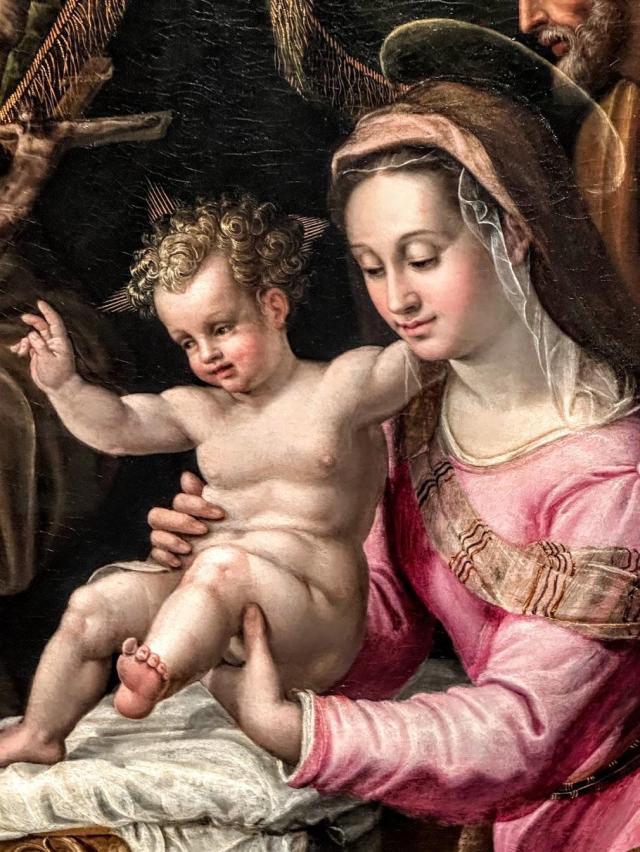
This is an oil on canvas painting, and there were at least 2 others by Lavinia Fontana in the Making Her Mark exhibit. I’ll show those at another time, with a few more tidbits of her extraordinary life.

In the meantime, should you be interested to learn more about her, you can check out the links at the end of this post, search her online or in libraries.
Barbara Longhi
Italian: 1552 – 1638
Known primarily for her religious paintings, Barbara Longhi’s work can be difficult to differentiate from her father’s work. Her father, Luca Longhi, was a renown painter and miniaturist. Barbara began her art journey, by assisting him with altar pieces.

She expanded beyond her father’s teachings by studying the works of Parmigianino and Correggio. Barbara painted primarily religious images, including several depictions of Madonna and Child with Renaissance style and features. I’m intrigued that parted drapes exposing landscapes was one of the elements.

Giorgio Vasari commended her for having “purity of line and soft brilliance of colour”.
Her ability to capture human interaction kept her one of the few successful career women of her day.
The Art Gallery of Ontario has obtained this 42.5 × 34 cm. oil on canvas painting for its permanent collection.
” Longhi’s painting, alongside two other gifted paintings by women artists (Mary Ann Alabaster (1805–1879) and Rosa Bonheur (1822–1899)), extends the AGO’s holdings of European Art by female artists three centuries deeper into the past.” – AGO
Photos © taken by Resa McConaghy – May 14, 2024
 Graffiti Lux Art & More
You must be logged in to post a comment.