

Museum Of Contemporary Art
I’d like to welcome Trent (Trent’s World the Blog) to Graffiti Lux Art & More to discuss some of the art I saw at a showing at MOCA in Toronto.
For all of the images below, Trent was sent just the images without any notes or an artist’s name.
Jes Fan

Resa – After just looking at the image, what are your first impressions?
Trent – My first thought was it looks like when sewage comes up and then recedes and leaves nasty toilet paper sticking to things. Second thought was just garbage bags.
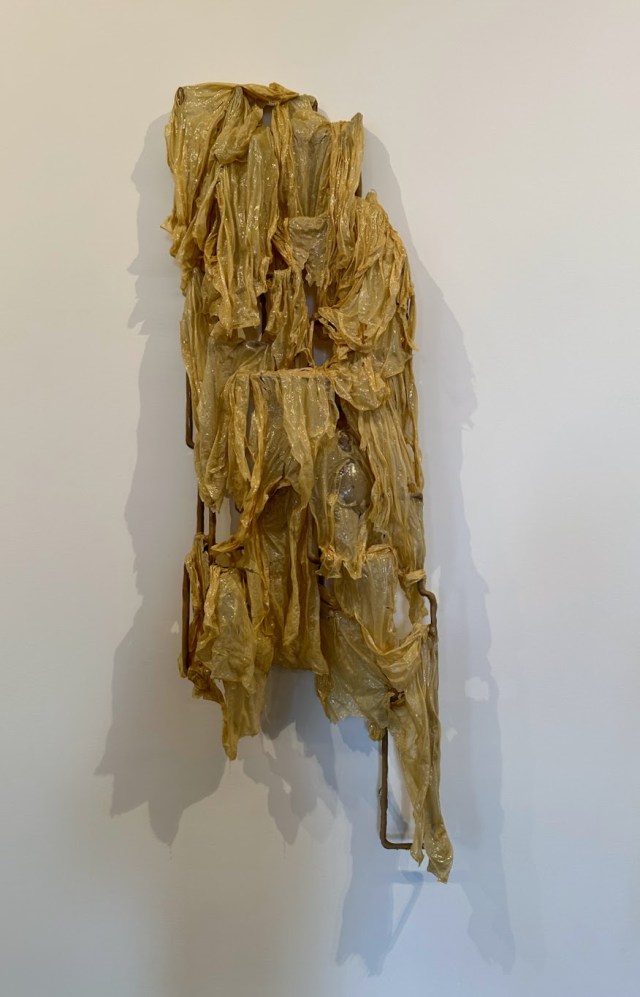
Resa – Fan’s silicone, soyaderm, resin, steel and glass “express the fragility and persistence of humans and animals in ever-changing, unstable systems.”So Trent, although you put it in different words, you have captured the intent. After knowing more about it, what are your thoughts?
Trent – OK, with the description I can see wasted people/animals barely hanging on to existence, flaps of skin sticking to bare ribs. The edge of existence . Combining the two thoughts, after all is said and done, we do persist and there is always something about life and about humans that will always hang in there, cling to those bits of stability so even a strong flush can’t get rid of us.
Oreka James
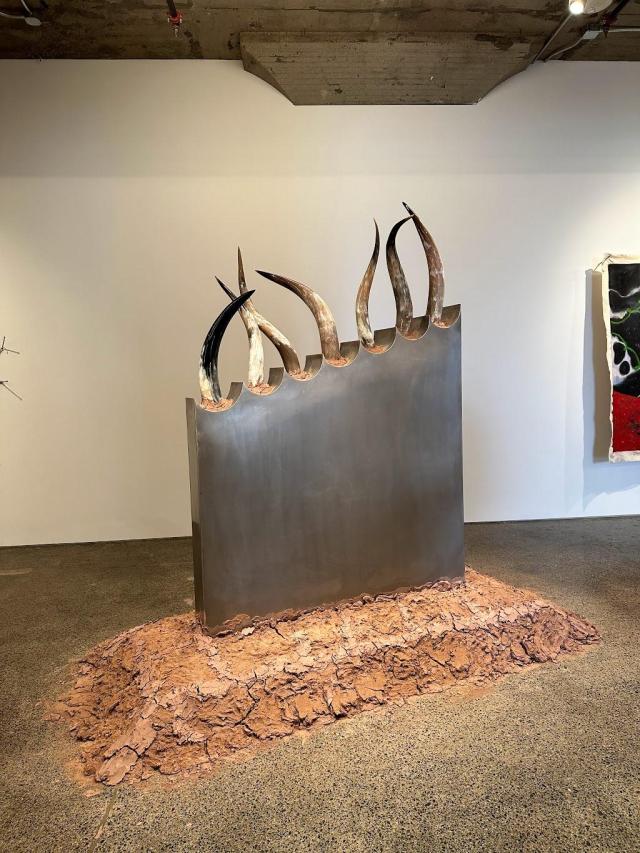
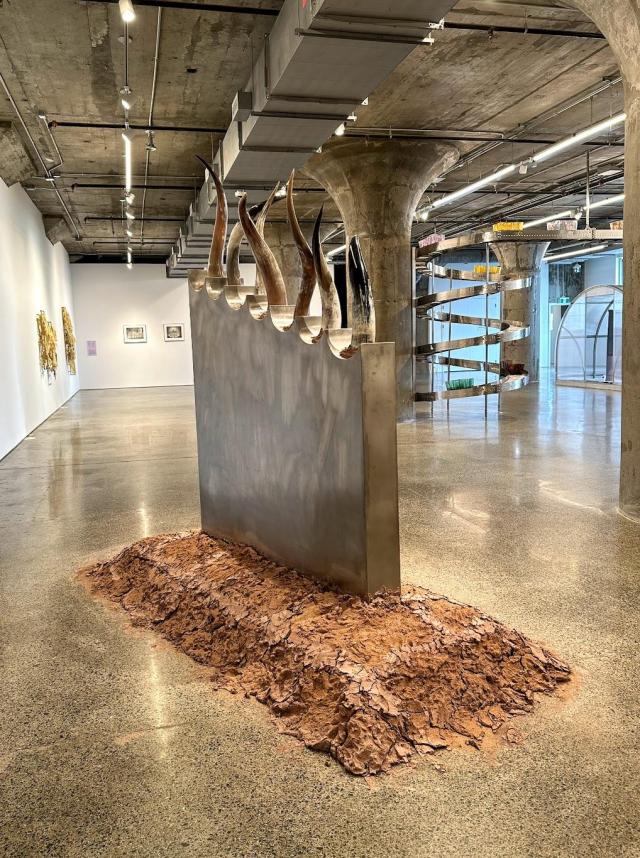
Another image sent without notes – I’m a bit taken with the fact that Trent thought of Africa right off the bat. I was feeling something Canadian aboriginal.

Trent– I instantly thought “Africa”. Perhaps agriculture destroying the land. The big metal thing with the waves? Not sure, perhaps the moisture that is no longer in the parched soil? But I really think it is man destroying the land in Africa, mostly with agriculture, though I suppose that the horns could be wild animals destroyed by man. Hmmm, that might make more sense…
Resa – In the description it said – “The use of metal references Ògún, the god of iron for the Yoruba people of West Africa” then goes on to say “and the alchemy of changing physical substances.” Your initial thoughts are quite on.
Trent – OK, “the alchemy of changing physical substances.” I can see that, the bare soil bringing forth the iron. I’ll stick with my first thoughts, but add that – our technical world is built from, and often destroys, our earthly soil.
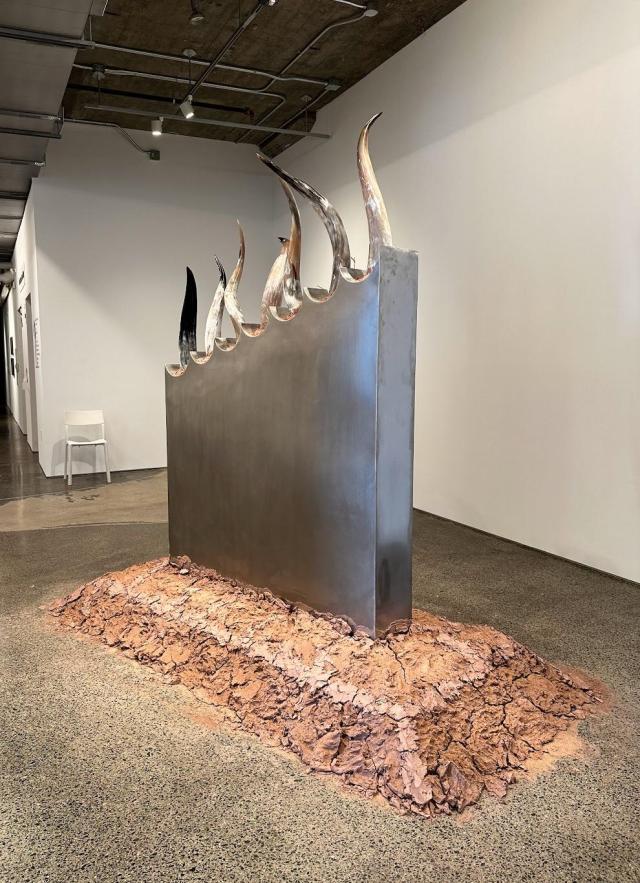
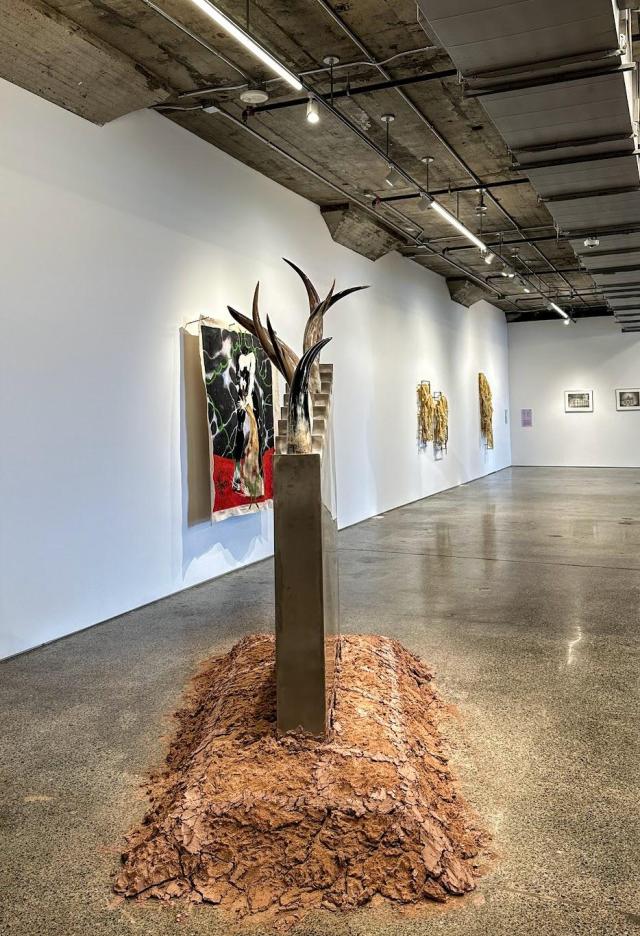
There were 2 more pieces by Oreka James, both in oil on unstretched canvas. There were no comments on these works, other than –“Horns are a reoccurring motif within this body of the artists work, symbolizing a quest for victory, freedom and fellowship.”
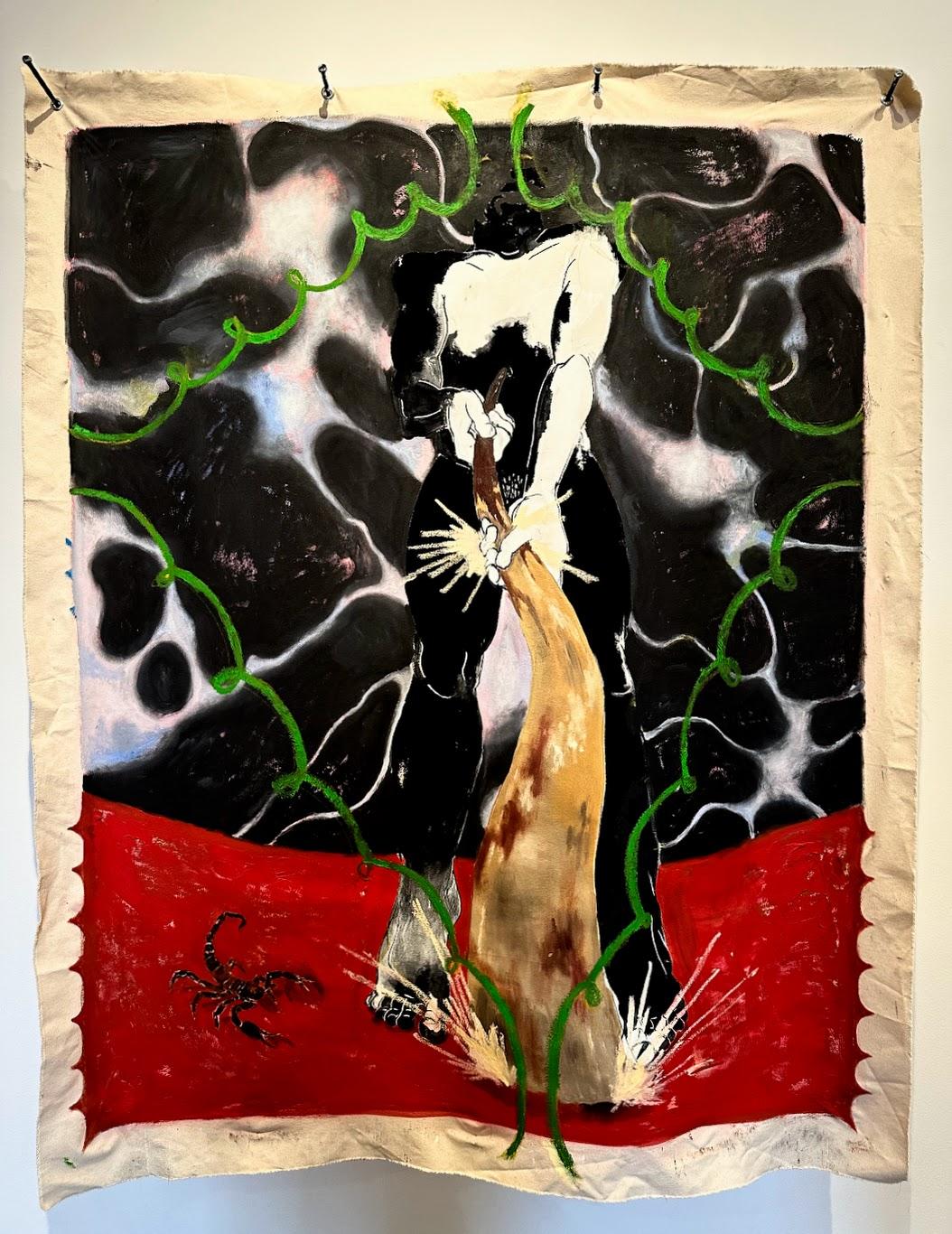
Night Angel was one of the original pics I had sent to Trent, without any info.
Trent – There is the animals horn that the person is wrestling with and the red soil. The figure is odd, very masculine, yet at first glance I thought it was a woman, so can be either. And their head is almost invisible, so they is all body.
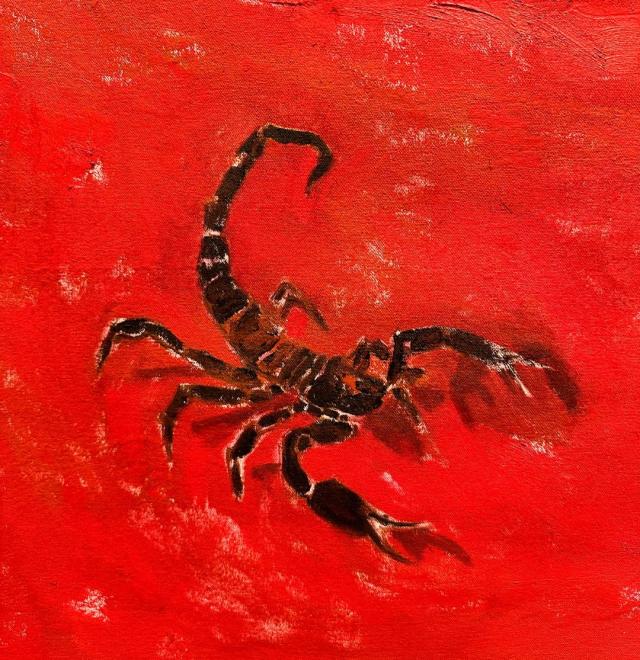
With the scorpion, I think man against nature, and again I place it in Africa. And with this, I take the horns as wild animals, not cattle.
I hadn’t sent the next piece to Trent, and he is seeing it in the rough draft for the first time.
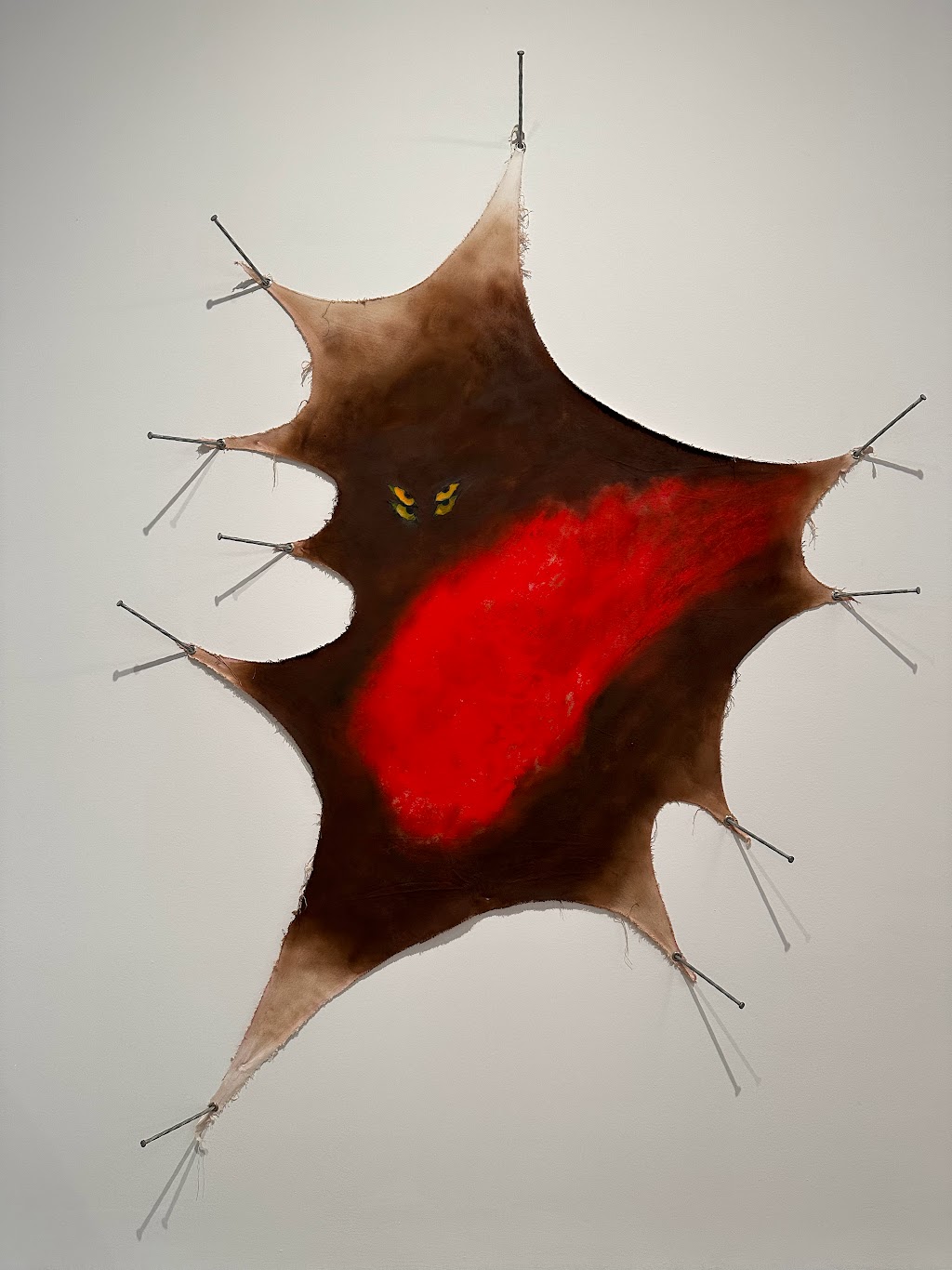
Resa – So, I thought this piece was painted on a stretched hide. Canvas never crossed my mind.
Trent – Ooo, those eyes are sinister, along with that red. And a mirrored set of eyes? It is a demon of the night waiting to get in.
Resa – At first I saw 4 butterflies of some kind, so I took a close up of them. When I got home and looked at the pics, I saw eyes.
Trent – Hmm, I guess I can see the butterflies, but for me the eyes jumped right out. With the odd, angular shape that looks like arms reaching out, and the red fireball giving forward momentum, I will stick with night demon coming to get you.
Resa – Yikes!

P. Mansaram
Born in India 1934 – Died in Canada 2020. A diasporic artist using multimedia, he became friends with Canadian Philosopher Marshall McLuhan, of the famous quote “The medium is the message”.

Trent – I am not sure! Very busy and hard to see, though I do see many faces and at least one Indian god.
Resa – Most insightful, as the artist was from India, and you didn’t know that.
Trent – My very first thought was panic, but there is something strangely sexual, but sexual in a pornographic way, not a “natural” or “sexy” way. Maybe “dirty” more than “pornographic”. I think it is strange that a sexual nature jumps out first thing, but I think it has to do with placement of shape and color.
OK, “Devi” is a multifaceted, all powerful goddess (I used Wikipedia ) And she does represent female sexual energy. I caught all of that, but I am not sure why I thought of that sexual energy as “dirty” – I think it must be implied by the male artist? But, Devi? It is perfect.


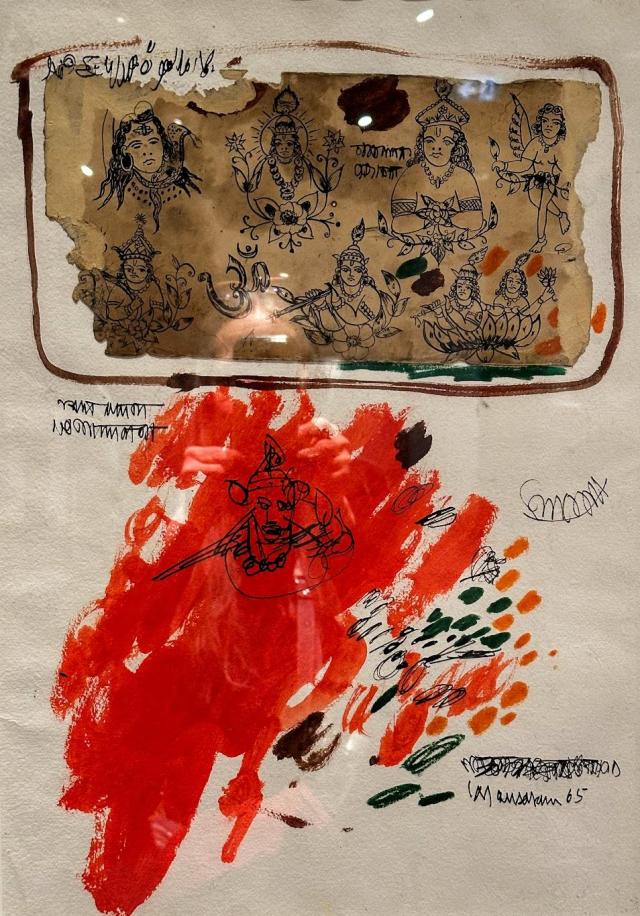
Resa – I mentioned Mansaram’s friendship with McLuhan, as together they had created a series of over 100 works together. The 1960’s series is titled Rearview Mirror (moving ahead while keeping an eye on the past). The first 2 in the above slideshow are from that series. Any comments on those? Anything to say on the last one My Gods?
Trent – They are interesting and really juxtaposes his Indian past with the Western present. With all three (or four if you include “Devi”) there is that idea that the final product is more than the sum of the parts – your first impression of the image without seeing any of the material it is created from is more important than any of said material.
I have a collage in my house (my wife used to work closely with an art gallery) that took years before I realized it was made of nude photos. A strange sensuality is present without knowing, and once I knew, it didn’t change. Same with these – it is the overall, not the parts of them.
Resa – Honestly Trent, when I originally saw the Mansaram art, I was like – MEH! Too busy! Now, I think it’s possibly the best part of the show. I love it!
Trent – I can understand why these grew on you – they are interesting and powerful in their way.
For anyone interested, below is link to more on P. Mansaram.
Jean-Paul Kelley
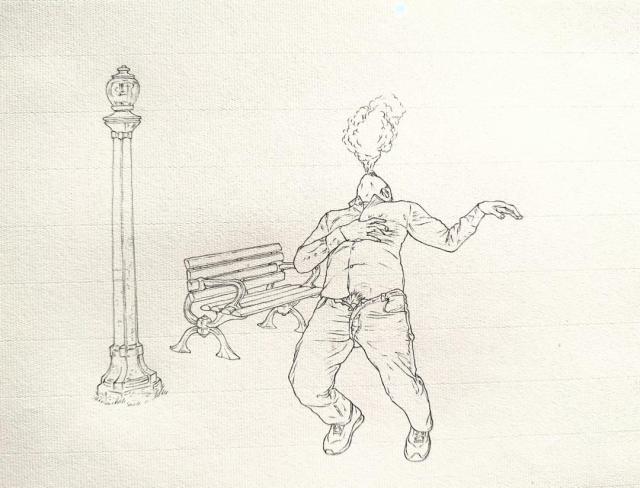
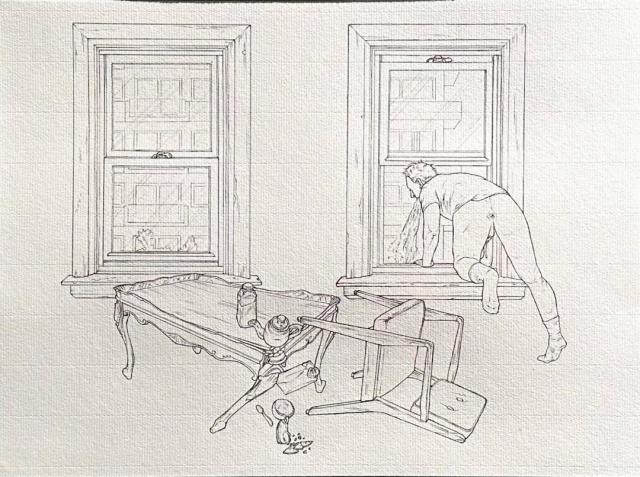
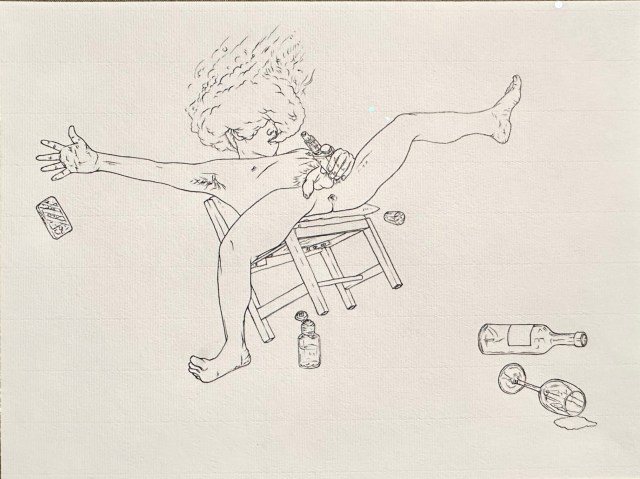
I asked my artist friend, who treated me to the show, what was with the penis drawings? She fluffed it off saying – Oh someone always does a penis thing at all these contemporary art shows. There was no commentary with this installation.
Resa – I had sent you only one of the drawings, which in retrospect I now think is the rudest of all the drawings. It’s is at the end of the slideshow. This way if someone doesn’t want to look, they don’t have to. I think your take on it (and in many ways the entire display) is right on.
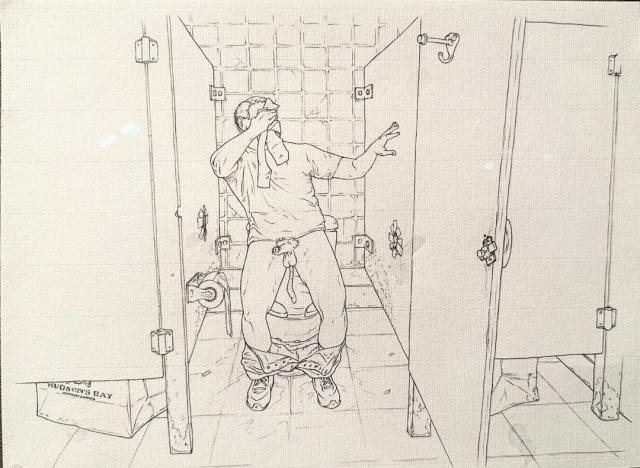
Trent’s Take on the Rudest Pic
Trent – Strange. He doesn’t look like he is wiping his forehead with the toilet paper, it looks like he is using it to hide in shame. The angle is like he is half squatting, half standing, but not sitting. And either he is in the middle of diarrhea or he has very large worms…
Resa – LOL! Still, I’m attempting to be open minded.
Trent – The non-sexual erection may be why he is hiding his face in shame – he has been exposed, the door opened, his “shame” on public display in the now far too, public toilet. There’s not one bit of sexuality despite that his penis is erect, which may be why he is hiding his face in shame.
Resa – Any comments on the other drawings?
Trent – The first and third in the series go very well with the one you sent – the guy is in the same pose, and it is like the same image seen from three different states of mind, or in three parallel universes. In the other two it is smoke, not toilet paper, but still…
OK, the first looks like he just dropped dead of a heart attack. The second he is peeing on the building because he can’t get in – I guess some sort of metaphor, just don’t ask right now. yeah, such is life, you are denying me what I need, but I will just do it anyway, and it will be you who pays. The third, like the first, but with the idea that he may be falling drunk, not dead. OK, puking out the window? No thanks.
Resa – I can’t remember where I read it, but someone said that they did not take pics because they did not want to foul their camera. What do you say to that?
Trent – Lol, I can see why. Although there may be a message and if I looked longer I could find it, I don’t want to look longer! They seem to be provocative just to be provocative.
As to penises, there is so much female full frontal nudity in art, why not male? I don’t think it has to be rude or “in your face”, but there is a place for it – I have both male and female nude paintings in my house.
Of course the art gallery my wife worked with had a lot of gay artists, and yes, a cliche, they liked drawing or painting men more than women. But, yeah, these drawings are not my favorite – I would not want to look at them every day!
Michael Thompson
I sent Trent the first image, again with no info. The anvil is new to Trent. The paintings are oil on canvas.
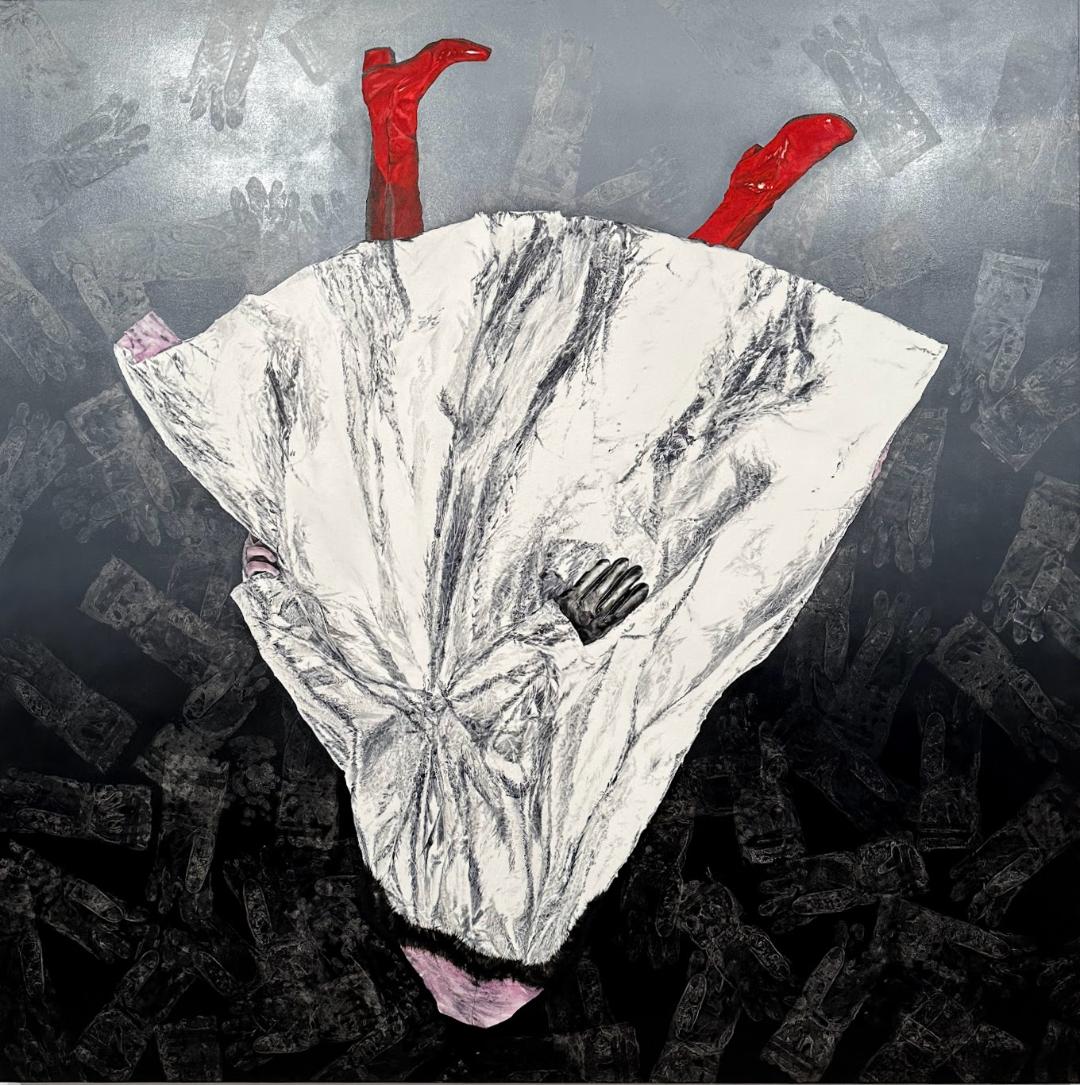
Trent – My first thought was roadkill. A woman in a raincoat squished/flattened into a mud puddle. But, gloves in the background? Hold on. Is there a person there or is it just accessories? Do the accessories make the person and person an illusion in that sea of gloves? The raincoat looks like just a piece of mylar, yet you have to look at it to see that is all it is.


But those accessories – boots, mylar rain coat and gloves, creates the illusion of the person laid out in a puddle of gloves.
Resa – Info offered is a kind of “non-place” & “perhaps even fetishizes objects and their surfaces”. This isn’t ringing any bells for me.
Trent – OK, “non-place” & “perhaps even fetishizes objects and their surfaces”. comes close to my final thought, that it isn’t about the person, it is about the objects, the surface, the image of the person. A lot of fetishes don’t depend on the people but on what I called the accessories in my initial description. These “accessories” are almost a cliche, what people see.
Resa – Okay the anvil has me stumped, almost annoyed. A description says “a place holder” & “present is inherently tied to the past.” Do we still use anvils?

Trent – I can see why you are stumped! “A place holder” – well, something that weighty will certainly hold anything in place! lol. This is an anvil used for doing horseshoes, though the right side does remind me of a hole for a cylinder in an engine block – maybe? Not sure. Yeah, no real thoughts – well done, but “so?”
GB Jones
This is her first time showing these 3 graphite on paper drawings. I had only sent the first one to Trent.

Trent – Nothing jumps out. It is a pretty good print, but not special. The building does look almost ghostly, but no huge first impression – I’ve seen better likenesses and I’ve seen much worse! Will have to wait for more on this one.
Resa – Here are the other 2 from the series.You said, “almost ghostly”? Uncanny!
GB says they are “… studies of haunted buildings” & “critiques social conditions through horror and the grotesque.”
Trent – lol, OK, so “ghostly” it is! I do like the one you sent the best, but I think the train station is cool.
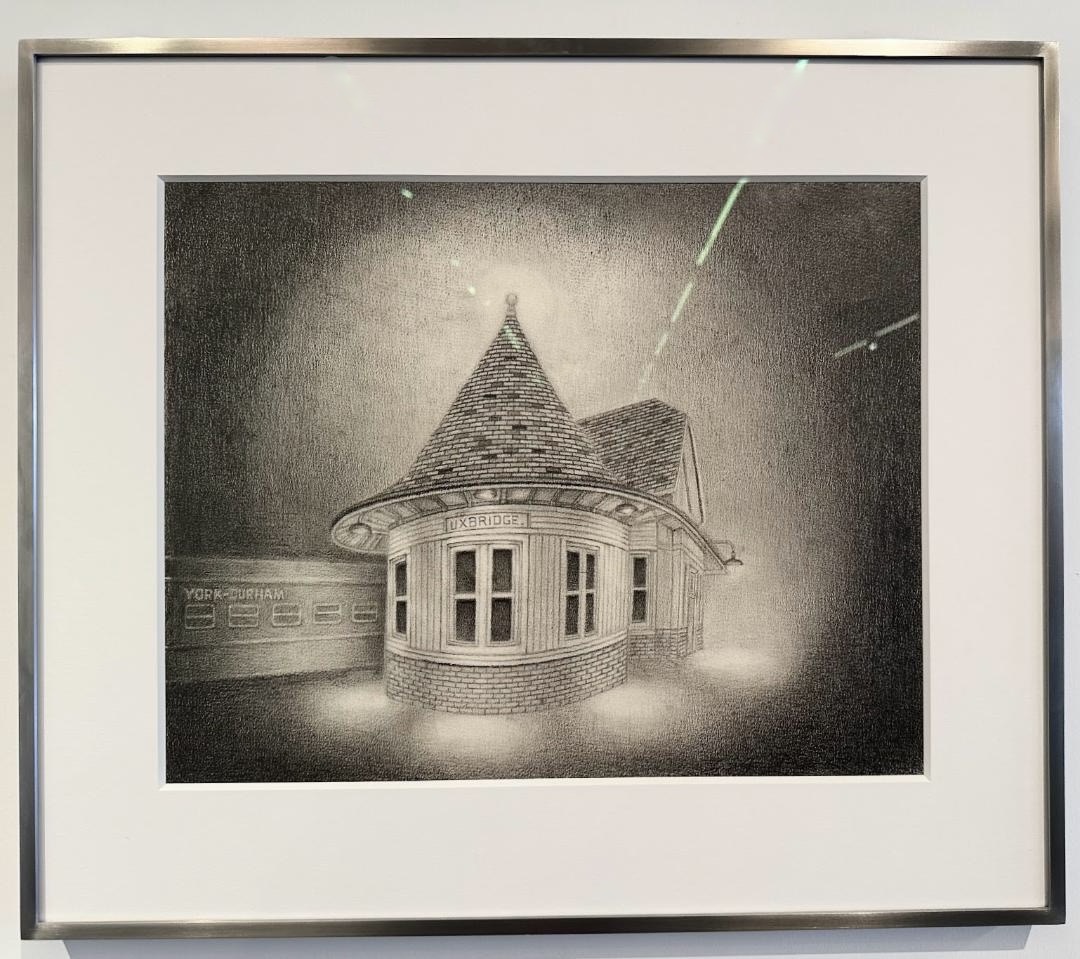
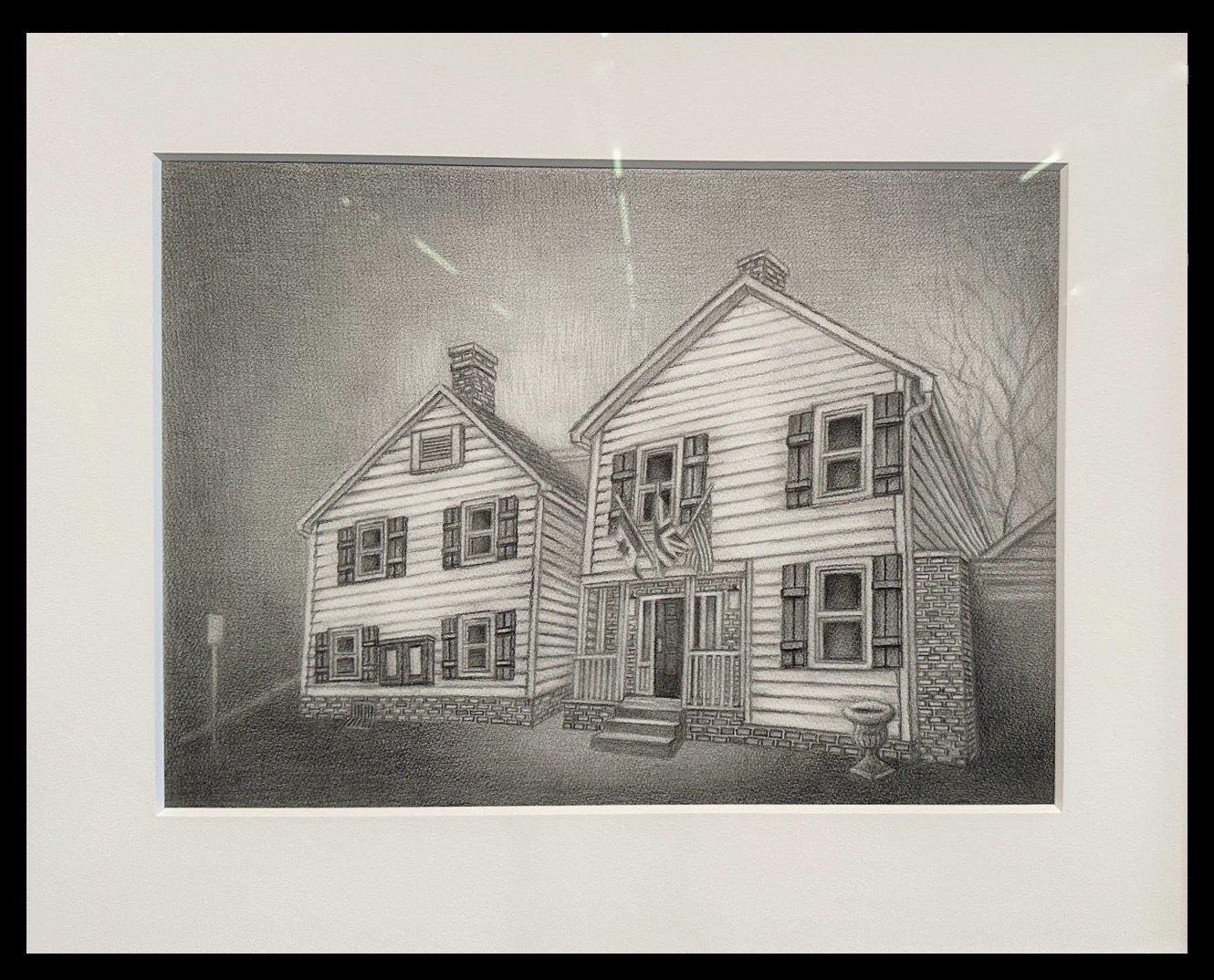
Trent – The prints are well done, but there was nothing until I had that hint that they are haunted, and, yes, they are! I like them better knowing that – it does bring something out, doesn’t it?
Resa – I completely agree with you!
Trent – Strange that these pieces of art are so much better knowing what they are than not.
Catherine Telford Keogh
Following is another image (plus pics of 2 of the plastic boxes) I sent Trent, with no explanation.

Trent – Hmm, very few thoughts. A conveyor in a factory, but what are in those containers? Random letters frozen in plastic or mud? Life keeps coming at us on that conveyor, but what does it contain, what is frozen in the instances?
Resa – Yes, your comment “Life keeps coming at us on that conveyor,” is relevant to what the artist says – “This new work mines the relationship between environmental histories and capitalist industry.”
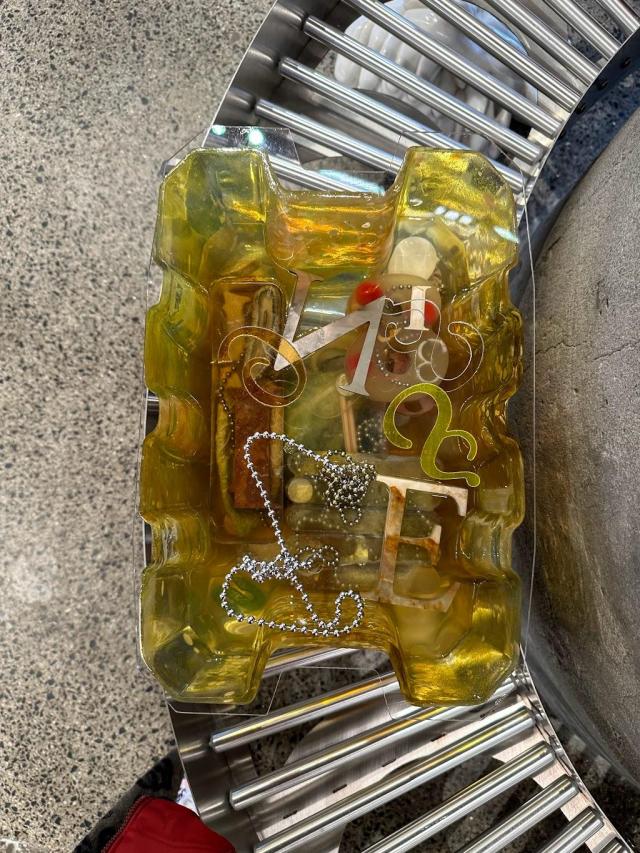
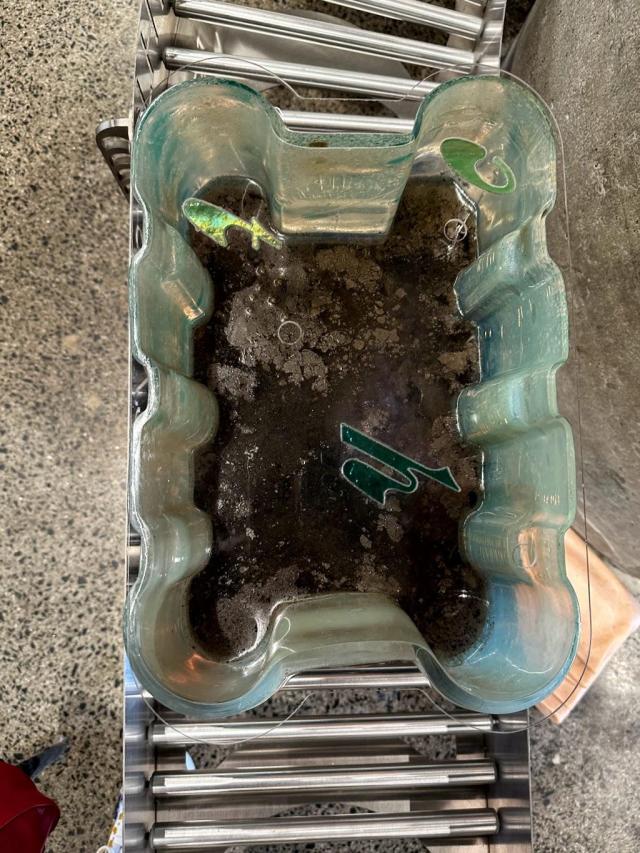
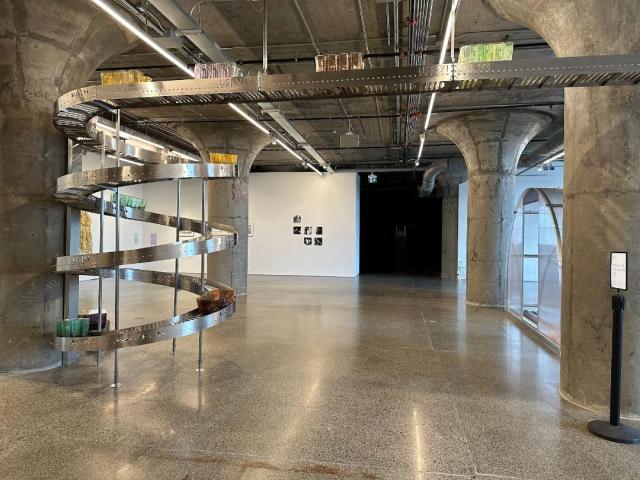

Trent – OK, I get it. If you haven’t seen it, go watch the video for the newer version by Yusuf of his former-self’s (Cat Stephens) song “Where do the children play”. Similar message, different medium. Though the medium is the message, isn’t it? In the case of the conveyor belt, yes, the medium really is the message!
The Medium’s Message
Where do the Children Play – at the beginning the 1970s Cat Stevens is playing guitar, at the end it is the modern Yusuf playing guitar in that band.
Now for some MOCA Music, by Trent
I really could not decide on which I like better for the post. The first is a contemporary classic, the second a full MOCA blow out.
Resa – Trent, thank you so much for joining me in this journey of discovery through some contemporary art!














 Graffiti Lux Art & More
You must be logged in to post a comment.